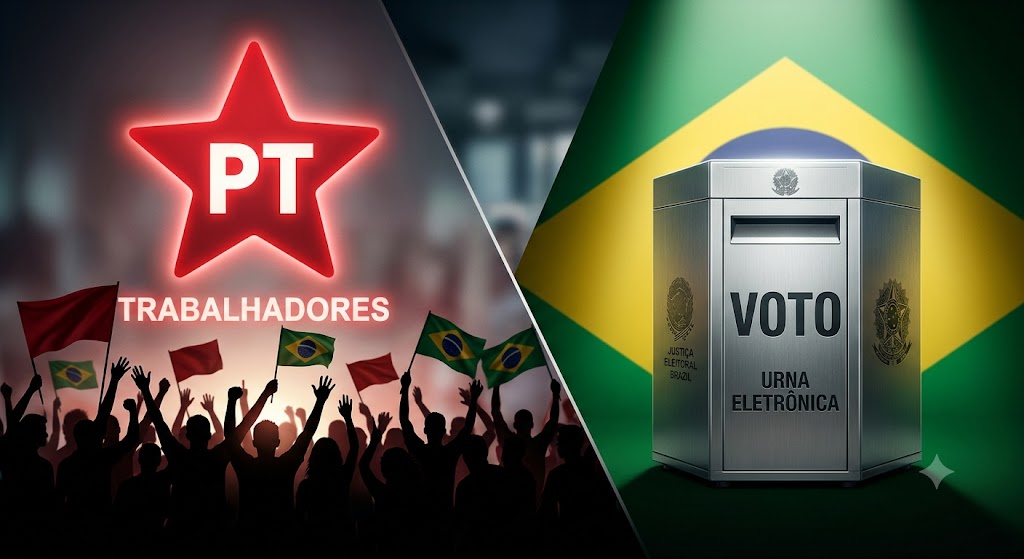
The political landscape of Latin America’s largest economy has once again shifted in dramatic and unexpected ways. Defying almost every major pre-election opinion poll, right-wing Senator Flávio Bolsonaro delivered a stunning performance in the first round of Brazil’s presidential election on Sunday. Finishing ahead of the 80-year-old incumbent President Luiz Inácio Lula da Silva, the younger Bolsonaro has successfully set the stage for a fiercely contested, winner-take-all runoff election scheduled for October 25.
The preliminary results from the electoral court in Brasília paint a picture of a deeply divided nation. With over 97% of the ballots counted, Bolsonaro secured a surprisingly robust 47.45% of the valid votes (translating to roughly 56.1 million votes). Lula, representing the leftist Workers’ Party (PT) and seeking a fourth non-consecutive term, trailed closely behind with 44.66% (approximately 53.8 million votes). Because neither candidate crossed the critical 50% majority threshold required for an outright victory in the first round, the race now heads to a grueling three-week sprint to the finish line.
A Reversal of Expectations
The most significant storyline emerging from Sunday’s vote is the utter failure of traditional polling to capture the silent momentum of the Bolsonaro camp. Up until the eve of the election, most major surveys indicated that Lula held a slight but consistent lead, with some analysts even speculating whether the incumbent could secure an outright first-round victory.
Instead, the results proved that the conservative, right-wing base mobilized by the Bolsonaro family name remains a potent and highly motivated force in Brazilian politics. “Brazil wants change and I am very happy with the results,” a confident Flávio Bolsonaro told reporters at a voting center in Rio de Janeiro.
The 45-year-old senator, representing the Liberal Party (PL), is the eldest son of former President Jair Bolsonaro. His strong showing effectively extends the bitter political rivalry between the left-wing Lula and the right-wing Bolsonaro factions—a rivalry that has dominated Brazilian politics for the better part of a decade. This runoff comes precisely four years after Lula narrowly defeated the elder Bolsonaro in the highly contentious 2022 election. Jair Bolsonaro is currently serving a 27-year prison sentence following a conviction related to a plot to overturn the results of that 2022 race. Unsurprisingly, securing the release of his father and orchestrating his return to the political arena has been a central, highly emotive pillar of Flávio Bolsonaro’s campaign.
The Core Battlegrounds: Economy, Security, and Corruption
As the campaign pivots to the runoff phase, both candidates face the daunting task of courting the moderate voters who backed the 10 other candidates eliminated in the first round.
The defining issues of the campaign thus far have been squarely domestic: a severe affordability crisis, rising living costs, physical insecurity, and the ever-present specter of corruption.
Lula is heavily leaning into his legacy as a champion of the working class. He continues to highlight the extensive social welfare policies that defined his earlier presidencies and credits them with lifting millions of Brazilians out of crushing poverty. However, the incumbent faces significant headwinds. His approval ratings have steadily declined during his current term, largely due to public frustration over the rising cost of living. Furthermore, his administration has been forced to navigate renewed corruption scandals, some of which involve the very Supreme Court justice who previously led investigations against the Bolsonaro family.
Flávio Bolsonaro is aggressively capitalizing on these vulnerabilities. He has hammered the incumbent on the affordability crisis and promised a much harder line against the powerful criminal organizations and drug factions that plague Brazil’s major cities. “Brazil needs change. Brazil can’t stand so much suffering,” Bolsonaro reiterated, presenting himself as the law-and-order candidate capable of revitalizing the sluggish economy.
The Shadow of Washington
Beyond domestic economic anxieties, the election is taking place against a highly volatile geopolitical backdrop, specifically concerning Brazil’s relationship with the United States.
The runoff is shadowed by severe diplomatic tensions between the Lula administration and the US government, currently led by Donald Trump. Lula has publicly accused Washington of attempting to manipulate the Brazilian election in favor of Bolsonaro. These accusations stem from aggressive US measures, including the imposition of tariffs, the unprecedented revocation of the Brazilian ambassador’s visa to Washington, and targeted sanctions against government officials and a Supreme Court justice.
The geopolitical stakes for the October 25 runoff are immense. A victory for Flávio Bolsonaro would likely herald a sharp realignment of Brazilian foreign policy, bringing Brasília back into Washington’s orbit and significantly increasing US influence in Latin America—a region where Trump allies have recently secured electoral victories in Argentina, Colombia, Honduras, and Peru. Bolsonaro has explicitly campaigned on forging better economic deals with the Trump administration, particularly in the strategic rare-minerals sector.
Conversely, a second term for Lula would guarantee that Brazil maintains a defiant distance from Washington. The incumbent has signaled a clear intent to continue deepening economic and diplomatic ties with China, preferring a multipolar approach to global affairs that actively resists US hegemony. This stark contrast in worldview was captured by Rosângela Resende da Rocha, a 69-year-old Lula supporter, who expressed deep anxiety over US influence: “That crazy guy [Trump] wants to come in here to buy our country… He won’t succeed if Lula wins”.
The Three-Week Sprint
As the dust settles on the first round, the momentum undeniably lies with the challenger. Flávio Bolsonaro goes into the runoff as the newfound favorite, bolstered not only by his individual polling upset but also by significant gains made by the conservative bloc in the Brazilian Congress, which will strengthen the right wing regardless of who ultimately wins the presidency.
However, with less than three percentage points separating the two men, the race remains incredibly tight. The winner on October 25 will take the helm of a deeply polarized nation of 214 million people on January 5, 2027. Over the next three weeks, Brazilians must choose not only between two fiercely opposing economic and social visions but also determine whether Latin America’s largest democracy looks toward Washington or Beijing for its future.
* Conceptual illustration generated using AI