
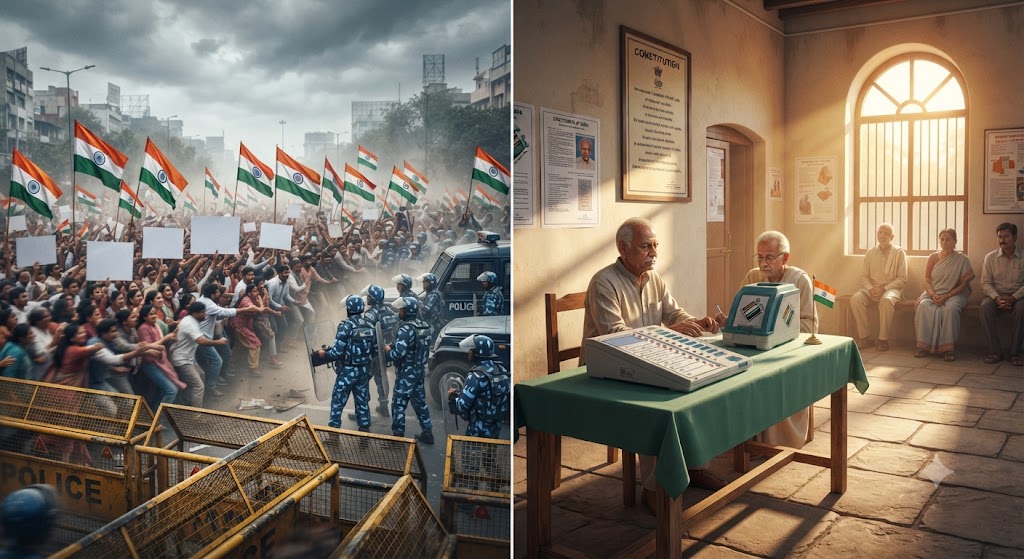
The political atmosphere in New Delhi in October 2026 has reached a boiling point, characterized by heavily barricaded streets, mass detentions, and an unprecedented opposition march to the Supreme Court. However, beyond the immediate logistical chaos lies a fierce, high-stakes battle over political narratives.
Following a massive wave of demonstrations led by the INDIA bloc and civil society groups like the Cockroach Janta Party (CJP), the ruling Bharatiya Janata Party (BJP) has launched a blistering counter-attack. The ruling establishment’s core thesis is stark: the ongoing unrest is not a grassroots democratic movement, but a calculated “regime change” initiative designed to manufacture “Bangladesh-like anarchy”. According to this political perspective, opposition leaders—primarily Rahul Gandhi, Arvind Kejriwal, and the fading Communist bloc—have realized they cannot secure power through the traditional ballot box and are thus attempting to bypass the democratic structure entirely through street-level disruption.
To understand the current paralysis gripping the Indian capital, it is essential to objectively examine this escalating rhetoric, exploring why the ruling party views the opposition’s tactics as manufactured anarchy, and how the opposition justifies its turn to the streets.
The Charge Against Rahul Gandhi: Bypassing the Ballot
At the center of the ruling party’s critique is Congress leader Rahul Gandhi. The BJP has explicitly accused Gandhi and his “entire ecosystem” of attempting to provoke a “Gen Z movement” to orchestrate a regime change.
The foundation of this accusation lies in electoral arithmetic. Critics of the Congress party argue that despite multiple rebranding efforts and nationwide marches, Gandhi has consistently struggled to assemble a national electoral coalition capable of decisively defeating Prime Minister Narendra Modi’s political machinery. From the perspective of the ruling establishment, this electoral ceiling has forced the Congress to change the rules of engagement.
If you cannot win the election, the argument goes, you must delegitimize the election itself. The recent protests, which focus on demanding the resignation of Chief Election Commissioner Gyanesh Kumar over the Special Intensive Revision (SIR) of electoral rolls, are viewed by the BJP through this cynical lens. By constantly pushing the narrative that institutions are compromised and the electoral playing field is rigged, Gandhi is accused of preparing the groundwork for extra-constitutional agitation. BJP spokesperson Pradeep Bhandari crystallized this view, stating that Gandhi’s objective is “not democratic resistance, but appropriation and legitimisation of anarchy”.
This narrative was further fueled when Gandhi and INDIA bloc leaders marched directly to the Supreme Court to file a petition against the Election Commission. The visual of a massive political procession converging on the apex court drew sharp criticism from Chief Justice of India Surya Kant, who noted, “It is unacceptable that this court is seized with a political procession. It should not have happened”. For critics, this confirmed that the opposition prioritizes political optics and institutional pressure over standard legal and parliamentary procedures.
The Left’s Waning Grip and the “Bangladesh” Analogy
The accusation of “manufactured regime change” extends beyond the Congress party, bringing India’s communist and leftist factions into the crosshairs. Historically a potent force in Indian politics, the Left has seen its electoral footprint shrink dramatically over the last decade, losing its traditional strongholds in states like West Bengal and Tripura.
With their conventional political power waning, critics argue that left-wing student unions and activist networks have increasingly turned to hyper-aggressive street agitations to maintain relevance. The BJP seized upon this dynamic during the October protests when Neha Bora, a leader of the communist-affiliated All India Students’ Association (AISA), reportedly expressed inspiration from the recent student-led movement in neighboring Bangladesh, suggesting similar mobilization should happen in India.
For the ruling government, this was a smoking gun. The student protests in Bangladesh successfully toppled a long-standing government, plunging the nation into sudden political transition. By explicitly citing the Bangladesh “andolan” (movement), the BJP argued that the Left’s true aim is not policy reform, but a localized insurrection. When a political faction loses its connection with the broader electorate, the ruling party contends, its only remaining tool is to radicalize the youth and weaponize public disruption.
Arvind Kejriwal, AAP, and Regional Anxieties
The Aam Aadmi Party (AAP) and its leader, Arvind Kejriwal, represent another crucial node in the “manufactured chaos” theory. AAP’s political identity was forged in the fires of the anti-corruption street protests of the early 2010s. However, transitioning from a movement of agitators to a party of governance has presented significant challenges, particularly outside of Delhi.
Political analysts note that AAP’s expansion efforts have faced recent turbulence, and maintaining a grip on complex regional dynamics—such as the volatile political landscape in Punjab—requires immense political capital. When regional governments face anti-incumbency, administrative hurdles, or internal factionalism, opposition parties often seek to deflect regional pressure by escalating a national narrative of victimhood against the central government.
By actively participating in the INDIA bloc’s street-level mobilization and aggressive anti-Election Commission rhetoric, Kejriwal and AAP are accused of reverting to their agitational roots. Critics suggest that when leaders feel their administrative grip loosening or their regional momentum stalling, creating a national spectacle of protest serves as a convenient distraction, rallying the core base by portraying the party as a victim of a centralized, authoritarian regime rather than acknowledging regional governance shortcomings.
The Opposition’s Defense: Institutional Survival
While the ruling establishment paints the protests as a cynical ploy by sore losers, maintaining political neutrality requires examining the opposition’s perspective. For Rahul Gandhi, Arvind Kejriwal, and their allies, the October mobilization is not an attempt to bypass democracy, but a desperate effort to save it.
The opposition’s central grievance revolves around the SIR process, which they allege has resulted in the deletion of up to 13 crore (130 million) voters from electoral rolls, disproportionately affecting minority communities and traditional opposition voters.
From the INDIA bloc’s viewpoint, the BJP has systematically captured the neutral arbiters of Indian democracy—most notably, the Election Commission. If the electoral rolls are manipulated and the referees are perceived to be compromised, the opposition argues that waiting for the next ballot box is equivalent to participating in a rigged game.
In this context, taking to the streets is framed as a constitutional duty. Rahul Gandhi has repeatedly insisted that the fight is to restore the democratic process. The opposition views the government’s heavy-handed response—including the deployment of 23,000 security personnel, the closure of 45 metro stations, and the denotification of Jantar Mantar as a protest site—as proof that the state is terrified of accountability. They argue that the BJP’s quickness to label any mass dissent as “anarchy” or “regime change” is a classic authoritarian tactic designed to criminalize legitimate political opposition.
A Dangerous Polarization
The current political standoff on the streets of New Delhi highlights a severe, perhaps unprecedented, crisis of trust within the Indian democratic system.
When the ruling party views massive public demonstrations not as an expression of civic grievance, but solely as an illegal “regime change” operation orchestrated by electorally defeated rivals, the space for dialogue collapses. The state becomes highly militarized in its response to dissent, viewing protesters not as citizens, but as existential threats to national stability.
Conversely, when the opposition views every electoral defeat and administrative process as proof of deep-state manipulation and institutional capture, they risk exhausting the public with constant outrage. If every political disagreement is elevated to an existential battle for the survival of the Constitution, the essential democratic mechanism of peaceful legislative debate breaks down.
Ultimately, the health of a democracy relies on mutual consent. The winners must allow space for vocal, disruptive dissent without immediately labeling it treasonous anarchy. Simultaneously, the losers must engage with the institutional framework, accepting that not every setback is the result of a stolen mandate. As the Supreme Court attempts to untangle the legal battles surrounding the Election Commission and the right to protest, the political rhetoric continues to escalate, leaving the Indian electorate caught in the crossfire of two mutually exclusive realities.
* Conceptual illustration generated using AI