
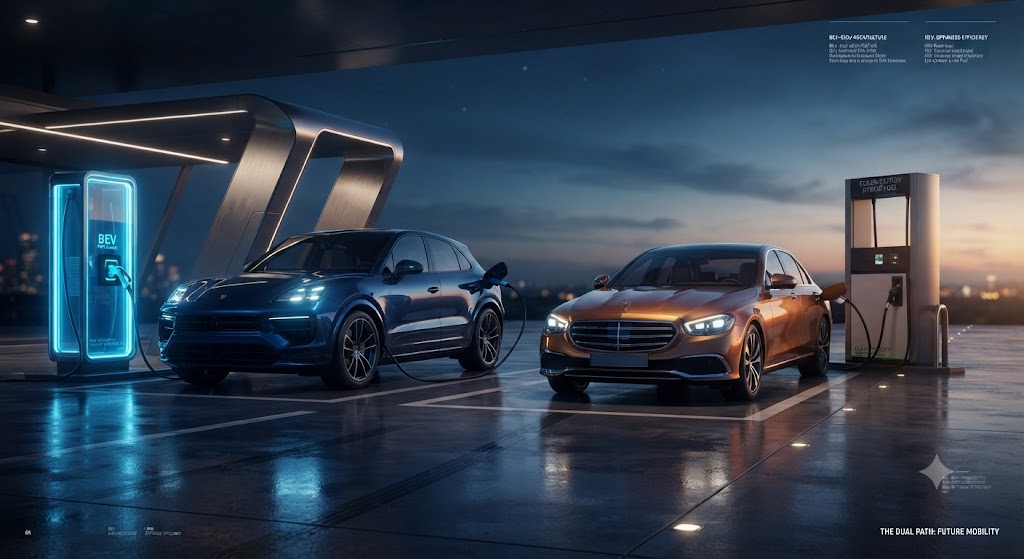
As we navigate the final quarter of 2026, the automotive industry has firmly moved past the theoretical phase of the green transition. The internal combustion engine (ICE) is gradually stepping aside, but the real battle for the future of mobility is no longer gas versus green. Instead, it is a fierce, highly nuanced competition between Battery Electric Vehicles (BEVs) and Hybrid Electric Vehicles (HEVs).
What makes the 2026 market particularly fascinating is the emergence of a new demographic driving these sales: the second-time alternative energy buyer. These are consumers who adopted early hybrid or electric technology half a decade ago and are now re-entering the market. Unlike first-time buyers who are often driven by novelty, tax incentives, or environmental idealism, second-time buyers are heavily pragmatic. They are evaluating their next purchase based on real-world charging experiences, long-term maintenance costs, battery degradation, and daily commuting realities.
Interestingly, the data shows that both EVs and Hybrids are receiving phenomenally good responses from these veteran buyers, but for very different reasons. Depending on the geographical market and the buyer’s lifestyle, hybrids and EVs are locking horns in a battle for supremacy that is radically reshaping automaker strategies.
The Rise of the Educated “Second-Time Buyer”
To understand why hybrids and EVs are competing so closely, we must examine the psychology of the second-time buyer in 2026.
For many early EV adopters who bought their cars around 2019 or 2020, the reality of public charging infrastructure has been a mixed bag. While home charging remains a massive convenience for homeowners, those who rely on public networks or frequently embark on long cross-country road trips have experienced “charger anxiety”—the frustration of broken charging stalls, long queues, or slower-than-advertised charging speeds. For a segment of these second-time buyers, the plug-in hybrid (PHEV) or strong hybrid has become the perfect compromise, offering electric efficiency in the city without the highway hassle.
Conversely, early hybrid owners are experiencing the exact opposite phenomenon. Having lived with a self-charging hybrid for five years, they have grown accustomed to regenerative braking and silent, low-speed electric cruising. For these buyers, making the full leap to a Battery Electric Vehicle (BEV) feels like a natural, risk-free upgrade. They are trading in their hybrids for next-generation EVs with 500+ kilometer ranges, motivated by the desire to eliminate oil changes, reduce moving parts, and capitalize on the massive expansion of domestic charging ecosystems.
The Global Perspective: The Hybrid Resurgence
If we look at the global market, particularly in North America, hybrids are experiencing an unexpected and massive resurgence. Car buyers have firmly chosen hybrids, leaving some automakers who went “all-in” on EVs scrambling to adjust their production lines.
For the first nine months of 2026, hybrid sales in the United States surged by 24 percent compared to the previous year. In a staggering shift, hybrid vehicles captured a record 15.9% of new vehicle retail sales in July 2026, while pure EV market share actually slipped to around 7%.
Why is the second-time American buyer retreating to hybrids? It comes down to pure affordability and fuel economy. A recent industry study revealed that fuel economy remains one of the top factors for non-luxury buyers. Automakers like Ford have capitalized on this beautifully. The Ford Maverick Hybrid, which achieves nearly 40 mpg combined, is flying off dealership lots, offering families savings of up to $900 a year on fuel. Even larger utility vehicles, like the hybrid Ford F-150, are offering 25 to 26 mpg combined, saving owners around $450 annually compared to traditional V8 models. For the pragmatic second-time buyer, a hybrid offers immediate financial returns without requiring a change in fueling habits.
The Indian Reality: The EV Takeover
However, the narrative flips entirely when we look at one of the world’s most critical emerging auto markets: India. In the subcontinent, electric cars are significantly outpacing strong hybrids, proving that Indian consumers are confidently bypassing the hybrid stepping-stone and diving straight into full electrification.
During the first half (H1) of 2026, electric passenger vehicles recorded a massive 1,48,023 retail sales in India, representing a blistering 79% year-on-year growth. In stark contrast, strong hybrid vehicles registered only 57,885 units during the same period. This means that Indian buyers purchased approximately 2.56 electric cars for every single strong hybrid vehicle sold in H1 2026.
Even more striking is the stagnation of the Indian hybrid market. While EVs grew by nearly 67% in volume among the top 20 models, strong hybrid sales saw almost zero growth, increasing by a mere 38 units compared to H1 2025.
Product Diversity vs. Extreme Concentration
The divergence in EV and Hybrid success in India comes down to product diversity and market concentration. Second-time buyers want choices, and the EV market is finally delivering.
The Indian EV sector is evolving into a broad, multi-brand industry. Growth is being driven by a deep bench of manufacturers including Tata, Mahindra, and Maruti Suzuki. The best-selling EV, the MG Windsor, accounted for roughly 13% of the total electric passenger vehicle market, moving over 19,000 units. Because demand is spread across multiple successful products and price points, the EV market is structurally robust.
Hybrids present the exact reverse picture. The Indian hybrid market is essentially a one-brand show dominated by Toyota. The Innova Hycross and the Urban Cruiser Hyryder are exceptional individual successes; the Innova Hycross individually outsells every single EV model in the country with over 27,000 units sold in H1 2026. Together, these two Toyota models generated roughly 80.1% of India’s entire strong-hybrid sales.
While Toyota’s dominance proves that there is a massive appetite for reliable, highly efficient hybrid family haulers, the lack of competition is the hybrid segment’s greatest weakness. Indian buyers haven’t necessarily rejected hybrids; they simply have far more EVs to choose from across different segments and price brackets.
The Path Forward: Coexistence and Multi-Powertrain Platforms
As we look toward 2027, the line between EV and Hybrid manufacturers will continue to blur. Automakers recognize that second-time buyers are not deeply loyal to a specific powertrain; they are loyal to whatever technology best suits their evolving lifestyle and budget.
To adapt, the industry is pivoting toward “Multi-Powertrain Vehicle Platforms.” Instead of designing a chassis exclusively for a gas engine or exclusively for a battery, automakers are developing flexible architectures. For instance, JSW MG Motor is slated to introduce two new-energy SUVs in FY27 based on its new ADAPT platform. This flexible architecture is engineered to support Battery Electric Vehicles (BEVs), Plug-in Hybrids (PHEVs), and Hybrid Electric Vehicles (HEVs) all on the same assembly line. This strategy drastically reduces R&D costs and allows manufacturers to dynamically shift production between hybrids and EVs based on real-time consumer demand.
Furthermore, localization will play a massive role in reducing the cost of both technologies. Automakers in emerging markets are aggressively localizing the production of battery packs, electric motors, and power electronics. This localization shields manufacturers from global supply chain shocks and ensures that the long-term affordability of both hybrids and EVs will continue to improve, drawing even more middle-class buyers into the fold.
Conclusion
The 2026 automotive market proves that the transition away from fossil fuels is not a one-size-fits-all journey. Hybrids and Electric Vehicles are fiercely competing for the attention of the educated, second-time buyer, and both are securing massive victories in different arenas. In markets where charging infrastructure lags or highway distances are vast, hybrids are enjoying a golden era of record market share. In rapidly developing markets like India, where urban commuting dominates and EV product diversity is exploding, pure electrics are leaving hybrids in the dust.
Ultimately, this competition is a massive win for the consumer. With automakers forced to innovate on both fronts, the second-time buyer of 2026 has unprecedented access to vehicles that are cleaner, cheaper to run, and better engineered than ever before.
* Conceptual illustration generated using AI