
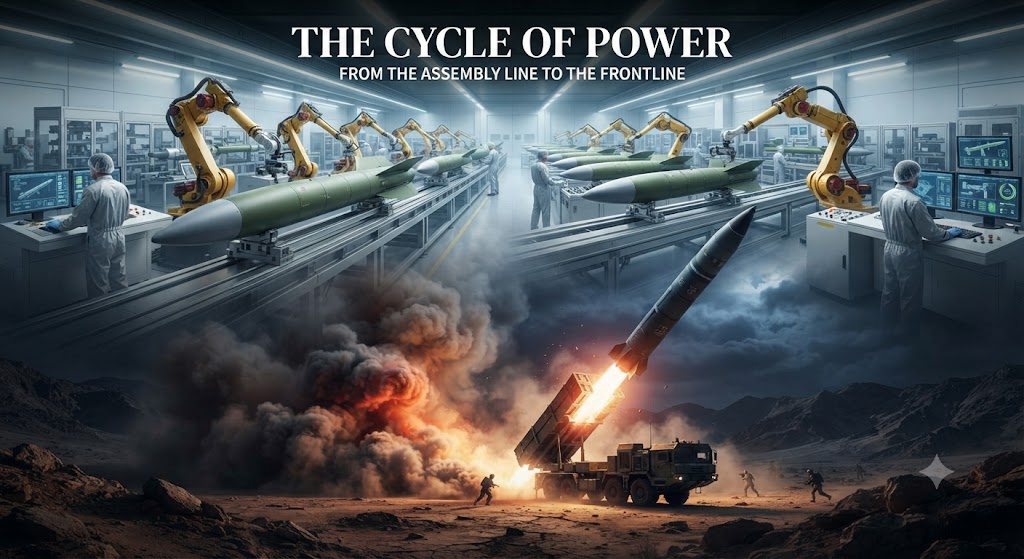
Across the globe, from the entrenched frontlines of Eastern Europe to the volatile airspace of the Middle East, a relentless barrage of artillery, drones, and precision missiles is reshaping the geopolitical landscape. However, beneath the chaotic fog of war and the high-minded diplomatic rhetoric lies a stark, deeply entrenched industrial reality. The world is rapidly firing and exhausting its existing military arsenals, creating an unprecedented vacuum. This systematic depletion is not just a byproduct of war; it is the catalyst for the most massive rearmament and defense procurement cycle since the height of the Cold War.
As aging stockpiles are cleared out on the battlefield, massive geopolitical space—and budgetary capital—is being made for next-generation weaponry. But a critical question remains: As the fires of conflict burn in Ukraine and the Middle East, who are the architects of this arsenal, and who is profiting from a global supply chain that seemingly requires perpetual instability to thrive?
The Theaters of Depletion: Ukraine and the Middle East
The mechanics of the modern arms boom can be observed in two primary theaters of conflict.
In Eastern Europe, the war in Ukraine has evolved into a grinding war of industrial attrition. To sustain Kyiv’s resistance, a formidable coalition comprising the United States, the European Union, Australia, and Japan has funneled billions of dollars worth of military hardware into the country. However, much of the equipment initially sent—from older artillery shells and early-model armored vehicles to legacy air defense systems—represented the clearing out of aging Western inventories.
By sending these older stocks to the frontlines, allied nations have effectively “purged” their arsenals. This creates a critical domestic vulnerability that must instantly be filled with newer, more advanced, and significantly more expensive systems. The war has essentially become a clearinghouse for late-20th-century technology, paving the way for lucrative domestic defense contracts to build 21st-century replacements.
Simultaneously, the escalating conflict in the Middle East has created an entirely different paradigm of consumption: the “interception economy.” With Iran, Saudi Arabia, Israel, and various proxy groups heavily engaged, the region’s skies are a constant theater of missile and drone warfare. When a relatively inexpensive, mass-produced Iranian or Houthi drone is intercepted by an advanced, multi-million-dollar Western surface-to-air missile, the economic victory belongs to the defense contractor. The rapid expenditure of highly sophisticated interceptors like the Patriot or THAAD (Terminal High Altitude Area Defense) systems guarantees that defense production lines will remain hot for years just to restore baseline operational capacity.
The Architects of the Arsenal: Who is Supplying the World?
The entities supplying these weapons and stocking up global arsenals are the multinational defense conglomerates—the “primes.” The scale of their current financial success is staggering, driven entirely by the global rush to modernize and replenish.
According to data reported by the Stockholm International Peace Research Institute (SIPRI), the combined revenues from the sales of arms and military services by the world’s 100 largest arms-producing companies surged to a record $679 billion in 2024. As we navigate 2026, those numbers have only accelerated.
The financial data from the second quarter of 2026 paints a picture of an industry operating at absolute maximum capacity:
- The Trillion-Dollar Backlog: The demand for new weapons is vastly outpacing the industry’s ability to build them. According to a midyear outlook, the five largest U.S. defense primes closed fiscal 2025 with an astonishing $1.36 trillion in combined backlog, representing a 23.7% increase.
- RTX Corporation (Raytheon): In Q2 2026, RTX posted massive top and bottom-line growth, heavily driven by its defense segment. Sales for Raytheon hit $8.3 billion for the quarter, up 18% year-over-year. This surge was directly attributed to the high volume of land and air defense systems currently being depleted globally, including the Patriot system and the AMRAAM (Advanced Medium-Range Air-to-Air Missile). RTX closed the quarter with a total backlog of $289 billion.
- Lockheed Martin: The aerospace giant saw its Q2 2026 sales rise 11% year-over-year to $20.1 billion. The sheer volume of incoming orders is staggering; in a single quarter, Lockheed received $65 billion in new orders. The most notable was a massive $35 billion multi-year contract for the THAAD anti-ballistic missile system—a direct response to the escalating missile threats in the Middle East. Lockheed’s backlog now sits at a record $230 billion.
- GE Aerospace: Powering the fighter jets and helicopters of the global fleet, GE Aerospace saw its Defense & Systems revenue rise 12% in Q2 2026, securing major international contracts with Turkish Aerospace and the UK Ministry of Defence.
The Global Supply Chain Shift
The unprecedented demand is not just enriching American corporations; it is fundamentally altering global supply chains. Because the primary U.S. and European defense contractors cannot build weapons fast enough to meet the demand of Ukraine, the Middle East, and the looming Indo-Pacific arms race, they are aggressively outsourcing.
India, traditionally one of the world’s largest arms importers, is rapidly transforming into a crucial node in the global defense supply chain. India’s domestic defense production reached ₹1.78 lakh crore in FY26, and crucially, its defense exports hit a record ₹38,424 crore. Indian firms are stepping up to fill the global manufacturing void. For instance, Sigma Advanced Systems has evolved into a Tier-1 global firm, securing a ₹3,800 crore long-term agreement with Rolls-Royce, and subsequently adding another ₹1,600 crore contract to supply complex engine structures. By shifting manufacturing to regions with lower economic costs but high technical capabilities, the global defense industry ensures it can continuously pump out the hardware required to keep global arsenals fully stocked.
The Profitability of Perpetual Conflict
The current state of the global defense industry raises profound ethical and geopolitical questions. When the top five defense companies hold a $1.36 trillion backlog, there is an inherent, structural economic incentive for that backlog to be converted into active production.
The military-industrial complex operates on a cycle of consumption. Weapons are not built to sit indefinitely in warehouses; they are built with the expectation of use or obsolescence. The ongoing conflicts in Ukraine and the Middle East are serving as the ultimate consumption mechanism. By firing off older arsenals, nations justify astronomical new defense budgets. The US, EU, Australia, and Japan are locked into a cycle where providing security assistance abroad necessitates massive domestic procurement contracts at home.
In this paradigm, peace is terrible for business. A sudden, total cessation of hostilities in Eastern Europe and the Middle East would lead to the cancellation of multi-billion dollar contracts, the collapse of record-high defense stock valuations, and the stalling of massive supply chain expansions. The defense sector requires the threat of conflict to secure funding, but it requires actual conflict to clear out the old stock and drive the hyper-growth seen in 2026.
Conclusion
The world is currently caught in a dangerous, self-sustaining loop. Nations are firing their arsenals, clearing space in their bunkers and their budgets for the next generation of warfare. As long as the missiles fly over Kyiv and Riyadh, the production lines in Texas, London, and Hyderabad will run 24/7. The defense primes are ensuring that the world’s militaries are stocked, supplied, and ready. But with trillions of dollars tied up in the business of war, the ultimate casualty may be the geopolitical will to actually forge a lasting peace.
* Conceptual illustration generated using AI