
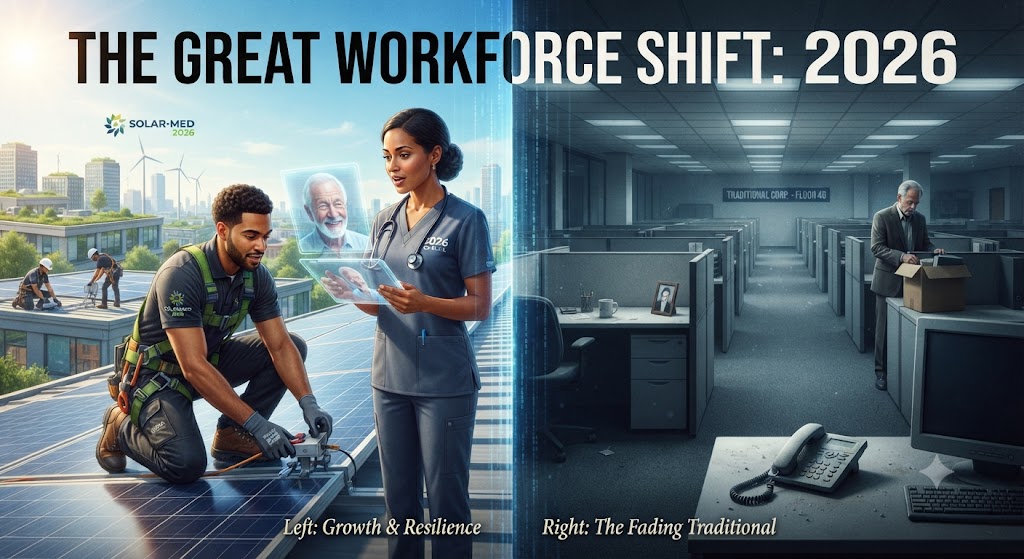
As we navigate the final quarter of 2026, the global labor market presents a profound paradox. On one hand, overall recruitment activity is facing severe headwinds, with major economies experiencing double-digit drops in job postings. On the other hand, a select group of hyper-specialized sectors is experiencing unprecedented, explosive growth, creating a highly polarized “two-track” economy.
If you are a professional trying to navigate this landscape, or a student deciding on a career path, understanding this divergence is critical. The era of the generalist is fading; employers are laser-focused on specific, durable capabilities. Here is a comprehensive, data-driven look at the sectors where jobs are in massive demand, the occupations that are declining rapidly, and what it all means for the future of work.
The Big Picture: A Global Hiring Slowdown and the Entry-Level Squeeze
Before diving into specific occupations, it is essential to understand the macroeconomic backdrop of late 2026. A recent Global Job Market Trends report by Bain & Company revealed that hiring demand weakened considerably across major markets, industries, and business functions between April and June.
The geographic distribution of this slowdown is uneven but widespread. Among major economies, France saw the steepest fall in job postings at 40%, followed by Brazil at 39%, the Netherlands at 33%, Germany at 27%, and the United States at 23%. Even traditionally resilient markets like India saw a 5% year-over-year decline in job postings.
However, the most alarming metric for the upcoming workforce is the sharp contraction in entry-level hiring. Junior and entry-level positions—which account for roughly 95% of all job postings—declined by 11% year-over-year globally in the second quarter of 2026. Employers are increasingly hesitant to invest in training fresh graduates, preferring to hire seasoned professionals who can deliver immediate ROI, or utilizing automation to handle tasks previously assigned to junior staff.
The Boom Sectors: Where Demand is Skyrocketing
Despite the broader economic slowdown, several sectors are desperate for talent. According to recent projections from the Bureau of Labor Statistics (BLS) and employment platforms like Simplify, the fastest-growing careers in 2026 are heavily concentrated in renewable energy, advanced healthcare, artificial intelligence, cybersecurity, and skilled technical trades.
1. Healthcare and Health Services
The healthcare and social assistance sector continues to be an unstoppable employment engine, driven largely by aging global populations and the expansion of preventative care models. The BLS projects this sector will add more jobs than any other through 2033.
- Nurse Practitioners: This role is experiencing a massive 40% growth rate, projected to add over 118,000 jobs to the economy. With master’s degrees and specialized licensure, NPs are increasingly taking on primary care responsibilities.
- Medical and Health Services Managers: Growing at 23% and adding approximately 62,100 openings annually, these professionals manage the complex business, compliance, and technological operations of hospitals and clinics.
- Specialized Technicians and Assistants: Roles like Physical Therapist Assistants (up 23%) and Psychiatric Technicians (up 22.3%) are seeing a massive surge as therapeutic and mental health interventions become more widely accessible.
2. Renewable Energy
As climate change mitigation moves from theoretical targets to aggressive, legally mandated infrastructure builds, the renewable energy sector has claimed the top spots for percentage growth.
- Wind Turbine Service Technicians: With a staggering 50% projected growth rate, this is officially one of the fastest-growing occupations in the country. While the total volume of jobs is smaller (about 2,300 openings annually), the velocity of demand is unmatched.
- Solar Photovoltaic Installers: Growing at 42%, this role requires high school education plus technical training, offering a highly accessible entry point into the lucrative green economy.
3. Artificial Intelligence, Data, and Cybersecurity
While traditional tech roles have cooled, specialized data and security functions remain red-hot. Strikingly, global AI job postings reached approximately 351,000 in the second quarter of 2026, marking a 60% increase from a year earlier.
- Data Scientists: Growing at 34%, organizations are desperate for professionals who can clean, analyze, and structure the massive datasets required to train enterprise AI models.
- Information Security Analysts: With cyber threats escalating, employment in this sector is projected to grow 29%, generating roughly 16,000 openings per year as companies rush to protect their digital infrastructure. Job postings in computer and network security have independently increased by 19% recently.
4. The Skilled Trades
We are witnessing a cultural and economic renaissance for skilled technical work. As older generations retire and digital infrastructure requires physical installation, trades are booming. Electricians, for example, are projected to grow by 9%, generating a massive 81,000 openings annually.
The Bust Sectors: What is Declining Rapidly
The 2026 job market is ruthless toward occupations centered on repetitive data processing, general administration, and outdated outreach methods. While automation and generative AI have not caused mass unemployment, they have systematically eroded specific functions.
1. Traditional Corporate White-Collar Roles
The corporate landscape is aggressively trimming its fat. Several traditional business functions recorded double-digit declines in job postings in mid-2026.
- Research, Design, and Development: Postings saw a steep 37% fall. Much of the foundational ideation and basic research is now being augmented by AI tools.
- Sales and Marketing: Down 32%. Automated marketing funnels, algorithmic ad buying, and AI-driven CRM platforms have significantly reduced the need for massive human marketing teams.
- Strategy and Analytics: Dropping by 27%. The democratization of data visualization tools means executives no longer need an army of analysts to interpret basic business metrics.
- General Administrative and IT: Traditional Information Technology roles fell 25%, and general administrative positions dropped 13%.
2. Routine and Outbound Service Roles
Jobs reliant on cold outreach and basic customer interactions are fading rapidly.
- Telemarketers: Projected to decline by an astounding 21%, telemarketing is one of the fastest-fading occupations nationwide. As FinanceBuzz points out, consumers heavily ignore unknown calls, and digital marketing provides vastly more efficient conversion pathways.
- Data Entry and Basic Customer Service: Roles focused entirely on manual data transcription or tier-1 customer support are continuing to decline as Optical Character Recognition (OCR) and sophisticated AI chatbots take over the bulk of the workload.
Navigating the 2026 Reality
The defining takeaway from the 2026 labor market data is that “growth” is no longer evenly distributed across the economy. A rising tide is no longer lifting all boats.
If you are currently in a declining field, such as traditional marketing or general administration, the writing is on the wall: you must pivot. The good news is that the booming sectors offer diverse entry points. You do not necessarily need a Ph.D. to thrive in the new economy; a master’s degree can make you a highly paid Nurse Practitioner, a bachelor’s degree is sufficient for Information Security, and a simple high school diploma combined with a technical apprenticeship can guarantee a lucrative career as a Solar PV Installer or Electrician.
The future belongs to the specialized. In 2026, the job market rewards those who either build the technology (AI and Cybersecurity), install the physical infrastructure of the future (Renewable Energy and Trades), or provide the deeply human touch that machines cannot replicate (Advanced Healthcare).
* Conceptual illustration generated using AI