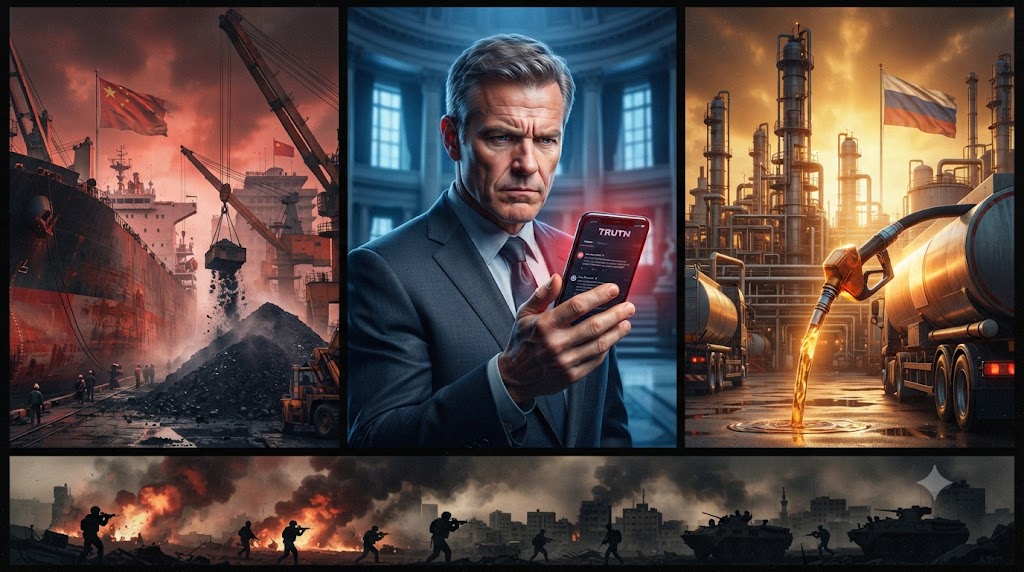
As the devastating war between the United States, Israel, and the Islamic Republic of Iran stretches into its eighth month, U.S. President Donald Trump has forcefully pushed back against mounting allegations that Moscow and Beijing are covertly aiding Tehran. In a characteristically blunt statement, the President dismissed the concerns as politically motivated fabrications, insisting that both Russia and China have “too much to lose” by intervening in the escalating Middle Eastern conflict.
The President’s remarks arrive at a highly precarious moment in global geopolitics. With the strategic Strait of Hormuz essentially paralyzed since the outbreak of direct hostilities on February 28, 2026, global energy markets are in extreme distress. Yet, rather than confronting Washington’s two primary superpower rivals over their potential involvement in the proxy warfare, Trump is actively deepening economic and energy ties with both Vladimir Putin and Xi Jinping. This apparent contradiction underscores a defining feature of the Trump administration’s foreign policy: a transactional “America First” realpolitik that prioritizes domestic economic victories over complex global containment strategies.
The Truth Social Declaration
The latest controversy ignited on Monday, October 12, when President Trump took to his social media platform, Truth Social, to address the swirling rumors regarding foreign interference in the Iran war. The President took direct aim at his domestic political opponents, whom he accused of manufacturing the narrative to undermine his diplomatic engagements.
“I see so many comments from the Radical Left Morons and Lunatics that China and Russia are helping the ‘wonderful’ Islamic Republic of Iran,” Trump wrote. “If they are, it’s at a very low level, but I don’t believe they are at all. They have too much to lose, and we would know about it, and know about it very fast!”
Trump’s assertion that any aid is “at a very low level” or non-existent stands in stark contrast to several recent, highly concerning reports from independent defense analysts and global media outlets. Just last month, the Financial Times reported that Russian specialists had been actively working with Iranian defense officials to advance Tehran’s cruise missile technology. Furthermore, numerous defense think tanks have warned that Chinese and Russian entities may be supplying Iran with satellite intelligence to help the Islamic Republic target U.S. troops and regional assets.
For the President, however, these reports are secondary to his personal assessments and his direct lines of communication with foreign leaders. His overarching argument is one of pragmatic deterrence: because the U.S. market and its global financial leverage are so essential to both China and Russia, neither nation would risk a catastrophic economic rupture simply to aid Tehran in a regional war.
The Moscow Connection: Diesel Diplomacy in a Crisis
To fully understand Trump’s reluctance to accuse Russia of arming Iran, one must look at the severe energy crisis currently gripping the United States. The war with Iran has effectively closed the Strait of Hormuz, cutting off a massive artery of the global oil and gas supply chain. This closure has sent domestic fuel prices soaring right before the crucial November 2026 midterm elections.
In this context, Vladimir Putin is not just a geopolitical rival; he is a vital economic lifeline. Trump’s defense of Russia directly follows a highly consequential, 90-minute phone call with the Russian President. According to Russian Presidential Aide Yuri Ushakov, the conversation was “very substantive” and friendly, heavily focused on energy supplies.
Immediately following this call, Trump announced a massive bilateral energy deal. Bypassing years of established sanctions frameworks, Trump revealed that Russia would immediately supply more than 300,000 tonnes of diesel fuel to American and global markets, with millions more tonnes promised in the coming months.
By explicitly waving through Russian diesel to lower prices at the American pump, Trump has tied his administration’s short-term domestic success directly to Moscow’s energy sector. Publicly accusing Putin of supplying cruise missile technology to Iran—the very nation the U.S. is currently fighting—would make this diesel arrangement politically toxic. Therefore, dismissing the intelligence reports becomes a political necessity to preserve the energy deal that Trump hopes will save his party in the midterms.
The Beijing Summit: Prioritizing Coal and Commerce
A similar transactional dynamic is at play regarding Beijing. Trump’s refusal to implicate China in the Iranian war effort follows a highly successful diplomatic summit with Chinese President Xi Jinping.
In September 2026, Xi Jinping undertook a three-day visit to Washington D.C., marking his second face-to-face meeting with Trump in less than six months. The U.S. President described the high-stakes summit as one focused on “friendship, strength, and success.” The centerpiece of this diplomatic engagement was not a hardline discussion on human rights or regional security, but the operationalization of the U.S.-China Board of Trade and the U.S.-China Board of Investment, which had been established earlier in the year.
Crucially, the summit yielded a massive win for Trump’s blue-collar base. According to official fact sheets released by the administration, China agreed to import at least 10 million metric tonnes of U.S. coal across 2027 and 2028.
Just as with Russia, Trump views his relationship with China through a purely economic lens. Securing a massive export deal for the American coal industry is viewed as a tangible, defining victory of his second term. Accusing Beijing of providing intelligence or logistical support to Iran would instantly derail these newly established trade boards and jeopardize the coal contracts. For Trump, the promise of Chinese capital flowing into American mining towns far outweighs the murky, unconfirmed reports of Chinese tech entities operating in the shadows of Tehran.
A Disconnect with the Defense Establishment
While President Trump appears entirely comfortable compartmentalizing his foreign policy—fighting a war with Iran while simultaneously cutting massive trade and energy deals with Iran’s two most powerful global partners—the U.S. defense establishment is reportedly deeply unsettled.
The strategy relies on a massive assumption: that Putin and Xi view global politics through the same transactional, financially motivated lens that Trump does. Trump argues they have “too much to lose” economically. However, geopolitical analysts point out that for both Russia and China, bogging the United States military down in a protracted, expensive, and highly destructive war in the Middle East is an incredibly lucrative strategic outcome.
If the U.S. is spending billions of dollars and deploying vital naval assets to the Persian Gulf to fight Iran, those resources are inherently not being used to counter Russian ambitions in Eastern Europe or Chinese expansionism in the Indo-Pacific. Therefore, covertly keeping Iran in the fight—through intelligence sharing or low-level technological assistance—is a highly effective, low-cost strategy for Moscow and Beijing to bleed American military readiness.
Conclusion: The Gamble of Transactional Diplomacy
As the war in the Middle East grinds on, President Trump’s dismissal of Russian and Chinese interference represents one of the most audacious diplomatic gambles of his presidency. He has frequently taken a more deferential tone toward Xi Jinping and Vladimir Putin than toward traditional Western allies, insisting that they must be respected as the leaders of major world powers.
By aggressively downplaying their potential roles in the Iranian conflict, Trump is betting the farm that economic self-interest will prevent a broader, global proxy war. He is willing to absorb intense criticism from Congress and political rivals in order to secure Russian diesel and Chinese coal purchases.
However, if the reports of Russian missile assistance or Chinese intelligence sharing prove to be accurate, Trump’s compartmentalized worldview may face a catastrophic reality check. If American troops are harmed by Iranian weapons guided by Chinese satellites or powered by Russian engineering, the President’s assertion that “we would know about it very fast” will offer little comfort. For now, however, the transactional deals are signed, the domestic economy requires fuel, and the Oval Office remains firmly committed to looking the other way.
* Conceptual illustration generated using AI