
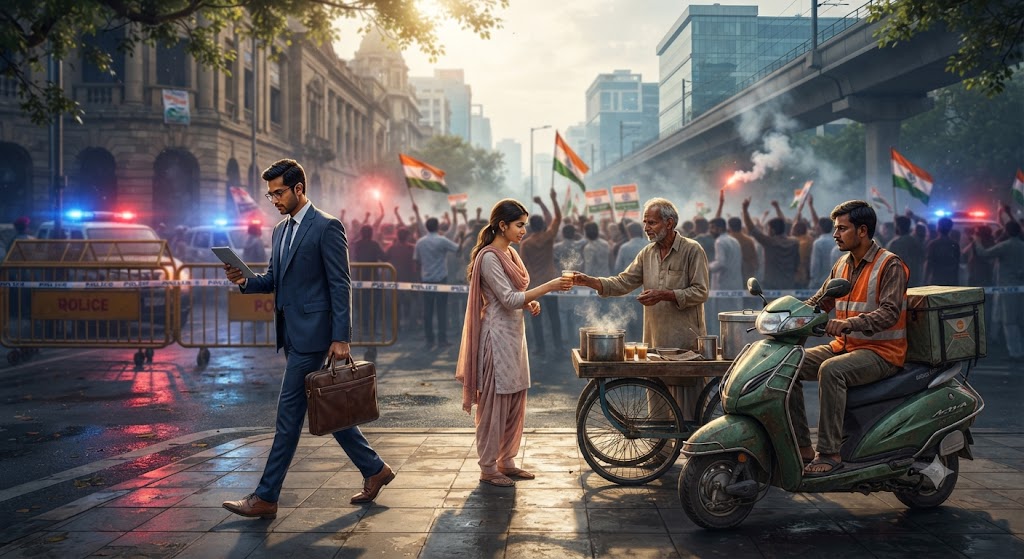
To look at the television screens and digital timelines in New Delhi this week is to witness a nation seemingly on the brink. Heavily fortified barricades choke arterial borders, thousands of riot police stand shoulder-to-shoulder, and the gates of nearly four dozen metro stations remain firmly shuttered. The national capital has been transformed into a sprawling theater of political confrontation. On one side, the ruling Bharatiya Janata Party (BJP) accuses the opposition of deliberately manufacturing “anarchy and chaos” to destabilize an elected government. On the other, a united opposition—spearheaded by the CJP—decries an “undeclared emergency,” pointing to the mass preventive detention of over 7,000 citizens and leaders.
Yet, step just a few miles away from the epicenter of Jantar Mantar or the Supreme Court, and a profoundly different reality unfolds. The tea vendor continues to boil his morning brew, the IT professional navigates a complex detour to reach her Gurugram office, and the gig-economy courier weaves through traffic to meet his delivery quota.
The defining story of this current political crisis is not the battle for the streets, but the remarkable, almost stoic apathy of the Indian economic engine. While political factions wage an existential war for the narrative, the vast majority of citizens have simply muted the noise, stepped around the barricades, and moved on with their daily business.
The Ruling Party’s Narrative: The Weaponization of the Streets
To understand the current political gridlock, one must examine the fierce rhetorical battle lines being drawn. The ruling establishment has categorically framed the ongoing protests—demanding the resignation of Chief Election Commissioner Gyanesh Kumar—not as a democratic exercise, but as a calculated attempt to usurp the electoral mandate through street-level chaos.
Senior BJP leaders have been vocal in their condemnation of the opposition’s tactics. Union Ministers and party spokespersons have articulated a distinct thesis: having failed to secure a decisive victory at the ballot box, the opposition is now resorting to a “street veto.” Defense Minister Rajnath Singh encapsulated this sentiment, stating, “In a democracy, every individual has the right to express dissent. However, one must not forget that spreading anarchy is not anyone’s right.” Similarly, BJP MP Ravi Shankar Prasad noted that Indian democracy has “thwarted attempts to incite anarchy,” emphasizing that the country must be “governed by Parliament, not by the streets.”
From the perspective of the ruling government, the mass mobilization, the traffic disruptions, and the aggressive posturing are not organic outpourings of public grievance, but orchestrated attempts to destabilize the nation. By framing the opposition’s actions as “anarchy,” the state justifies its heavy-handed response—including the deployment of multi-agency security teams and widespread detentions—as a necessary defense of constitutional order and public safety.
The Opposition’s Counter: The Cry of “Dictatorship”
The opposition, however, vehemently rejects the label of anarchists. For the CJP, the Congress, the Left, and regional powerhouses like the Trinamool Congress, the protests are a desperate defense of institutional integrity. Their core demand—accountability regarding the electoral rolls and the conduct of the CEC—is framed as a battle for the very soul of India’s electoral democracy.
When the state responded to the planned march with the detention of over 7,000 individuals—including sitting Chief Ministers, Members of Parliament, and prominent civil society voices—the opposition’s narrative solidified around the concept of an “undeclared emergency.” Leader of the Opposition Rahul Gandhi summarized the sentiment on social media: “Arrest all the leaders. Arrest all the young people. Arrest us all.”
The opposition argues that by conflating peaceful protest with “anarchy,” the government is attempting to police dissent into silence. They point to the Constitution, which guarantees the right to peaceful assembly, arguing that a democracy does not end at the ballot box; it survives through continuous debate, protest, and accountability. To them, the barricades and the internet suspensions are not signs of a government maintaining order, but of an insecure regime resorting to authoritarian tactics.
The Real Story: The Immunity of the Aam Aadmi
Amidst these towering ideological claims of “anarchy” versus “dictatorship,” a fascinating sociological phenomenon is occurring: the radical decoupling of political theater from everyday life.
There was a time in Indian political history when a call for a bandh (strike) by a major political coalition would bring entire cities, if not states, to a grinding halt. Markets would shutter, transportation would freeze, and the economic life of the city would bend to the will of the political class. Today, that power has severely diminished.
Despite the intense clashes in central Delhi, the broader economic machinery of the National Capital Region (NCR), and the country at large, has barely registered a tremor. Why?
1. The Economic Imperative: The modern Indian workforce is bound by relentless economic realities. In a highly competitive, post-pandemic economy, the luxury of pausing life for political outrage is scarce. For the daily wage earner, missing a day of work means a missed meal. For the corporate employee, the integration of remote work infrastructure means that even physical barricades cannot stop the workflow; if the roads are blocked, the laptop simply opens at home. The financial imperative to survive and thrive overwhelmingly supersedes the urge to participate in political street battles.
2. Political Fatigue: The Indian electorate is arguably one of the most politically stimulated populations in the world, bombarded by 24/7 news cycles, WhatsApp forwards, and hyper-partisan debates. This constant overstimulation has bred a deep sense of political fatigue. The average citizen views the grandstanding of both the ruling party and the opposition with a healthy dose of cynicism. They recognize the protests and the subsequent crackdowns as a high-stakes game of political chess, one in which they are merely collateral damage. Consequently, they choose to tune out. The chaos on the news is consumed as digital content during a metro ride, not as a call to arms.
3. The Privatization of Normalcy: Over the last two decades, the Indian middle class has increasingly privatized its normalcy. From gated communities to private transport, individuals have built robust micro-ecosystems designed to insulate them from systemic failures and public disruptions. When public spaces become battlegrounds, the citizenry simply retreats into these private, functional bubbles, ensuring their personal productivity remains uninterrupted.
The Danger of the “Street Veto” vs. The Necessity of Dissent
This growing apathy, while keeping the economy running, raises profound questions about the health of the democratic social contract.
There is a legitimate danger, as the ruling party suggests, in the normalization of the “street veto.” If continuous, disruptive street protests become the primary mechanism for forcing legislative or administrative change, the authority of elected institutions is fundamentally undermined. A constitutional democracy must govern through its Parliament, its courts, and its established agencies. If governments capitulate purely to the sheer volume of crowds occupying public infrastructure, it sets a precedent that the loudest, most disruptive faction can overrule the silent majority of the ballot box.
Conversely, a democracy entirely devoid of street-level dissent is equally perilous. As the opposition rightly notes, institutions are not infallible. When mechanisms of accountability appear compromised—such as the allegations surrounding the Election Commission—the public square remains the ultimate release valve for democratic frustration. If a state views all protest as “anarchy” and responds with mass preventive detentions, it risks suffocating the very feedback loops that keep a democracy responsive and vibrant.
Conclusion: The Silent Majority Moves Forward
As the Supreme Court steps in to mediate the immediate crisis—ordering the unblocking of transit routes and balancing the right to protest with the maintenance of public order—the dust will eventually settle on Jantar Mantar. The barricades will be dismantled, the detained leaders will be released, and both sides will claim a moral victory in the ongoing narrative war.
But the most enduring image of this week will not be the political speeches or the lines of riot police. It will be the millions of ordinary citizens who looked at the chaos, adjusted their routes, and went to work. The opposition may attempt to generate momentum, and the government may mobilize to crush perceived anarchy, but the true stabilizing force of the world’s largest democracy remains the unshakeable, quiet resilience of a populace that simply refuses to stop moving forward.
* Conceptual illustration generated using AI