
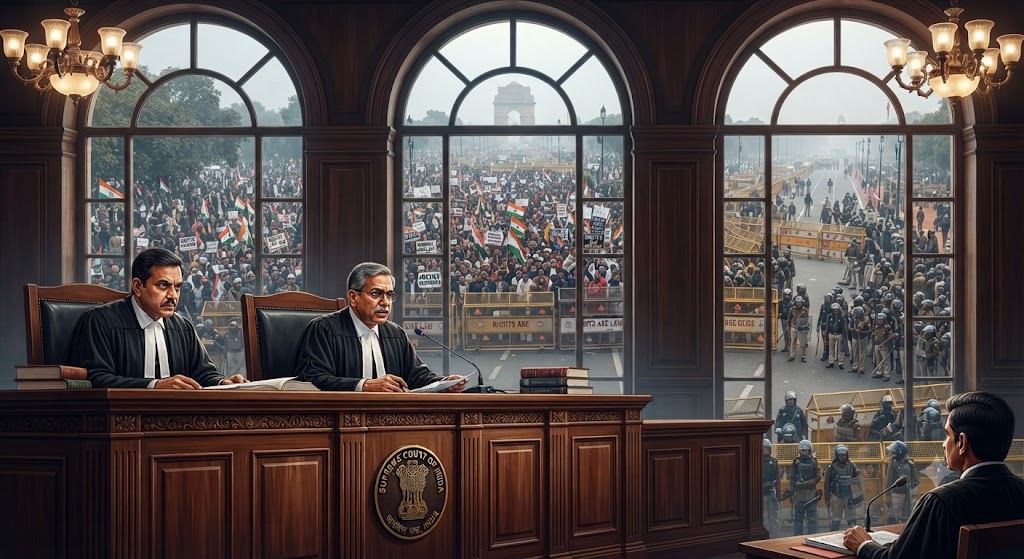
In an unprecedented move that underscores the gravity of the unfolding political crisis in the national capital, a special two-judge bench of the Supreme Court convened on a Sunday morning to hear urgent pleas regarding the mass detention of over 7,000 citizens, political leaders, and lawyers. The sweeping police crackdown was executed to thwart a massive protest organized by the Cockroach Janta Party (CJP), which is demanding the resignation of Chief Election Commissioner (CEC) Gyanesh Kumar over allegations concerning the SIR exercise.
As Delhi transformed into a fortress—with barricades, internet suspensions, and the shutdown of dozens of metro stations—the legal battle shifted to the highest court of the land. Justices Joymalya Bagchi and V Mohana presided over the emergency session, navigating a complex web of habeas corpus petitions, allegations of police brutality, and a high-stakes contempt of court plea against the Delhi Police Commissioner and DMRC Chairperson.
Here is a comprehensive breakdown and live update summary from the Supreme Court’s extraordinary Sunday session, alongside the developing political reality on the ground.
The Ground Reality: 7,000 Detained and a Capital Paralyzed
Before the Court convened, the situation in New Delhi had already reached a boiling point. The Delhi Police, citing procedural requirements, public safety, and traffic management concerns, had explicitly denied permission for the CJP’s planned march to Jantar Mantar. When protesters attempted to defy the order, the state machinery responded with overwhelming force.
Official figures indicate that over 7,000 individuals were placed under preventive detention. The dragnet captured citizens, activists, and high-profile political figures across the opposition spectrum. Key detentions included:
- CJP Leadership: Top CJP leaders Abhijeet Dipke, Saurav Das, and Ashutosh Ranka were detained inside their aircraft immediately upon arriving from Mumbai.
- Opposition Heavyweights: Several prominent opposition figures, including Mamata Banerjee and Arvind Kejriwal, alongside three former Chief Ministers, were reportedly taken into custody at various locations across the capital.
- Civil Society & Media: Popular YouTuber Dhruv Rathee was picked up from his residence in Gurugram, signaling a widening of the crackdown to include digital commentators and activists.
To physically prevent the mobilization, authorities initiated mass closures of public transport. Initially proposing the closure of 57 Delhi Metro stations, the number was revised to 45 following earlier judicial scrutiny. Mobile internet services were strategically suspended in parts of the city, and major arterial roads were heavily barricaded.
Despite the total shutdown, isolated groups of protesters continued to navigate the blockades. With the primary leadership detained, the CJP swiftly appointed its national organization in-charge, Ajinkya Shinde, as the new face of the mobilization. In a defiant video message, Shinde stated, “This dictatorial government is once again scared of the unity of this country,” urging supporters to adopt a decentralized protest strategy: “Wherever the police stop you, that place will become your Jantar Mantar”.
The Supreme Court Sunday Hearing: Key Arguments and Live Updates
The urgency of the mass detentions prompted the Supreme Court to interrupt its weekend recess. The special bench, comprising Justices Joymalya Bagchi and V Mohana, faced a dual-pronged legal challenge: habeas corpus petitions regarding the 7,000 detained individuals, and a contempt of court petition arguing that the state deliberately disobeyed previous Court directives regarding public transport and free movement.
5:47 AM – Lawyers Detained and Internet Suspended
The proceedings began early, with the Court attempting to manage a massive influx of lawyers seeking to mention unlisted pleas. A woman counsel brought immediate attention to the detention of legal professionals, stating that roughly 150 lawyers had gathered peacefully near the MC Setalvad chambers on Saturday before police intervened and detained four of them. Furthermore, she highlighted that the suspension of internet services severely hampered the ability of lawyers to file urgent petitions. SCAORA President Devvrat echoed this, seeking relief for Advocates-on-Record who were caught in the sweep.
5:57 AM – The Scale of the Crackdown
Senior Advocate Shoeb Alam emphasized the unprecedented scale of the police action, pointing out that people were being detained directly from trains. “Please see the magnitude of the scale and the magnitude of the problem that we are facing. 7,000 to 6,000 people have been detained… Several Leaders of Opposition,” Alam submitted, highlighting the indiscriminate nature of the preventive detentions.
6:06 AM – “Weaponizing Preventive Detention”
Senior Advocate Menaka Guruswamy delivered a powerful argument on the habeas corpus petition, elevating the issue from individual detentions to a constitutional crisis. “What is at stake is the suspension of citizens’ peacefully exercised constitutional rights,” she argued. Referencing the darkest periods of Indian democratic history, she noted, “The last time this Court had to consider such requests, such challenges, was at the time of the Emergency.” Guruswamy detailed how Members of Parliament were barricaded in their homes before being transported around the city in jailhouse vans. She argued that preventive detention cannot be weaponized to suppress fundamental rights.
6:11 AM – The State’s Defense: A Temporary Measure
Representing the State, Solicitor General (SG) Tushar Mehta offered a technical defense of the police action. He argued that the detentions followed a strict statutory regime designed to maintain public order. “Most of these people mentioned here were picked up at 2 p.m. and they were released at around 6 o’clock,” the SG stated. Mehta suggested that because the detentions were short-term and many individuals had already been released, the fundamental prayer of the habeas corpus petitions “may perhaps not survive”.
6:16 AM – The Contempt Plea and Metro Closures
The Bench then turned its attention to the crippling of public infrastructure. The contempt petition, filed against the Home Secretary, Delhi Police Commissioner Anurag Kumar, and the DMRC Chairperson, argued that the deliberate shutdown of 45 to 57 metro stations constituted willful disobedience of the Court’s October 9 directions, which sought to prevent a “complete prohibition” on movement. Justice Bagchi pressed the State for an affidavit explaining the necessity of such widespread closures, reminding the government of its previous assurances that restrictions would be reconsidered.
6:38 AM – Allegations of Police Brutality
The hearing took a darker turn as Senior Advocate Gopal Sankaranarayanan brought forth allegations of excessive force. He informed the Bench that unarmed children participating in the protests had been beaten by authorities. Other petitions highlighted that participating police officers were allegedly operating without visible name tags, and that female protesters had been manhandled by male officers during the street-level crackdown.
6:54 AM – The Court’s Directives
Refusing to allow the capital to remain indefinitely paralyzed, the Bench issued clear, interim directives aimed at restoring normalcy while balancing the State’s law and order concerns. Justice Bagchi directed:
- Restoration of Transit: “Metro and rail facilities shall function normally, unless regulations are required to be imposed, keeping in mind disturbance to public order as envisaged under Article 19(2) of the Constitution”.
- Removal of Barricades: “Free movement of people in the city shall be permitted, subject to traffic regulations. The requirement of imposition of barricades shall be reviewed forthwith”.
- Protection for Legal Professionals: The Court explicitly stated that no advocate should be hindered in discharging their professional duties.
Justice Bagchi also made a poignant observation regarding the State’s use of prohibitory orders, noting that while Section 144 (or Section 163 under new codes) is frequently issued around sensitive government installations, it is rarely enforced evenly, adding to the “cauldron of suspicion and concern” regarding selective policing.
7:08 AM – The Condition of Peaceful Protest
Before rising, the Bench extracted a commitment from the petitioners. Justice V Mohana addressed the courtroom: “All of you present here, if you are seriously interested in public welfare, please undertake that you will all protest peacefully and not instigate any other person”. Senior Advocate Sankaranarayanan agreed on behalf of the petitioners, affirming their commitment to non-violence.
The Broader Democratic Implications
The events unfolding in New Delhi—and the subsequent judicial intervention—represent a critical stress test for Indian democracy. The State’s decision to utilize mass preventive detention, digital blackouts, and the suspension of essential public transit to counter a political demonstration has drawn sharp criticism both domestically and internationally.
The CJP’s demand for the resignation of CEC Gyanesh Kumar over the SIR exercise allegations has now been somewhat overshadowed by the government’s heavy-handed response. By detaining thousands of citizens, including rival Chief Ministers and prominent digital voices, the administration has inadvertently amplified the CJP’s narrative of democratic backsliding.
The Supreme Court’s special Sunday sitting provided a necessary judicial check on executive power, ensuring that the capital did not remain under a de facto state of siege. However, the legal questions raised during the session—particularly the limits of preventive detention and the proportionality of state force against peaceful assembly—will require prolonged adjudication. As the barricades are reviewed and the metro stations slowly reopen, the political fallout from this weekend’s crackdown is only just beginning.
* Conceptual illustration generated using AI