
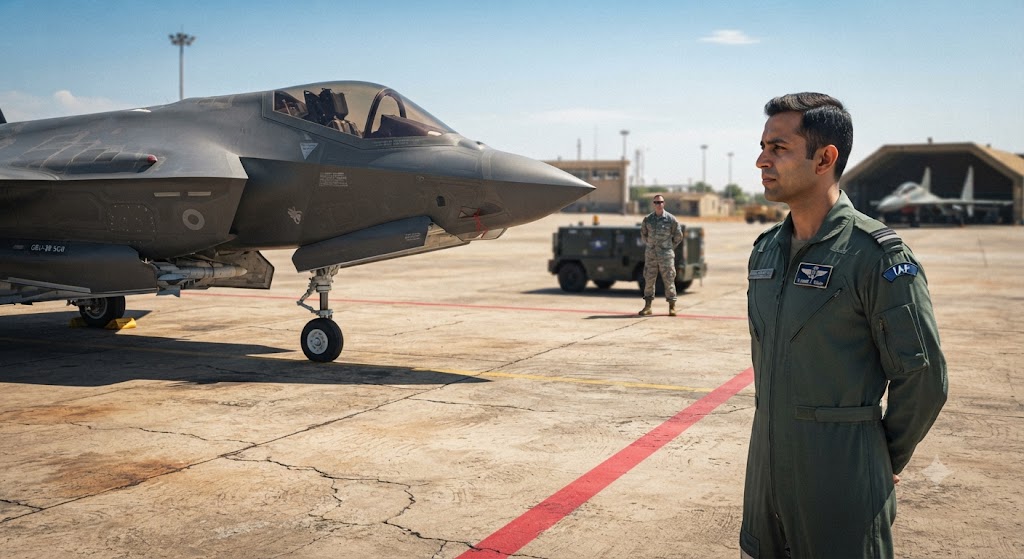
For years, defense analysts, geopolitical commentators, and military enthusiasts have endlessly speculated about whether the United States would offer its crown jewel of military aviation—the Lockheed Martin F-35 Lightning II stealth fighter—to the Indian Air Force (IAF). Rumors of high-level negotiations and strategic realignments have frequently circulated, painting a picture of an impending mega-deal that would forever alter the balance of air power in South Asia.
However, during a recent press conference in Jodhpur, the Chief of the Indian Air Force decisively grounded those rumors with a single, blunt, and slightly humorous observation. In doing so, he not only shut down the immediate prospect of an F-35 acquisition but also highlighted the complex, sometimes contradictory nature of Indo-U.S. defense ties.
The Jodhpur Press Conference: A Candid Quip
The defining moment occurred during a joint press briefing at the conclusion of the multinational air exercise, Tarang Shakti-2026, held in Jodhpur, Rajasthan. Indian Air Chief Marshal A.P. Singh was sharing the stage with General Kevin Schneider, Commander of the U.S. Pacific Air Forces.
When pressed by reporters about the swirling rumors regarding India’s potential procurement of the fifth-generation American stealth fighter, Air Chief Marshal Singh did not deflect with standard diplomatic jargon. Instead, he offered a candid assessment of the situation on the ground.
“The US has made no official offer to sell F-35 stealth fighters to India,” Singh stated unequivocally. He then delivered the line that immediately went viral across global defense circles: “These people don’t even let us go near the aircraft, and you are talking [about an offer].”
The IAF Chief elaborated on the strict access controls enforced by the U.S. personnel during the joint military exercises, noting, “The US did not show us the cockpit, but allowed us to fly in close formation.”
The remark, delivered with a hint of humor right beside a senior U.S. commander, cut through years of speculative reporting. It underscored a fundamental reality of American military technology exports: Washington remains fiercely protective of its most advanced proprietary systems, enforcing stringent operational and physical security protocols even with its closest strategic partners.
Dispelling the Vice Presidential Rumors
The IAF Chief’s clarification was particularly necessary given recent political rhetoric. During a diplomatic visit to India in April 2025, U.S. Vice President J.D. Vance made comments that many interpreted as a soft pitch for advanced defense sales. Vance stated, “We, of course, want to collaborate more. We want to work together more. And we want your nation to buy more of our military equipment, which we believe is best-in-class.”
While the U.S. has indeed successfully marketed and sold advanced platforms to India—such as the P-8I Poseidon maritime patrol aircraft, AH-64 Apache attack helicopters, and MQ-9B SeaGuardian drones—the F-35 belongs to an entirely different classification of export-controlled technology. The U.S. government has historically offered the F-15EX to India for its Medium Multi-Role Combat Aircraft (MMRCA) requirements, but a formal, on-paper proposal for the F-35 has never materialized.
The Stumbling Blocks: The S-400 and the ODIN Network
The reluctance of the United States to offer the F-35 to New Delhi is rooted in deep structural and technological conflicts between the two nations’ defense ecosystems.
First and foremost is India’s deployment of the Russian-origin S-400 Triumf advanced air defense system. The U.S. Department of Defense has long maintained that the S-400 and the F-35 cannot operate in the same airspace without compromising the stealth jet’s highly classified radar cross-section data and electronic warfare signatures. The U.S. fears that the S-400’s powerful radar networks could collect and transmit sensitive data back to Moscow. This is not a theoretical concern for Washington; the U.S. famously expelled its NATO ally Turkey from the F-35 consortium entirely after Ankara refused to cancel its own S-400 procurement. Given that India already operates the Russian system, integrating the F-35 is seen as an unacceptable security risk by the Pentagon.
Secondly, the F-35 is not just a standalone aircraft; it is a flying data node. The jet relies heavily on the U.S.-controlled Operational Data Integrated Network (ODIN) for software updates, mission planning, and logistics. Procuring the F-35 would mean tying a critical component of India’s national security to a foreign-controlled digital ecosystem. For a nation that fiercely guards its “Strategic Autonomy,” handing over the operational keys of its premier fighter to Washington is a non-starter.
Furthermore, the contractual nature of the F-35 program clashes with India’s long-term defense manufacturing goals. Any potential F-35 deal would strictly be a supply-and-support contract. Washington does not offer technology transfer or source code access for the Lightning II, entirely negating the “Make-in-India” mandates that New Delhi now requires for major defense procurements.
The Indigenous Path: AMCA and Alternative Offers
With the American stealth fighter effectively off the table, the Indian Air Force’s path to fifth-generation capabilities remains focused on two distinct avenues.
The primary long-term solution is the indigenous Advanced Medium Combat Aircraft (AMCA) program. Recently, major Indian defense contractors Larsen & Toubro (L&T) and Bharat Electronics Limited (BEL) announced pacts to accelerate the development of this fifth-generation fighter. The AMCA is intended to form the backbone of India’s future air superiority fleet, ensuring self-reliance in aerospace manufacturing. However, developing a stealth fighter from scratch is a notoriously long, expensive, and complex process, and the AMCA is not expected to enter full-scale production for several years.
In the interim, other global powers continue to court New Delhi. Air Chief Marshal Singh confirmed during the Jodhpur press conference that Russia has formally offered its own fifth-generation stealth fighter, the Sukhoi Su-57. “Yes, the Russians have offered [the Su-57],” Singh stated, while carefully adding, “But there has been no decision yet.” While the Su-57 represents a formidable platform, India previously withdrew from a joint fifth-generation fighter program with Russia due to concerns over technology transfer, stealth capabilities, and engine performance, making a direct purchase of the Su-57 a highly complex proposition.
A Pragmatic Partnership
The frank comments from Air Chief Marshal A.P. Singh serve as a necessary reality check for Indo-U.S. defense relations. The partnership between New Delhi and Washington is robust, expanding, and strategically vital for maintaining a free and open Indo-Pacific. The regular occurrence of massive, integrated exercises like Tarang Shakti demonstrates a high level of operational interoperability between the two air forces.
However, interoperability does not equate to absolute integration. The U.S. will continue to guard its most sensitive stealth technology, and India will continue to prioritize its strategic autonomy, indigenous manufacturing, and diversified defense supply chains.
For now, American personnel will keep the cockpit of the F-35 securely locked, and India will continue pouring its resources into ensuring that, one day, the cockpit of its own AMCA is the only one its pilots will ever need.
* Conceptual illustration generated using AI