
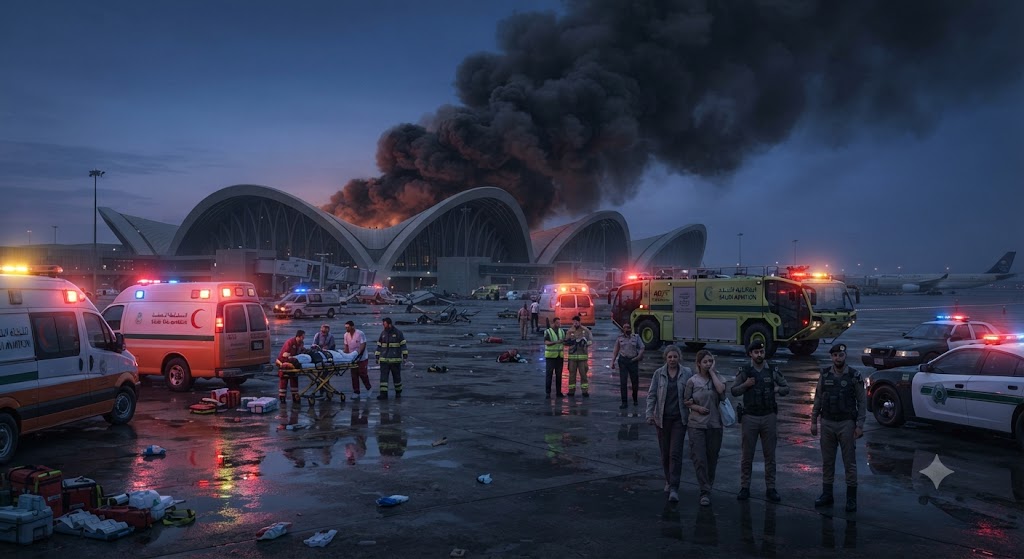
October 10, 2026, will be remembered as a grim and transformative milestone in the escalating Middle Eastern conflict. In what is now confirmed to be the deadliest attack on Saudi Arabian soil in more than a decade, Yemen’s Iran-backed Houthi rebels launched a devastating strike on King Khalid International Airport in Riyadh. The attack, which targeted a bustling civilian aviation hub, has triggered an avalanche of international condemnation and pushed the already volatile region to the brink of a much wider, multi-national military escalation.
As emergency crews clear the debris and airlines scramble to reroute flights, the geopolitical fallout is moving swiftly. With a staggering civilian casualty count and threats of direct intervention from the United States, the Houthi strike has transformed a localized proxy conflict into a direct assault on international travel and global security.
The Scene of the Tragedy: Chaos at Gate 403
The attack unfolded when a drone and missile barrage successfully penetrated Saudi airspace, striking a passenger departure terminal at King Khalid International Airport. The sheer kinetic force of the impact caused partial structural collapses, including the caving in of a ceiling near a busy departure gate.
Witnesses described scenes of absolute terror. Travelers waiting to board their flights reported hearing a massive explosion and seeing a projectile streak across the sky before the terminal was engulfed in chaos, smoke, and flying debris. Flight operations were immediately suspended, and over 124 flights were diverted or grounded as authorities initiated emergency mass-casualty protocols.
The human toll reflects the cosmopolitan nature of an international transit hub. Saudi authorities have confirmed that 12 people were killed in the strike. The victims span the globe, including four Saudi citizens, two nationals from Bangladesh, and one citizen each from the United States, Jordan, Palestine, Syria, Sudan, and Egypt. Furthermore, over 300 individuals sustained injuries ranging from severe trauma to lacerations from shattered glass.
The Joint Forces Command of the Saudi-led Coalition condemned the strike as a “cowardly terrorist attack” and a “full-fledged war crime according to Customary International Humanitarian Law”.
The Houthi Calculus: Retaliation and Escalation
Almost immediately following the bloodshed, the Houthi militia proudly claimed responsibility for the assault. Houthi official Mohammed al-Bukhaiti framed the deadly strike as direct retaliation for recent Saudi military operations against civilian infrastructure in Yemen, specifically citing recent Saudi-led airstrikes that hit Sanaa International Airport.
Al-Bukhaiti stated that the Houthis executed the airport attack “so that the world understands that airports, seaports, wedding and mourning halls” are all vulnerable, attempting to establish a brutal deterrent against further Saudi incursions.
However, by intentionally targeting a civilian international airport with a multi-national passenger base, the Houthis have dramatically altered the diplomatic calculus. The attack sits at the dangerous intersection of the ongoing 2026 Yemen offensives and the broader, escalating 2026 Iran war. By disrupting international air traffic and killing foreign nationals, the militia has effectively invited the wrath of the global community.
An Avalanche of Global Condemnation
The international response was immediate, unanimous, and remarkably forceful. The deliberate targeting of civil aviation infrastructure represents a severe violation of international norms, uniting traditionally fractured diplomatic blocs in their outrage.
- The United Nations: UN Secretary-General António Guterres led the global outcry, stating he was “deeply shocked” by the lethal attack. “Attacks on civilians and civilian infrastructure are a violation of international law,” Guterres declared, demanding that “these attacks must cease immediately”.
- The European Union: EU Commission leadership branded the strike a “dangerous escalation.” European aviation bodies subsequently widened their airspace warnings for the region, reflecting the severe threat posed to commercial flight corridors.
- The Arab League and Regional Powers: The League of Arab States denounced the strike as a “blatant violation of international law” that poses a “direct threat to civil safety [and] international air navigation”. Neighboring nations, including Kuwait and Egypt, echoed these sentiments, condemning the “heinous and cowardly” act. Even Syria, which has complex ties with the broader Iranian axis, issued a statement condemning the attack on the Riyadh airport and urging steps to protect civilian facilities.
- Global Allies: Canadian Prime Minister Mark Carney labeled the Houthi attacks “abhorrent,” emphasizing that “no political or military objective can justify the deliberate targeting of innocent people”. Meanwhile, Pakistani Prime Minister Shehbaz Sharif invoked the Mecca Joint Defense Agreement, reaffirming Islamabad’s commitment to Saudi Arabia’s security and sovereignty, calling the attacks “absolutely unacceptable”.
Washington’s Threat: Will the U.S. Intervene?
Perhaps the most consequential reaction came from Washington, D.C. With an American citizen among the deceased, the United States is facing immense pressure to respond.
U.S. Secretary of State Marco Rubio issued a fierce condemnation, noting that the strikes demonstrate a “blatant disregard for innocent civilian life”. But it was President Donald Trump who dramatically escalated the rhetoric, indicating that the U.S. military might directly join Saudi Arabia in retaliatory strikes against Houthi positions in Yemen.
Speaking to reporters outside the White House, Trump was asked if the United States planned to join the Saudi military response. “We may. We’re going to look at it,” the President confirmed. “We just found out about the recent attack, so we’ll make a decision. We move very quickly”.
A direct American military intervention against the Houthis in Yemen would signify a massive expansion of the current conflict. It would effectively blur the lines between the Saudi-Houthi proxy war and the broader U.S.-Iran geopolitical standoff. As the U.S. Mission in Saudi Arabia updates its travel advisories to Level 3, warning Americans to “Reconsider travel” due to missile and drone threats, the Pentagon is undoubtedly drawing up target packages.
A Precarious Horizon
The October 2026 attack on King Khalid International Airport has shattered the illusion that the Yemeni conflict can be contained within its own borders. By weaponizing drones and missiles against civilian transit hubs, the Houthis have forced the hand of the international community.
Saudi Arabia, backed by a chorus of outraged global leaders and potentially the direct military might of the United States, has vowed a “decisive” and “firm” response. As airlines suspend flights and nations mourn their dead, the Middle East braces for what comes next. The threshold for mass-casualty violence has been tragically raised, and the diplomatic off-ramps are rapidly disappearing in the smoke over Riyadh.
* Conceptual illustration generated using AI