
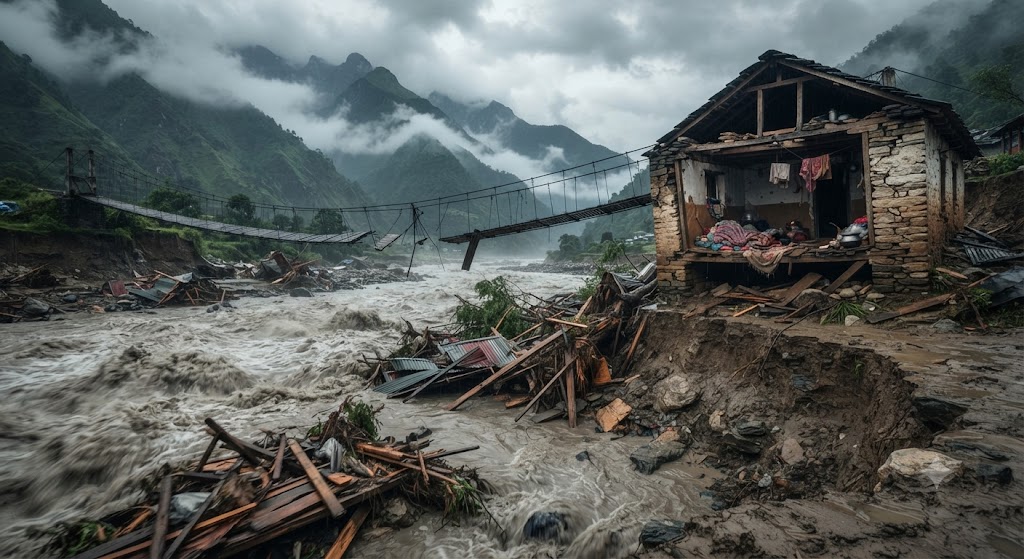
The sheer, destructive power of nature has once again descended upon the Himalayas, shattering the precarious calm that had settled over central Nepal. Early Sunday morning, October 11, 2026, a sudden, debris-laden flash flood surged through the Budhi Gandaki River in the Gorkha district. Raging torrents of dark, muddy water obliterated everything in their path, sweeping away an estimated 35 to 40 houses, severing crucial transport bridges, and severely damaging local infrastructure.
While authorities have launched immediate rescue operations and no fatalities have been officially confirmed as of late Sunday, the images of entire settlements being erased by the river have sent a collective shudder through the nation. The Gorkha flash flood arrives just weeks after Nepal endured one of the most catastrophic natural disasters in its modern history—the devastating August 2026 Nepal-Tibet floods that claimed over 1,450 lives. This latest incident lays bare the acute, ongoing vulnerability of mountain communities to sudden geological and climatic events, raising urgent questions about climate adaptation, infrastructure resilience, and the future of Himalayan settlements.
The Midnight Surge: Devastation in Gorkha
The disaster struck under the cover of darkness. At approximately 4:00 a.m., residents in the rural municipalities of Chumnubri and Dharche were awakened by an ominous, deafening roar. Sherap Gurung, a resident of Lokpa, noted that the terrifying sound suggested the river’s flow had repeatedly stopped and violently resumed—a classic indicator of temporary blockages and subsequent outburst floods upstream. “Because it was dark, we could not tell whether the stream had been blocked or a landslide had occurred. It had not rained either,” he recounted.
The wall of water and debris hit the settlements of Salleri, Paiyun, and Jagat Bagar with catastrophic force. According to preliminary reports from Gorkha Chief District Officer Dharmendra Kumar Mishra, the deluge was likely triggered by a massive landslide that occurred upstream above Siuribas, blocking the Budhi Gandaki River before the natural dam gave way.
The resulting destruction was absolute. Rushing floodwaters eroded the riverbanks, undercutting the foundations of dozens of homes and dragging them into the torrent. Crucial lifelines were severed; the vital suspension bridge linking Nyakchet and Philim Bazaar in Chumnubri-3 was entirely washed away, immediately isolating remote mountain communities from rescue and supply routes. Furthermore, a local hydropower project situated along the river suffered extensive damage, with infrastructure and heavy equipment obliterated by the sheer force of the debris flow.
The Immediate Response and Evacuation
Recognizing the imminent threat of further downstream flooding, local authorities and security forces mobilized rapidly. The Nepal Police, the Armed Police Force, and local administrative units were dispatched to the affected zones. Given the destruction of local bridges and the severing of road networks, the Ministry of Home Affairs deployed helicopters to facilitate emergency rescue operations, distribute critical relief supplies, and conduct aerial evacuations.
In a race against time, authorities utilized loudspeakers along the riverbanks, urgently warning communities downstream to abandon their properties and move immediately to higher ground. Tourists staying in riverside hotels were evacuated in the pre-dawn hours.
Miraculously, thanks to the swift localized warnings and the sheer luck of residents managing to flee in the dark, Home Minister Sudan Gurung confirmed that no casualties had been immediately reported, though initial assessments had flagged four individuals as missing. However, the exact extent of the damage remains difficult to quantify, as ongoing river volatility and isolated geography hamper comprehensive ground surveys.
The Shadow of the Bhotekoshi Disaster
For the people of Nepal, the terror of the Budhi Gandaki flood is magnified exponentially by the trauma of recent history. The Gorkha incident is eerily reminiscent of the catastrophic events that unfolded barely two months prior.
On August 26, 2026, a massive rock-ice avalanche originating from the Lirung massif triggered a cataclysmic debris flow that surged across the China-Nepal border into the Trishuli and Bhotekoshi rivers. That disaster, which heavily impacted the districts of Rasuwa, Nuwakot, and Dhading, was of an apocalyptic scale.
Floodwaters in August reached staggering heights of up to 80 meters (270 feet) above normal river levels, wiping out entire towns, destroying over 7,500 houses, and wiping out 27 hydropower stations. The death toll from the August floods stands at a horrifying 1,454 people, with over 5,200 individuals still officially listed as missing, including hundreds of foreign nationals. The United Nations estimated that the August flood generated 2.2 million tonnes of debris, fundamentally altering the topography of the region.
When the waters rose in Gorkha this Sunday, the immediate, paralyzing fear was that the country was witnessing a repeat of the August nightmare. While the scale of the Gorkha flood appears exponentially smaller in terms of human casualties, the mechanism of destruction—a sudden, unseasonal debris flow obliterating infrastructure—is identical.
A Region on the Brink: Climate Change and Geological Fragility
The back-to-back disasters in Nepal highlight a terrifying new normal for the Himalayan region. The traditional threats of the summer monsoon season have been entirely eclipsed by unpredictable, massive geological events that occur without the warning of heavy rainfall.
Geologists and climate scientists have repeatedly warned that the Himalayas are uniquely vulnerable to the accelerating impacts of global climate change. Rising global temperatures are causing the rapid retreat and destabilization of high-altitude glaciers. This thermal thawing weakens the permafrost that holds massive rock faces together, leading to an increased frequency of catastrophic rock-ice avalanches—the exact mechanism that triggered the deadly August floods. When these massive volumes of ice and rock fall into glacial lakes or narrow river valleys, they create temporary dams. The inevitable breaching of these dams results in Glacial Lake Outburst Floods (GLOFs) or massive debris flows that move with the viscosity of wet concrete, carrying boulders the size of houses downstream at terrifying speeds.
Following the August disaster, Nepal’s Foreign Minister Shisir Khanal made a desperate plea to the international community, stating that Nepal was bearing a “disproportionate share” of the consequences of global climate change. The events in Gorkha only validate that grim assessment.
The Challenge of Adaptation and Rebuilding
For the Nepali government, the cascading disasters present an almost insurmountable logistical and economic challenge. The World Bank had already slashed Nepal’s annual fiscal growth projections to a mere 3.7% due to the economic paralysis caused by the August floods. Now, the state must stretch its already depleted disaster relief funds and engineering resources to address the fresh crisis in Gorkha.
The destruction of the Budhi Gandaki hydropower infrastructure and the local bridges underscores the futility of traditional engineering in the face of these new mega-floods. Planners are now faced with an existential dilemma: how do you build resilient infrastructure and secure settlements in river valleys that can be subjected to 80-meter walls of water and rock at a moment’s notice?
As the helicopters ferry supplies into Chumnubri and Dharche, the immediate focus remains on survival, shelter, and preventing outbreaks of waterborne diseases. Yet, the broader, looming reality is impossible to ignore. The Himalayas are shifting, the ice is melting, and the rivers are rewriting their courses. The flash flood in Gorkha is not an isolated freak occurrence; it is the latest, violent symptom of a fragile ecosystem pushed to the brink, leaving the people of Nepal on the precarious front lines of a changing planet.
* Conceptual illustration generated using AI