
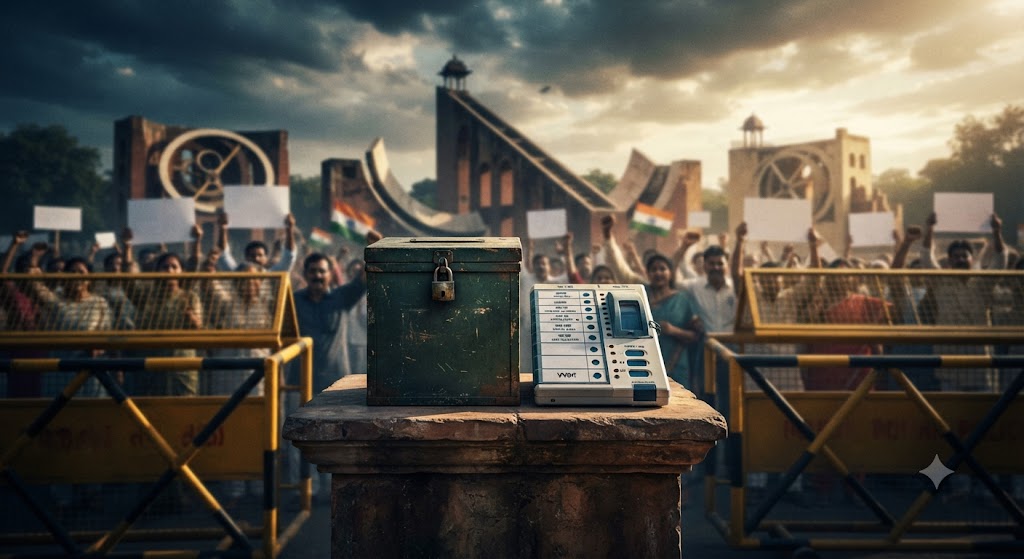
The physical footprint of Jantar Mantar—a historic observatory that evolved into the undisputed epicenter of Indian democratic protest—is shrinking under the weight of modern political warfare. Surrounded by multi-layered barricades, rapid action force deployments, and a pervasive surveillance apparatus, the site’s future as a sanctuary for public dissent is rapidly closing. The massive police crackdown in October 2026, which saw over 7,000 citizens and prominent political figures detained, has brought the logistical and political viability of Jantar Mantar to a breaking point.
However, the barricades on Parliament Street reflect a much deeper ideological fracture. The intense clashes over the Election Commission, the calls for Chief Election Commissioner Gyanesh Kumar’s resignation, and the mobilization of the Cockroach Janta Party (CJP) have triggered a fierce debate regarding the nature of democratic opposition in India. The ruling establishment argues that opposition leaders—most notably Rahul Gandhi and Arvind Kejriwal—are actively manufacturing street-level anarchy to compensate for their inability to secure decisive electoral mandates, pointing to shifting narratives surrounding Electronic Voting Machines (EVMs) and paper ballots.
The Ticking Clock on a Democratic Sanctuary
For decades, Jantar Mantar served as the pressure valve for the world’s largest democracy. It was the designated geography where citizens could directly face the corridors of power to voice their grievances. Today, the state views the venue not as a democratic necessity, but as a logistical hazard.
During the recent protests, the Delhi Police justified the preemptive detention of 7,000 people—including opposition heavyweights like Mamata Banerjee, Pinarayi Vijayan, and Arvind Kejriwal—by citing a strict spatial reality: the designated protest area at Jantar Mantar can safely accommodate a maximum of 1,000 people. When national political mobilizations attempt to channel tens of thousands of demonstrators into this confined space, the result is the paralysis of the National Capital Region.
The state’s response to the CJP’s “Jantar Mantar 2.0” mobilization was unprecedented. Authorities ordered the closure of entry and exit gates at 45 to 57 Delhi Metro stations, suspended mobile internet in key sectors, and canceled long-distance trains. From the government’s perspective, protecting the daily economic and transit functions of millions of Delhi residents supersedes the right of political factions to indefinitely occupy the city’s core. The sheer scale of the October lockdowns suggests that the clock is ticking on Jantar Mantar; the state apparatus is laying the groundwork to permanently push large-scale political agitations outside the city limits, fundamentally altering how dissent is expressed in the capital.
The Charge of Manufactured Anarchy
The ruling Bharatiya Janata Party (BJP) has categorically framed the ongoing unrest not as a grassroots democratic movement, but as a calculated, top-down strategy to destabilize the government through “anarchy and chaos.”
Delhi Chief Minister Rekha Gupta crystallized this narrative during the October protests, directly accusing Rahul Gandhi and Arvind Kejriwal of attempting to turn the capital into a “battleground.” The ruling party asserts that the CJP—the youth-driven movement spearheading the recent protests—is merely the “B-Team” of the Congress and the Aam Aadmi Party (AAP). By allegedly utilizing proxy organizations to paralyze the city, the opposition is accused of engaging in a “street veto” designed to bypass the structural realities of Parliament and the ballot box.
This perspective argues that street protests are being weaponized. Rather than engaging in constructive legislative debate or accepting the outcomes of institutional processes, the opposition is repeatedly taking to the streets to project an image of a nation in perpetual crisis. For the ruling administration, the disruptions, the clashes with law enforcement, and the subsequent international headlines are not byproducts of a frustrated electorate, but the primary objectives of an opposition that thrives on the optics of disorder.
The Electoral Trust Deficit: Moving the Goalposts
At the heart of the ruling party’s accusation of political hypocrisy is the opposition’s deeply inconsistent stance on India’s electoral mechanisms. The primary catalyst for the October unrest was the opposition’s demand for the removal of CEC Gyanesh Kumar, citing compromised voter rolls and an alleged lack of electoral integrity. This is a continuation of a long-standing campaign by opposition leaders to discredit the tools of Indian democracy whenever electoral outcomes do not favor them.
Rahul Gandhi has consistently targeted the Electronic Voting Machine (EVM), recently labeling it a “black box” that lacks transparency. He has repeatedly demanded that the Election Commission either completely open the machines for public scrutiny or abolish them entirely in favor of a return to paper ballots. Gandhi asserts that his fight is to save the Constitution and ensure the integrity of the “One Man, One Vote” principle.
The ruling establishment views these demands as the ultimate expression of political hypocrisy. BJP spokespersons, including Sambit Patra, have frequently highlighted the historical irony of the Congress party’s stance. They point out that during the era of paper ballots—which were notoriously plagued by armed booth capturing, ballot stuffing, and violent voter suppression—former Prime Minister Rajiv Gandhi and the Congress leadership fiercely criticized the paper system, eventually ushering in the era of EVMs to clean up the process. Now that the BJP dominates the EVM era, the Congress leadership claims the machines are rigged and demands a return to the very paper ballots their predecessors condemned.
The ruling party’s thesis is straightforward: the opposition does not actually care about the mechanics of the vote; they only care about the outcome. When the Congress or AAP secures a victory in state elections utilizing the exact same EVMs managed by the exact same Election Commission, the allegations of tampering vanish entirely. When they suffer a national defeat, the machines are instantly labeled “black boxes,” and the electoral institutions are branded as compromised. By perpetually shifting the blame to the process—whether it be paper or digital—the opposition avoids the difficult task of introspecting on their own political messaging and voter disconnect.
The Opposition’s Defense: The Necessity of the Street
Conversely, the opposition alliance fiercely defends its right to mobilize, rejecting the “anarchy” label as an authoritarian tactic designed to criminalize dissent. For leaders like Rahul Gandhi, Arvind Kejriwal, and the broader INDIA bloc, the institutional checks and balances of the Indian state have been systematically captured by the ruling party.
When the opposition attempts to raise issues regarding voter roll manipulation or the impartiality of the Election Commission, they argue that their concerns are summarily dismissed by compromised investigative bodies and a partisan bureaucratic infrastructure. Gandhi, who was physically detained by Delhi Police on October 6 while marching to the Election Commission, frames the street protests as the last remaining avenue for democratic accountability.
From the opposition’s vantage point, the true threat to democracy is not the temporary traffic disruption caused by a protest at Jantar Mantar, but the long-term erosion of electoral fairness. They argue that when a government responds to a peaceful assembly by detaining 7,000 citizens, deploying the Rapid Action Force, and essentially placing the capital under lockdown, it reveals an insecure regime terrified of public accountability, not a government merely trying to maintain public order.
A Fractured Democratic Ecosystem
The barricades currently encircling Jantar Mantar represent more than just crowd control; they are physical manifestations of a total collapse in political trust.
The ruling party sees an opposition that refuses to accept defeat with grace, choosing instead to inflict manufactured chaos on the public, perpetually moving the goalposts between paper ballots and EVMs to obscure their own political failures. The opposition sees a ruling juggernaut that uses the guise of “public order” and “traffic management” to ruthlessly crush any challenge to its dominance, aggressively policing dissent into silence.
As the Supreme Court steps in to mediate the restrictions and the public grapples with the paralysis of their city, the clock continues to tick. If Jantar Mantar is permanently restricted, and if trust in the electoral process—regardless of whether a machine or a piece of paper records the vote—cannot be mutually restored, the clashes on the streets of New Delhi will only intensify. A democracy relies on the loser’s consent just as much as the winner’s mandate; when that consent is replaced by allegations of rigged machines and manufactured anarchy, the entire system stands on a precipice.
* Conceptual illustration generated using AI