
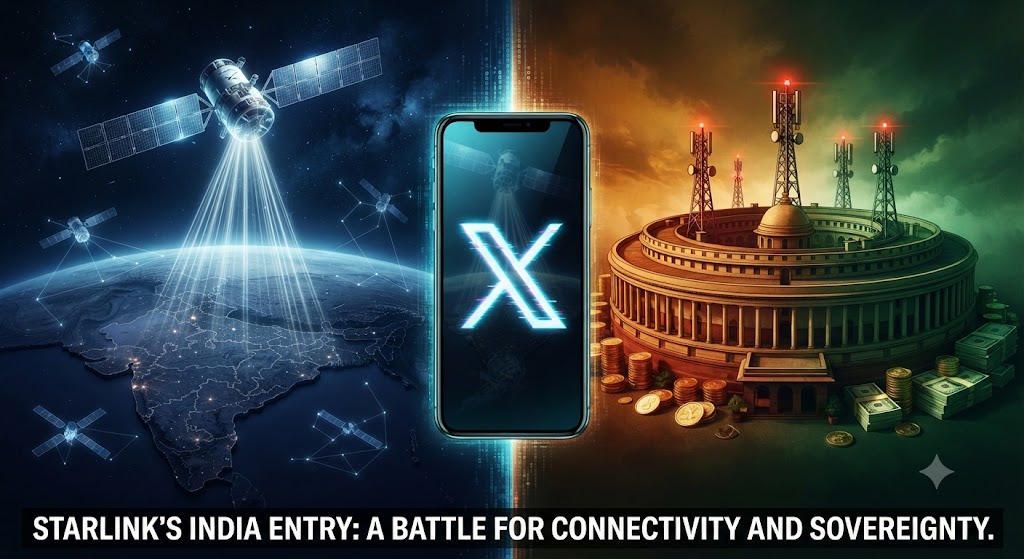
The intersection of global technology, domestic corporate dominance, and national politics has rarely been as explosive as the current public feud between SpaceX CEO Elon Musk and Reliance Industries Chairman Mukesh Ambani. What began as a regulatory gridlock over the entry of Musk’s Starlink satellite internet service into the Indian market has rapidly escalated into a highly politicized digital brawl.
Over the past week, Elon Musk has taken his grievances to X (formerly Twitter), launching a direct assault not only on Reliance Industries but on the political financial ecosystem of India’s ruling Bharatiya Janata Party (BJP). By sharing archived reports of corporate donations and sarcastically addressing Mukesh Ambani as “Prime Minister Ambani,” Musk has ignited a firestorm.
His aggressive tactics have led to intense speculation and accusations from political commentators: is the world’s richest man merely lobbying for market access, or is he attempting to aggressively shape India’s domestic political narrative—and potentially destabilize its current regime—simply to secure a business license for Starlink?
Here is a deep dive into the corporate warfare, the political fallout, and the underlying regulatory battle defining the Starlink-India saga.
The Provocation: Weaponizing Political Donations
The latest escalation occurred over the weekend when Elon Musk shared highly sensitive news reports regarding political funding in India to his hundreds of millions of followers.
Musk posted screenshots of two specific journalistic investigations. The first was an archived 2024 report by The Indian Express detailing how Qwik Supply—a company with deep links to Reliance Industries—purchased electoral bonds worth ₹410 crore, donating ₹385 crore to the ruling BJP and ₹25 crore to the Shiv Sena. The second was a 2022 Al Jazeera report titled “How a Reliance-funded firm boosts BJP’s campaigns on Facebook.”
These posts followed a series of increasingly hostile remarks from Musk targeting India’s richest man. Just days prior, Musk had questioned, “Is Ambani the real boss of India?” and mockingly referred to the Reliance Chairman as “Prime Minister Ambani.” Musk explicitly accused Ambani and other “oligarchs” of blocking Starlink’s entry to maintain a “monopolistic chokehold on the Indian people.”
By explicitly highlighting the financial ties between India’s largest corporate conglomerate and its ruling political party, Musk crossed a line rarely breached by foreign investors. He bypassed standard corporate lobbying channels, opting instead for a public, digital pressure campaign designed to embarrass the Modi government and cast doubt on the integrity of India’s telecom regulatory framework.
The Core Conflict: The Battle for India’s Skies
To understand Musk’s extraordinary digital offensive, one must look at the lucrative prize at stake: India’s nascent satellite broadband market.
SpaceX’s Starlink, alongside Bharti Group-backed Eutelsat OneWeb and Ambani’s own Jio Satellite, has been vying for commercial operation rights in India. While Starlink has secured a basic license to operate, its commercial launch remains stalled due to pending security compliance clearances and spectrum assignment protocols from the Department of Telecommunications (DoT).
Musk claims this delay is a deliberate, protectionist maneuver orchestrated by Reliance Jio and Bharti Airtel to stifle foreign competition and protect their massive terrestrial mobile network investments. Starlink’s model, which can beam high-speed internet directly to remote and underserved areas, poses a disruptive threat to the traditional telecom infrastructure dominated by Jio.
However, the Indian government vehemently denies these allegations of cronyism. Communications Minister Jyotiraditya Scindia recently pushed back against Musk’s claims, stating unequivocally that India does not permit monopolies in any sector. Scindia clarified that three satellite communications operators (including Starlink) are currently at broadly the same regulatory stage. They are all permitted to begin commercial operations only after they individually meet stringent security conditions and regulatory milestones.
National Security vs. Corporate Ambition
The government’s insistence on security compliance is not mere bureaucratic red tape; it is rooted in deep national security concerns.
Satellite internet bypasses traditional terrestrial fiber networks, making data interception and monitoring significantly more complex for national intelligence agencies. Furthermore, there have been highly concerning reports from Indian security agencies regarding the unauthorized use of Starlink devices. Authorities have reportedly recovered smuggled Starlink terminals in sensitive border regions, including the Andaman and Nicobar Islands, and from insurgent groups in the volatile state of Manipur.
While Musk has consistently maintained that Starlink beams over unauthorized Indian territories are switched off, the Indian security apparatus remains wary. For New Delhi, granting a foreign entity unfettered access to the nation’s digital airspace without foolproof local data storage, lawful interception capabilities, and strict geographic fencing is an unacceptable risk.
From the government’s perspective, Musk is attempting to use his massive social media megaphone to bypass these critical national security requirements, framing a legitimate regulatory process as corporate corruption.
Domestic Politics Hijacked: The Opposition Seizes the Moment
Musk’s strategy of naming and shaming the BJP’s corporate donors predictably triggered a massive domestic political spat. India’s opposition parties, already engaged in fierce protests against the Election Commission over other issues, seized upon Musk’s posts as validation of their long-standing “crony capitalism” narrative.
Leader of the Opposition Rahul Gandhi welcomed the controversy, posting, “Welcome to India, Elon. Wait till you discover the other guy.” The Congress party utilized Musk’s attacks on Ambani to reinforce their claims that the Modi administration bends national policy to favor a select few billionaires.
The BJP, however, swiftly turned the tables, accusing the opposition of hypocrisy and compromising national security to score cheap political points. BJP national spokesperson Pradeep Bhandari highlighted the irony, stating: “Congress in April 2026: Govt is favouring a foreign billionaire. Congress in October 2026: Why is the govt not favouring a foreign billionaire?”
Other BJP leaders accused Rahul Gandhi of acting like a “Jaichand” (traitor) by siding with a foreign businessman trying to bully the Indian government over sensitive security protocols. The ruling party successfully shifted the narrative, portraying Musk not as a champion of free markets, but as an arrogant foreign billionaire attempting to dictate terms to a sovereign nation.
The “Regime Change” Narrative and Blatant Hypocrisy
The sheer ferocity of Musk’s attacks has led some political analysts and ruling party supporters to question his ultimate motives. Critics argue that Musk’s willingness to amplify opposition talking points and target the BJP’s financial lifelines borders on an attempt at regime destabilization. The narrative suggests that Musk is so desperate for Starlink revenue that he is willing to foment political chaos and undermine the current government, hoping the resulting pressure will force a capitulation on the licensing front.
Whether Musk genuinely seeks a “regime change” or is simply executing a highly aggressive, scorched-earth PR strategy, his actions have opened him up to devastating charges of hypocrisy.
As Musk decried the influence of corporate money in Indian politics, global netizens were quick to point out his own unprecedented political spending in the United States. During the 2024 U.S. election cycle, Musk emerged as one of the most powerful political megadonors in American history. According to campaign finance analyses by The Washington Post and The Associated Press, Musk spent at least $288 million—primarily through his America PAC—to ensure the election of Donald Trump.
The internet’s reaction was swift and merciless. “This is coming from someone who personally donated billions to help… Trump win the election,” noted one viral user on X. By pouring hundreds of millions of dollars into shaping the U.S. government to favor his own corporate interests (which include SpaceX, Tesla, and xAI), Musk’s sudden moral outrage over Reliance’s ₹385 crore (approximately $46 million) donation to the BJP rings incredibly hollow to international observers.
Conclusion: A Miscalculated Gamble?
Elon Musk is accustomed to getting his way. From the United States to Europe, he has frequently used his immense wealth, his cult of personality, and his ownership of a major social media platform to force regulators to bend to his timelines.
However, his aggressive playbook may be severely miscalculated in India. The Indian government has a proven track record of standing firm against foreign tech giants attempting to subvert local laws—a reality highlighted by the banning of TikTok and the strict compliance laws forced upon platforms like WhatsApp and X itself.
By attacking Mukesh Ambani—a figure deeply embedded in India’s economic fabric—and actively attempting to destabilize the political narrative of the ruling government, Musk has alienated the very policymakers he needs to win over. Starlink’s entry into India is ultimately contingent on spectrum allocation and national security clearances. No amount of social media pressure, political mudslinging, or corporate name-calling can replace the fundamental requirement of aligning with the security architecture of a sovereign state.
Musk’s desperation to secure the Indian market for Starlink has undoubtedly brought global attention to India’s telecom sector. But in his rush to break down the door, he may have just convinced the Indian government to add another lock.
* Conceptual illustration generated using AI