
As search engine optimization (SEO) professionals, digital marketers, and webmasters logged into their Google Search Console (GSC) accounts this week, they were met with an all-too-familiar sense of dread: a completely frozen performance dashboard. As of mid-October 2026, the Google Search Console Performance Report is experiencing an extreme data delay. The reporting lag has now surpassed the 60-hour mark—reaching nearly 62 hours for many users—leaving site owners completely in the dark regarding their organic search performance.
While data delays in Google Search Console are not entirely uncommon, an outage of this magnitude, particularly on the heels of major algorithm shifts, has sent ripples of anxiety throughout the SEO community. When a primary source of truth goes dark, the immediate reaction is often panic. However, understanding the mechanics of this delay, looking at Google’s history of reporting bugs, and utilizing alternative data sources can help you navigate this blackout without making disastrous reactive decisions.
Here is a comprehensive breakdown of the current Google Search Console performance report delay, why it is happening, and exactly what you should do while you wait for the data to catch up.
The Current Situation: The 62-Hour Blackout
Typically, the Google Search Console Performance report is incredibly reliable, operating with a standard processing delay of about 24 to 48 hours. This slight lag is expected, as Google needs time to aggregate, process, and anonymize billions of search queries and clicks from around the world before displaying them in your dashboard.
However, starting this past weekend, the data pipeline ground to a halt. Prominent SEO commentators and industry trackers, including Barry Schwartz at Search Engine Roundtable, began reporting widespread complaints on social media platforms. Webmasters noted that their performance data was stubbornly stuck, with the gap between real-time and reported data widening by the hour.
As of October 11, 2026, the delay has reached approximately 62 hours. This means that if you check your GSC account today, you are essentially looking at a snapshot of the web from nearly three days ago. For publishers who publish dozens of time-sensitive articles daily, or e-commerce sites running flash sales, this blind spot is highly disruptive.
Visualizing the Lag: GSC Performance Report Delay
To illustrate the severity of the current reporting freeze compared to the standard operational baseline, here is a static chart tracking the data lag over the past week.
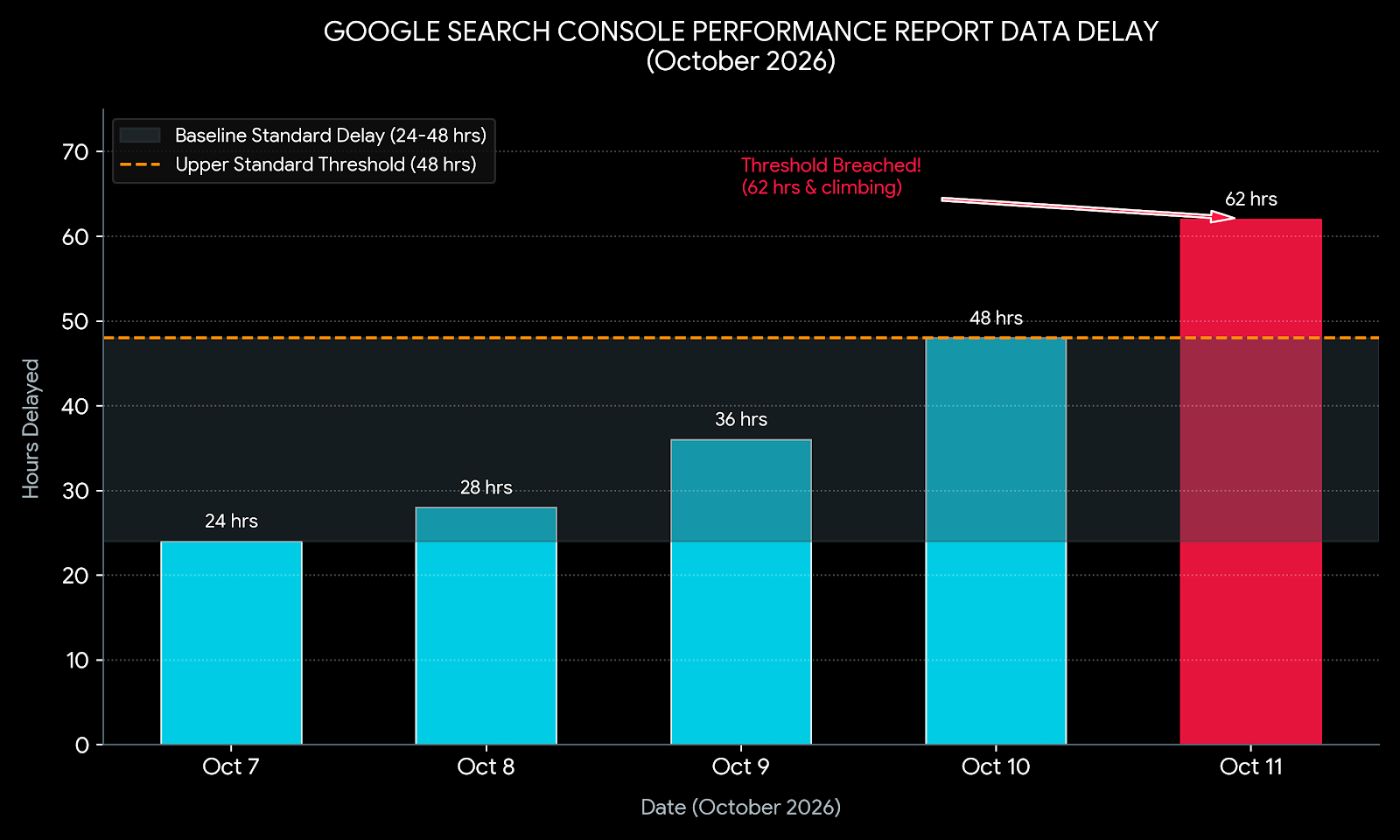
Google Search Console Performance Delayed
Why the Timing Couldn’t Be Worse
A frozen dashboard is frustrating on any given day, but the timing of this specific 60-plus hour delay has amplified the anxiety within the SEO community.
First, the SEO industry just emerged from a turbulent algorithmic period. The September 2026 Google Spam Update, which targeted manipulative linking practices and low-quality AI content, officially concluded its rollout on October 8. Webmasters rely heavily on the GSC Performance report in the days immediately following a confirmed algorithm update to assess whether their domain was penalized, rewarded, or unaffected. By freezing the data right as the dust was supposed to settle, Google has left site owners flying blind during a critical assessment window.
Secondly, there is widespread speculation that a massive Google Core Update is looming on the horizon. When data stops flowing just before or right after major updates, human nature often assumes the worst. Many webmasters misinterpret the flatline in their reporting graphs as a catastrophic drop in actual traffic.
A Pattern of Reporting Hiccups
It is vital to separate a reporting bug from a ranking penalty. If you are panicking about the missing data, it helps to look at Google’s recent history of dashboard outages.
Earlier this year, the SEO community endured an even more agonizing reporting failure. Starting on June 11, 2026, the Google Search Console Page Indexing report completely froze. For nearly three weeks, the report remained locked in time, showing data that was over 14 days old. It wasn’t until July 3 that Google engineers finally resolved the processing backlog, and the reports were backfilled with the missing information.
At the time, Google confirmed that the delay was purely a display issue and was entirely unrelated to the concurrent June 2026 Spam Update. The current 62-hour delay in the Performance report follows the exact same pattern. It is an internal pipeline processing issue on Google’s end. Your pages are still being crawled, they are still being indexed, and they are still ranking in the Search Engine Results Pages (SERPs). The only thing that is broken is the dashboard that shows you the numbers.
Diagnosing vs. Reacting: Why You Shouldn’t Panic
When faced with incomplete or delayed data, the worst thing an SEO or site owner can do is make sudden, reactive changes.
If you see a sudden “drop” to zero for your most recent days in GSC, remember that the report is simply waiting for data to populate. Resist the overwhelming urge to start altering your SEO strategy. Do not rewrite your title tags, do not change your canonical URLs, do not overhaul your internal linking structure, and absolutely do not resubmit your XML sitemaps in a desperate bid to force Google to “see” you again.
Making decisions based on stale, delayed, or incomplete information will almost certainly do more harm than good. If you attempt to “fix” a traffic drop that only exists because of a reporting lag, you might accidentally break a page that is actually performing perfectly well in the live search results.
Actionable Steps: How to Monitor SEO Health in the Dark
Just because Google Search Console is temporarily out of commission does not mean you have to stop working. A robust SEO operation is built on redundancy. As the SEO Sherpa team noted during the July indexing outage, the smartest move is to ensure that no single dashboard going dark leaves you completely guessing. Here is how you can continue monitoring your site’s health while GSC catches up.
1. Lean on Google Analytics 4 (GA4)
While GSC provides query-level data and impression metrics, Google Analytics 4 (GA4) measures actual user sessions on your website. GA4 operates on a completely different data processing pipeline than Search Console. Check your organic traffic acquisition reports in GA4. If your real-time and daily organic traffic numbers are holding steady compared to previous weeks, you can rest assured that your site has not suffered a ranking penalty, regardless of what the frozen GSC chart implies.
2. Utilize Third-Party Rank Trackers
Now is the perfect time to rely on your third-party rank tracking software. Tools like Ahrefs, Semrush, Moz, or Advanced Web Ranking scrape the live search results daily to determine where your target keywords are ranking. Because these tools operate independently of Google’s internal APIs, they are unaffected by the GSC reporting delay. If your primary keywords are still sitting on Page 1 in your rank tracker, your search visibility is secure.
3. Dive into Server Log Files
For technical SEOs, server log analysis is the ultimate source of truth. Your server logs record every single interaction a bot has with your website. By analyzing these logs, you can see exactly when and how frequently Googlebot is crawling your site. If Googlebot is still actively requesting your pages and returning 200 OK status codes, your technical foundation is solid.
4. Communicate with Clients and Stakeholders
If you manage SEO for clients or report to a C-suite executive, proactive communication is essential. Do not wait for them to log in, see the missing data, and panic. Send a brief update explaining that Google is currently experiencing a confirmed global reporting delay exceeding 60 hours. Frame it as a temporary data visibility issue rather than a performance crisis, and provide them with alternative metrics (like GA4 traffic or third-party keyword rankings) to prove that the ship is still sailing smoothly.
Conclusion
The current 62-hour delay in the Google Search Console Performance report is a frustrating inconvenience, particularly during a period of high algorithm volatility. However, it is crucial to remember that this is simply a broken gauge on the dashboard, not an engine failure.
Google’s engineering teams are undoubtedly working to clear the processing backlog, and history dictates that the missing data will eventually be backfilled once the pipeline is restored. Until then, keep your hands off the panic button, trust your diversified analytics tools, and focus on long-term, high-quality content creation. The data will return—make sure you haven’t broken your site while waiting for it.
* Conceptual illustration generated using AI