
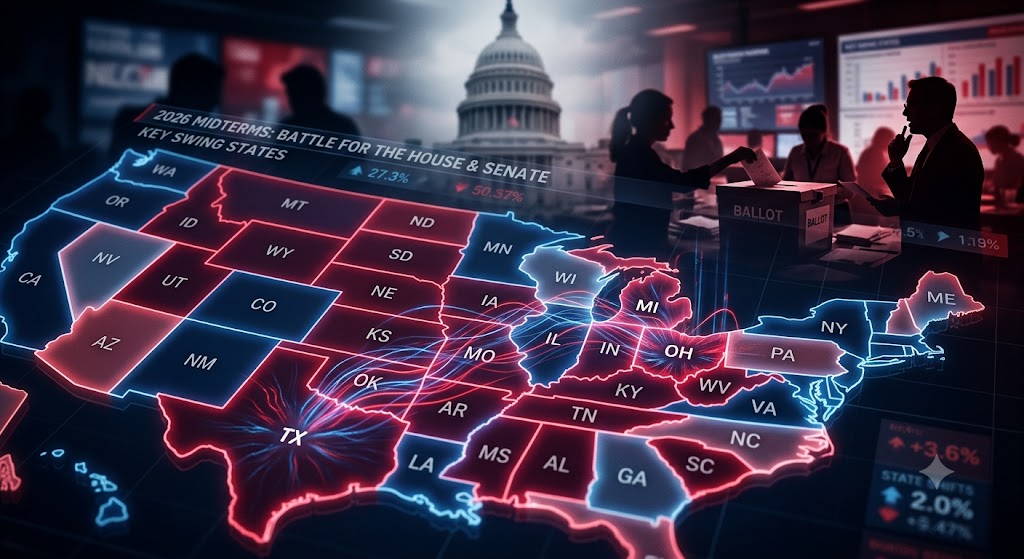
The 2026 midterm elections are shaping up to be the most consequential political event of Donald Trump’s second term in the White House. Scheduled for November 3, 2026, the midterms will serve as a stark national referendum on the administration’s policies, from sweeping economic tariffs to contentious judicial appointments. With Republicans currently holding a narrow 53-47 majority in the Senate and a razor-thin advantage in the House of Representatives, the balance of power in Washington hangs by a thread.
For Democrats, the midterms present a critical opportunity to capture control of Congress and install a formidable legislative blockade against the president’s agenda. If successful, a Democratic Senate would have the unilateral authority to block any new appointments to the Supreme Court or the presidential cabinet.
The fight for this control, however, is not a national one; it is a trench war fought across a shrinking map of hyper-competitive battlegrounds. According to leading election forecasters, including the Cook Political Report, the Senate battlefield is largely confined to just a handful of toss-up states. Here are the ten states that will ultimately decide control of Congress and dictate the legislative trajectory of Trump’s political future.
1. Ohio: The Midwest Ground Zero
Ohio has solidified its position as one of the most important Senate battlegrounds of the 2026 midterms. The state features a blockbuster special election to fill the final two years of the Senate term originally won by J.D. Vance in 2022 before his elevation to the vice presidency. Republican Jon Husted, the former lieutenant governor who was appointed to the seat, is defending it against a high-profile comeback bid by former Democratic Senator Sherrod Brown. Although Trump won Ohio by a commanding 11 percentage points in 2024, early polling and a mobilized Democratic base have rendered this race a toss-up. Holding the state is essential for Republicans to protect their Senate majority.
2. Texas: The Shifting Stronghold
For decades, Texas has been the impenetrable fortress of the Republican electoral map, but 2026 is testing those foundations. The state is hosting a fiercely competitive Senate race between Republican Attorney General Ken Paxton and Democratic state Representative James Talarico. Talarico’s populist messaging, heavily focused on billionaires and economic inequality, has resonated in the expanding Texas suburbs. Recent polling averages indicate a razor-thin margin—with Talarico polling at 47.6% against Paxton’s 44.7%—signaling that this long-standing GOP stronghold is officially in play.
3. Michigan: The Rust Belt Bellwether
Michigan remains a quintessential battleground. The retirement of Democratic Senator Gary Peters has triggered a volatile race for an open Senate seat. The contest features former Republican Congressman Mike Rogers squaring off against Abdul El-Sayed, a progressive former public health official endorsed by prominent figures like Kamala Harris and Bernie Sanders. With El-Sayed currently holding a slight lead in polling averages, Michigan will test whether a progressive platform—including strong support for a single-payer, Medicare for All style healthcare system—can win in a pivotal swing state.
4. Iowa: A Test of Democratic Fortunes
Iowa has trended heavily Republican in recent cycles, backing Donald Trump decisively and failing to elect a Democratic senator since 2008. However, the decision by GOP Senator Joni Ernst to forgo reelection has unexpectedly scrambled the board. The open seat has triggered a surprisingly tight race between Republican Representative Ashley Hinson and Democratic state Representative Josh Turek. Democrats see a rare pickup opportunity here, capitalizing on voter anxieties surrounding affordability issues and the localized economic impacts of Trump’s tariff policies.
5. Maine: The Moderate’s Defense
Maine presents one of the most complex battlegrounds for Republicans. Moderate GOP Senator Susan Collins is defending her seat against Democrat Troy Jackson in a state that Kamala Harris carried by nearly 7 points in the 2024 presidential election. Jackson secured the Democratic nomination after Graham Platner bowed out of the race earlier in the year. Collins has a proven track record of surviving difficult reelection fights by maintaining an independent brand, but Democrats view her seat as a prime target to erode the Republican majority.
6. Alaska: The Top-Four Wildcard
Alaska’s unique top-four primary system frequently produces unconventional electoral outcomes, and 2026 is no exception. Incumbent Republican Senator Dan Sullivan is facing a formidable challenge from former Democratic Representative Mary Peltola, who is utilizing the state’s ranked-choice dynamics to build a broad coalition. While Alaska has not elected a Democrat to the U.S. Senate in nearly two decades, Peltola’s distinct brand of rural politics and the state’s independent-minded electorate make this a legitimate pickup opportunity for the Democratic party, with the Cook Political Report listing it as a toss-up.
7. Georgia: The Sun Belt Defense
Georgia has been at the epicenter of America’s political realignment since 2020. In 2026, Democrats are on defense, attempting to protect a crucial Senate seat in a state that Donald Trump successfully flipped back to his column in the 2024 presidential election. Maintaining control of this Sun Belt battleground is an absolute necessity for Democrats if they hope to forge a path to a 51-seat Senate majority. Fortunately for the party, early momentum has shifted the state’s rating toward a likely win for the Democrats.
8. Florida: The Special Election
Similar to Ohio, Florida is hosting a critical special election in 2026 to fill the final two years of Marco Rubio’s Senate term following his departure from the chamber in 2022. While Florida has marched steadily to the right over the past three election cycles, a highly motivated Democratic base—fueled by downstream House races and local ballot initiatives—hopes to catch the GOP off guard and challenge the prevailing narrative of Republican dominance in the Sunshine State.
9. New Hampshire: The New England Swing
Always a volatile battleground, New Hampshire features another Senate seat listed as a pure toss-up by the Cook Political Report. Its small, highly engaged electorate frequently swings between the two parties, making it a critical piece of the puzzle for Senate control. The race here will heavily test the coattails of the Trump administration in the socially moderate, fiscally conservative New England corridor.
10. Pennsylvania: The House Crucible
While Pennsylvania lacks a marquee Senate race this cycle, it holds outsized importance in the battle for the House of Representatives. With all 435 House seats up for election and the GOP defending a fragile majority, the road to the Speaker’s gavel runs straight through the Philadelphia suburbs. Races like the one in Pennsylvania’s 1st Congressional District will serve as a bellwether for the national political environment. Overshadowing these House elections is an unprecedented level of politically motivated redistricting, meaning that control of the lower chamber may ultimately be decided by just a handful of intensely competitive districts.
As the campaigns escalate, these ten states will act as the ultimate jury on the current administration. They will not only decide who holds the legislative gavels but also define the long-term political viability of Donald Trump’s governing agenda.
* Conceptual illustration generated using AI