
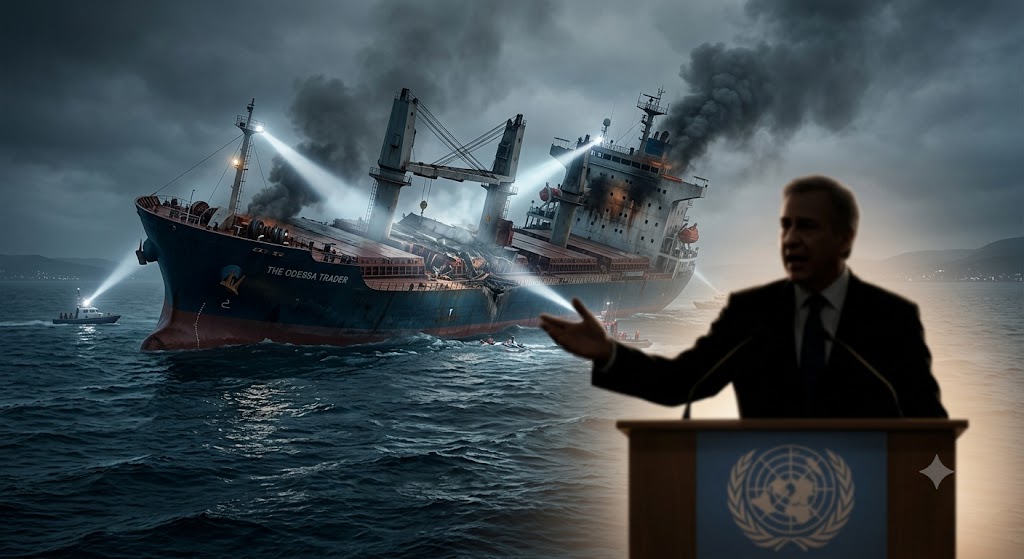
The geopolitical fallout from the ongoing Russia-Ukraine war continues to spill beyond the immediate theater of combat, once again threatening global trade and the lives of non-combatant seafarers. This week, the conflict directly impacted Indian citizens when a commercial cargo vessel, the MV Royad Mammadov, was struck by Russian drones in the Black Sea. The attack resulted in the deaths of at least two foreign nationals, including the ship’s captain, and left one Indian sailor hospitalized with injuries.
The incident has drawn a remarkably sharp and unequivocal response from New Delhi. Speaking before the United Nations General Assembly, India’s External Affairs Minister S. Jaishankar issued a forceful condemnation of the escalating violence targeting civilian maritime operations, marking a notable hardening of India’s rhetoric regarding the collateral damage generated by the war.
The Strike on the MV Royad Mammadov
The details of the attack underscore the extreme peril facing commercial shipping in the contested waters of the Black Sea. According to maritime tracking data and statements from regional authorities, the MV Royad Mammadov—a Turkish-owned civilian cargo vessel—had recently departed from the crucial Ukrainian port of Izmail on the Danube River and was heavily laden with a shipment of corn destined for Ravenna, Italy.
While navigating in what Ukrainian and Romanian officials described as neutral waters, just outside Romania’s territorial boundaries, the vessel was targeted. Ukrainian President Volodymyr Zelenskyy confirmed that two Russian combat drones struck the ship, triggering a massive onboard fire that ultimately caused the MV Royad Mammadov to sink. The strike occurred in close proximity to an offshore oil platform operated by the Romanian energy company OMV Petrom, highlighting how precariously close the violence came to NATO infrastructure.
Following the strike, Romanian naval and interior ministry authorities launched a rapid search and rescue operation, successfully pulling 11 crew members from the fiery wreckage. Tragically, the ship’s captain was killed in the blast, and the fate of another crew member remained uncertain in the immediate aftermath.
The Indian Crew and Diplomatic Mobilization
Among the crew members navigating the ill-fated vessel were three Indian nationals. As news of the attack broke, the Indian Embassy in Romania rapidly mobilized to locate and assist its citizens.
Initial reports generated significant concern, but the embassy later issued a relieving update: all three Indian sailors had survived the ordeal and were safely accounted for. However, one of the Indian nationals sustained injuries during the drone strike and was transported to the Constanța County Hospital in Romania for emergency medical treatment.
Indian Ambassador to Romania, Manoj Mohapatra, established direct contact with the rescued crew members and the hospital’s chief physician to ensure they were receiving optimal care.
“All three Indian nationals are safe. We have spoken to them. One of them has been injured and is receiving medical attention,” the Indian Embassy stated on the social media platform X. “We are in close touch with the hospital authorities. We are extending all possible support for the welfare and wellbeing of the Indian crew members”.
“Completely Unacceptable”: Jaishankar’s UN Address
While the Indian sailors survived, the attack on a civilian vessel carrying agricultural goods triggered a stern diplomatic response from New Delhi. Historically, India has maintained a delicate, neutral diplomatic tightrope regarding the Russia-Ukraine conflict, repeatedly calling for a cessation of hostilities and a return to dialogue without explicitly condemning Moscow’s broader military campaign.
However, an attack directly imperiling Indian lives and threatening the fundamental tenets of freedom of navigation crossed a distinct diplomatic red line.
Addressing the United Nations General Assembly in New York shortly after the incident, External Affairs Minister S. Jaishankar did not mince words. He linked the Black Sea attack to a broader, disturbing global trend of maritime violence stretching from the Red Sea to Eastern Europe.
“New challenges in the maritime domain have added to longstanding ones on land. There have been attacks on commercial shipping and seafarers in the Gulf and from the Red Sea to the Black Sea,” Jaishankar asserted to the international body. “Indian seafarers have lost their lives, as have others from other nations. This is completely unacceptable”.
The External Affairs Minister utilized the platform to reiterate India’s foundational stance that scrupulously observing international law and protecting civilian crews are non-negotiable imperatives for global stability. He further emphasized that diplomacy and dialogue remain the only viable paths forward to resolve the gridlocked conflict between Russia and Ukraine.
A Chokepoint Under Fire
The sinking of the MV Royad Mammadov is not an isolated incident; it represents a dangerous escalation in the militarization of critical maritime chokepoints. Following the collapse of the UN-brokered Black Sea Grain Initiative, Ukraine has been forced to rely heavily on its Danube River ports, like Izmail, to export its vital agricultural yields to the global market.
To counter this, Russian forces have increasingly targeted these alternative logistical routes, utilizing drone swarms and missiles to strike port infrastructure and, as evidenced this week, the commercial vessels brave enough to navigate the corridor. The presence of drifting sea mines and the frequent violation of Romanian airspace by Russian drones further compound the extreme risks faced by international shipping conglomerates operating in the region.
For India, a nation that provides a massive percentage of the global merchant navy workforce, the stakes are deeply personal. When commercial vessels are targeted—whether by Houthi rebels in the Red Sea or Russian drones in the Black Sea—it is frequently Indian citizens who find themselves in the crosshairs.
The forceful “unacceptable” declaration from New Delhi serves as a clear signal: while India remains committed to diplomatic neutrality regarding the territorial war in Eastern Europe, it will not remain silent when its citizens and the fundamental rules of global maritime commerce are treated as acceptable collateral damage.
* Conceptual illustration generated using AI