
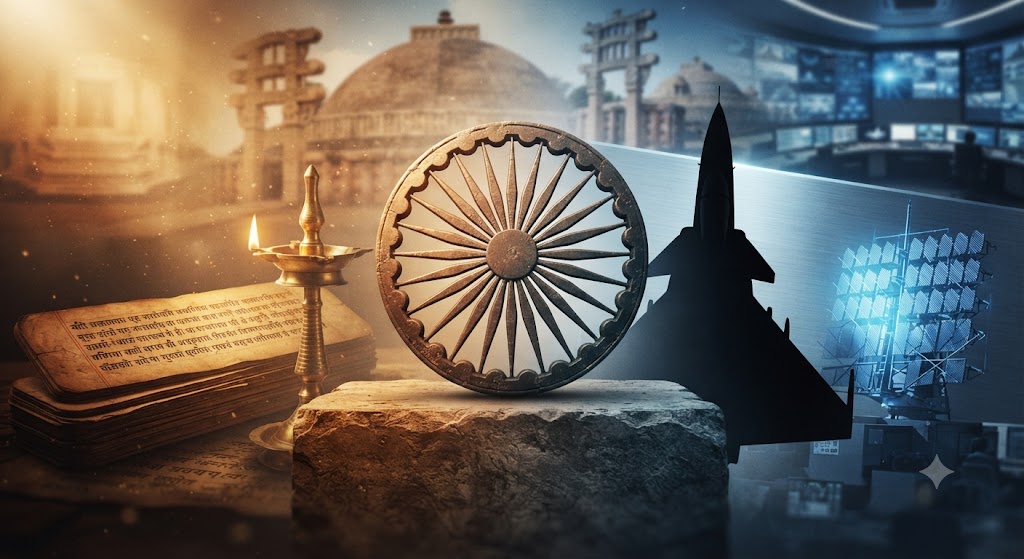
Throughout civilizational history, few nations have generated as much debate regarding their core strategic ethos as India. Observers, historians, and political commentators frequently characterize Indian society through the lens of inherent “softness,” high moral idealism, and an extraordinary capacity for tolerance. This perception is often contrasted with a historical narrative marked by repeated foreign incursions, centuries of colonial subjugation, and the destruction of indigenous institutions.
To understand whether this civilizational stance stems from philosophical idealism, structural fragmentation, or strategic restraint, one must look beyond simplistic labels. The historical trajectory of the Indian subcontinent reveals a complex interplay between deeply ingrained ethical frameworks, the rules of traditional engagement, and a gradual, pragmatic evolution toward modern strategic realism.
The Philosophical Bedrock: Ahimsa, Pluralism, and Ethical Warfare
The foundational ethos of Indian civilization was built on philosophical concepts that stood in stark contrast to the expansionist paradigms of many contemporary empires. Central to this worldview were concepts like Ahimsa (non-injury), Vasudhaiva Kutumbakam (the world is one family), and Atithi Devo Bhava (the guest is equivalent to God).
Unlike Western or Near Eastern antiquity, where military conquest often aimed at the total destruction or cultural assimilation of defeated populations, traditional Indian statecraft—as articulated in texts like the Dharmashastras and the Mahabharata—emphasized codes of ethical warfare known as Dharma Yuddha.
Under Dharma Yuddha:
- Non-combatants, agricultural lands, and places of worship were strictly off-limits during military engagements.
- Warfare was largely confined to designated warrior classes (Kshatriyas), shielding the broader agrarian and commercial society from total devastation.
- Defeated rulers were frequently reinstated as vassals rather than executed, provided they accepted sovereign hegemony.
This ethical framework fostered a society that prioritized internal cultural synthesis, spiritual inquiry, and economic prosperity over external territorial expansion. Consequently, Indian empires rarely projected military power beyond the natural geographical boundaries of the subcontinent, choosing instead to export religion, art, philosophy, and trade—most notably across Southeast Asia via the Chola Empire and maritime trade networks.
Structural Vulnerabilities: Fragmentation and the Rules of Engagement
While ethical codes of conduct created a high-trust internal civilization, they simultaneously generated severe strategic vulnerabilities when faced with external invaders who operated under vastly different doctrines of total war.
Historians point to several factors that contributed to historical vulnerabilities across the subcontinent:
1. Political Fragmentation and Regional Rivalries
The Indian subcontinent was rarely unified under a single centralized authority. Instead, it comprised a mosaic of regional kingdoms, principalities, and republics. Internal rivalries frequently led regional rulers to form tactical alliances with external forces to defeat domestic rivals, inadvertently opening the doors to long-term foreign domination—a pattern observed during the early invasions through the Khyber Pass and later exploited by European colonial trading companies.
2. The Asymmetry of Strategic Doctrines
When foreign forces entered the subcontinent, they brought doctrines where surprise attacks, environmental destruction, and total societal mobilization were standard military tactics. The adherence of local rulers to traditional codes of engagement often placed them at a tactical disadvantage. The insistence on chivalry in defeat—such as granting clemency to defeated adversaries—frequently allowed invader forces to regroup and eventually dismantle local kingdoms.
3. Institutional Inertia in Military Technology
Despite possessing vast wealth and advanced metallurgical capabilities, historical Indian states occasionally suffered from military conservatism. Over-reliance on traditional war elephants, rigid infantry formations, and static fortification techniques left regional armies vulnerable to fast-moving cavalry archers, early artillery innovations, and naval blockades introduced by foreign powers.
The Counter-Narrative: Civilizational Resistance and Continuity
The narrative that Indian history is purely a record of passive submission fails to capture the immense civilizational resilience and active armed resistance that defined different eras. While external forces established powerful empires at various junctures, indigenous resistance movements continuously emerged to challenge and reshape the political landscape.
- Ancient Resurgence: The Maurya Empire under Chandragupta and Chanakya successfully repelled Seleucid expansion, establishing an integrated administrative state. Centuries later, the Gupta Empire and Emperor Harshavardhana successfully repelled invading forces to preserve regional stability.
- Medieval and Early Modern Resistance: The Vijayanagara Empire in Southern India stood for centuries as a bulwark of indigenous art, architecture, and statecraft. In the North and West, the Rajputs, the Ahoms of Assam (who famously defeated Mughal expansion in the Battle of Saraighat), the Sikhs under Maharaja Ranjit Singh, and the Marathas under Chhatrapati Shivaji Maharaj demonstrated sophisticated guerilla tactics, naval engineering, and statebuilding.
- Cultural Assimilation vs. Eradication: Perhaps the greatest indicator of civilizational strength was the ability to absorb, transform, and outlast political occupiers. While physical infrastructure and wealth were repeatedly targeted, the core philosophical, linguistic, and spiritual traditions of India survived, adapting to circumstances while maintaining an unbroken continuity over thousands of years.
The Colonial Era and the Institutionalization of “Softness”
The establishment of British colonial rule in the 18th and 19th centuries fundamentally altered the self-perception and political structures of the subcontinent. The colonial administration employed systematic strategies to disarm the general population, dismantle traditional martial institutions, and promote narratives that framed indigenous populations as inherently non-martial or passive, justifying foreign governance as a stabilizing necessity.
In the 20th century, the Indian freedom struggle under Mahatma Gandhi weaponized the traditional concept of Ahimsa into a powerful tool of political mass mobilization. Satyagraha (non-violent resistance) proved remarkably effective against British colonial rule, but it also reinforced the international perception of India as a nation whose primary strength lay in moral suasion rather than hard military power.
Post-independence, this ideal was codified in India’s early foreign policy. Principles like Panchsheel (Five Principles of Peaceful Coexistence) and the Non-Aligned Movement (NAM) reflected a belief that moral authority and international law could insulate a newly sovereign nation from Cold War power dynamics. However, military setbacks in the mid-20th century exposed the limits of pure idealism in a realist global order.
Modern Realism: The Evolution of Strategic Autonomy
In the 21st century, India has undergone a profound shift in its strategic doctrine. The modern Indian state has recognized that historical tolerance and ethical restraint must be backed by credible deterrence and hard power.
Today, India’s strategic posture is defined by:
- Credible Nuclear Deterrence: The transition to a declared nuclear weapons state with a robust “No First Use” policy balances ethical restraint with absolute strategic deterrence.
- Military Modernization: Continuous investment in modern defense infrastructure, naval carrier strike groups, indigenous aerospace technology, and border infrastructure.
- Strategic Autonomy and Multi-Alignment: Shifting from passive non-alignment to active multi-alignment, building strong defense partnerships across global power centers while preserving independent decision-making.
- Economic Realism: Leveraging a multi-trillion-dollar economy, digital public infrastructure, and manufacturing capacity to secure geopolitical leverage.
Conclusion
The perception of Indians as “soft-hearted” is neither an absolute truth nor an accidental myth. It is the reflection of a civilizational choice that historically prioritized moral order, cultural synthesis, and social harmony over ruthless expansionism.
However, history has demonstrated that moral authority without hard power leaves a society vulnerable to external shocks. Modern India is actively rewriting this equation—preserving its foundational commitment to peace, pluralism, and global cooperation, while developing the strategic, economic, and military capabilities required to protect its sovereignty in an increasingly complex world.
* Conceptual illustration generated using AI