

For over two decades, the global workforce has been sold a compelling digital promise: create a profile, upload your resume, build a professional network, and the democratic algorithms of LinkedIn will connect you to your next career breakthrough. Today, with more than 1.3 billion registered members across 200 countries and an annual revenue run rate exceeding $18 billion, LinkedIn stands as the undisputed titan of professional networking.
Yet, behind the polished corporate interface, glowing badges, and celebratory “I’m thrilled to announce” posts lies a deeply frustrating reality for millions of job seekers in 2026. Despite unprecedented technological advancements, AI-driven matching engines, and algorithmic screening, landing a job on LinkedIn feels more difficult, impersonal, and opaque than ever before.
The fundamental reason for this failure is not a glitch in the code; it is a feature of the business model. LinkedIn is not built primarily as a public service to land job seekers their dream roles. It is a multi-sided monetization engine designed to extract, aggregate, and commercialize the zero-party data of over a billion human beings. In this economic ecosystem, the job seeker is not the customer; the job seeker is the raw material.
Here is an investigative analysis of how LinkedIn’s asymmetric data model exploits user data, monetizes career anxiety, and creates an algorithmic black hole for job seekers worldwide.
The Illusion of the “Easy Apply” Black Hole
To understand why LinkedIn fails to provide a “perfect landing” for job seekers, one must examine the reality of the modern job application pipeline. The platform’s ubiquitous “Easy Apply” button—designed to make application submissions frictionless—has unintentionally created a severe structural collapse in recruitment efficiency.
By reducing the application process to a single click, LinkedIn incentivizes candidates to fire off dozens, sometimes hundreds, of generic applications. This has triggered an unprecedented flood of resumes into corporate databases. A single job posting for a remote or hybrid role in 2026 routinely attracts thousands of applicants within hours of going live.
To cope with this overwhelming volume, corporations deploy aggressive Applicant Tracking Systems (ATS) and AI screening bots to instantly filter out up to 90% of incoming applications based on arbitrary keyword density or structural formatting. The result is a demoralizing “black hole” where qualified human beings submit their life’s work into an algorithmic void, never receiving a response, feedback, or a human review.
Furthermore, the platform is plagued by the proliferation of “ghost jobs”—listings posted by companies with no immediate intention to hire, used instead to project corporate growth to investors, collect talent pipelines for future quarters, or benchmark internal salaries. LinkedIn’s algorithms treat these ghost listings with the same prominence as legitimate openings, leading millions of desperate job seekers to waste time, energy, and emotional bandwidth applying for positions that do not exist in reality.
Digital Sharecropping: Free Data Creation for an $18 Billion Empire
The core ethical conflict of LinkedIn lies in the mechanics of its data extraction. In the digital economy, sociologists and tech critics refer to LinkedIn’s model as a form of “digital sharecropping.”
In traditional Software-as-a-Service (SaaS) or enterprise data platforms, maintaining an accurate, updated database of hundreds of millions of people requires billions of dollars in operational research and data acquisition. LinkedIn, however, gets its 1.3 billion members to build, update, and verify its global database entirely for free.
Every time a user updates their job title, adds a new skill certification, lists a former colleague, or writes an article, they are donating high-value, zero-party data to Microsoft’s servers. The user does this voluntarily under the unspoken contract that doing so will yield professional returns—specifically, employment opportunities.
However, the monetization of this data is deeply asymmetric:
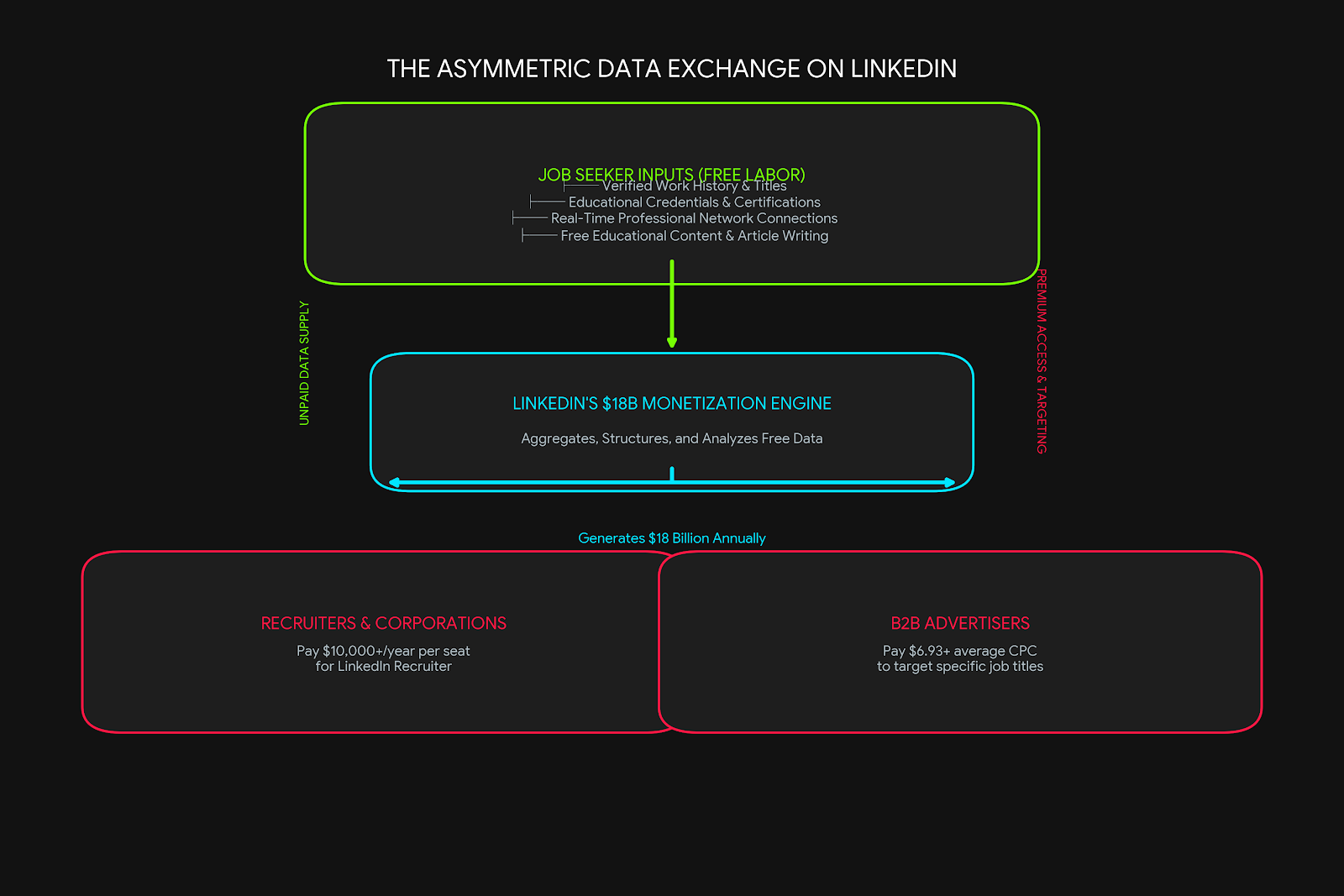
Asymmetric Data Exchange Chart
LinkedIn takes this freely created database and commercializes it across its high-margin enterprise business units:
- Talent Solutions (~$7.8 Billion): Corporate recruiters and headhunters pay upwards of $10,000 per seat annually for LinkedIn Recruiter licenses, giving them unrestricted power to mine the very profiles members created for free.
- Marketing Solutions (~$6.2 Billion): B2B advertisers pay exorbitant Cost-Per-Click (CPC) rates—averaging $6.93 per click—to target members based on the exact job titles, company sizes, and seniority levels those members self-reported.
- AI Training Infrastructure: In the era of Generative AI, Microsoft utilizes the vast corpus of user-generated posts, articles, and career histories on LinkedIn to train its proprietary AI models and Copilot features, creating immense enterprise value without offering data dividends or royalties to the content creators.
The user performs the labor of maintaining the global economic graph, while LinkedIn harvests the billions in rent.
Monetizing Anxiety: The Premium Subscription Trap
When a job seeker realizes that their free profile is sinking in a sea of 1.3 billion members, LinkedIn offers a solution: pay them money.
Through LinkedIn Premium Career (which costs approximately $39.99 per month), the platform monetizes the anxiety and vulnerability of the unemployed and underemployed. The subscription promises to grant job seekers “competitive insights,” show them who viewed their profile, highlight their application above non-paying members, and grant a handful of “InMail” credits to message recruiters directly.
This creates a predatory paradox. A job seeker who has lost their income is nudged to pay a monthly tax to the very platform that sits between them and potential employment.
Yet, the efficacy of Premium is fiercely debated. An InMail sent to an overworked corporate recruiter who is already drowning in thousands of automated applications rarely guarantees a response. By charging job seekers to see basic data—such as who visited their profile or where they rank among applicants—LinkedIn effectively paywalls transparency, forcing the most vulnerable users to subsidize its platform revenue simply to gain basic visibility.
The Death of Authentic Connection: AI Slop and Engagement Farming
Beyond the job application pipeline, LinkedIn’s feed algorithm has fundamentally degraded the quality of professional networking.
To maximize ad impressions for its $6.2 billion Marketing Solutions business, LinkedIn’s algorithm rewards content that generates high engagement—measured in likes, comments, and shares. This incentive structure has transformed a once-useful professional utility into a performative theater of “engagement farming.”
Users are subjected to endless feeds of manufactured vulnerability, inspirational platitudes, exaggerated career achievements, and, increasingly in 2026, low-quality “AI slop.” Generative AI tools allow users to churn out sterile, generic thought-leadership posts and automated comments in seconds.
Real, organic networking—the simple human act of one professional helping another find a job out of goodwill—has been crowded out by algorithmic noise. When every direct message is a automated sales pitch from a B2B vendor, and every post is an AI-generated essay designed to game the feed, genuine professional trust collapses. Job seekers are left navigating a digital environment where authentic human touchpoints are nearly impossible to find.
The Power Imbalance: Recruiters vs. Applicants
The fundamental reason LinkedIn cannot deliver a “perfect landing” for job seekers is that its platform architecture heavily favors the buyer (the recruiter) over the seller (the candidate).
Because Talent Solutions provides the majority of LinkedIn’s revenue, the platform’s features are optimized to suit recruiter convenience rather than candidate dignity:
- One-Way Transparency: Recruiters using enterprise tools can view candidate profiles, track when candidates open their messages, and filter candidates by age, graduation year, or career gaps. Candidates, on the other hand, are given almost zero visibility into the hiring status of a role, whether a job has been filled internally, or why their application was rejected.
- Ghosting by Design: LinkedIn provides no structural mechanisms or algorithmic penalties to hold recruiters accountable for “ghosting” candidates after multiple rounds of interviews. The platform allows companies to harvest thousands of resumes without ever sending a automated status update to applicants.
- Asymmetric Communication: A recruiter can mass-message hundreds of candidates simultaneously using automated InMail templates, but a job seeker is restricted to a handful of monthly credits unless they pay high subscription fees.
This power imbalance ensures that job seekers remain in a subordinate position, perpetually performing digital labor to keep their profiles attractive while receiving minimal institutional protection or operational transparency in return.
Conclusion: Reclaiming the Power of Human-Centric Hiring
LinkedIn’s $18 billion financial success is a masterclass in enterprise monetization, but its failure to serve job seekers is a tragic indictment of modern platform capitalism. By treating user profiles as free data fodder for recruiters and advertisers, paywalling visibility behind expensive monthly subscriptions, and allowing its ecosystem to be overrun by algorithmic gatekeeping and AI noise, LinkedIn has turned job hunting into an exhausting, dehumanizing gauntlet.
The solution to this crisis requires a fundamental shift in how we approach professional networking. Job seekers are increasingly recognizing that the path to a “perfect landing” lies not in firing off hundreds of automated applications into LinkedIn’s algorithmic void, but in bypassing the platform’s corporate machinery altogether.
True career advancement in 2026 is returning to its roots: direct human-to-human relationships, localized networking, offline industry gatherings, decentralized talent registries, and direct outreach to leaders based on genuine value rather than platform metrics. Until LinkedIn restructures its business model to treat its 1.3 billion users as valued partners rather than extractable data points, it will remain what it is today: a brilliant financial tool for Microsoft, and a profound disappointment for the global job seeker.
* Conceptual illustration generated using AI