

In the modern digital economy, consumer social media networks like Meta, TikTok, and X operate on a relatively simple business model: they capture human attention through entertaining or sensational content and monetize that attention via algorithmic ad impressions. Their revenue is fundamentally tied to consumer screen time.
LinkedIn, however, operates on a completely different economic wavelength.
Rather than monetizing casual consumer attention, LinkedIn monetizes high-intent professional data and economic transactions. It does not care if a user spends three hours scrolling through a feed; it cares whether a corporate recruiter finds a senior software engineer, whether a B2B sales representative closes a contract, or whether a enterprise marketer reaches decision-makers with buying power.
As of 2026, under the stewardship of parent company Microsoft and newly appointed CEO Daniel Shapero, LinkedIn operates at an annual revenue run rate exceeding $18 billion. With over 1.3 billion registered members across 200 countries, LinkedIn has built one of the most durable, highly defensive multi-sided platform business models in tech history.
Here is an in-depth analysis of how LinkedIn transformed a basic digital resume directory into an $18 billion enterprise powerhouse, the trajectory of its data growth since 2010, and why its economic moat remains virtually impenetrable.
The Core Flywheel: The Multi-Sided Data Engine
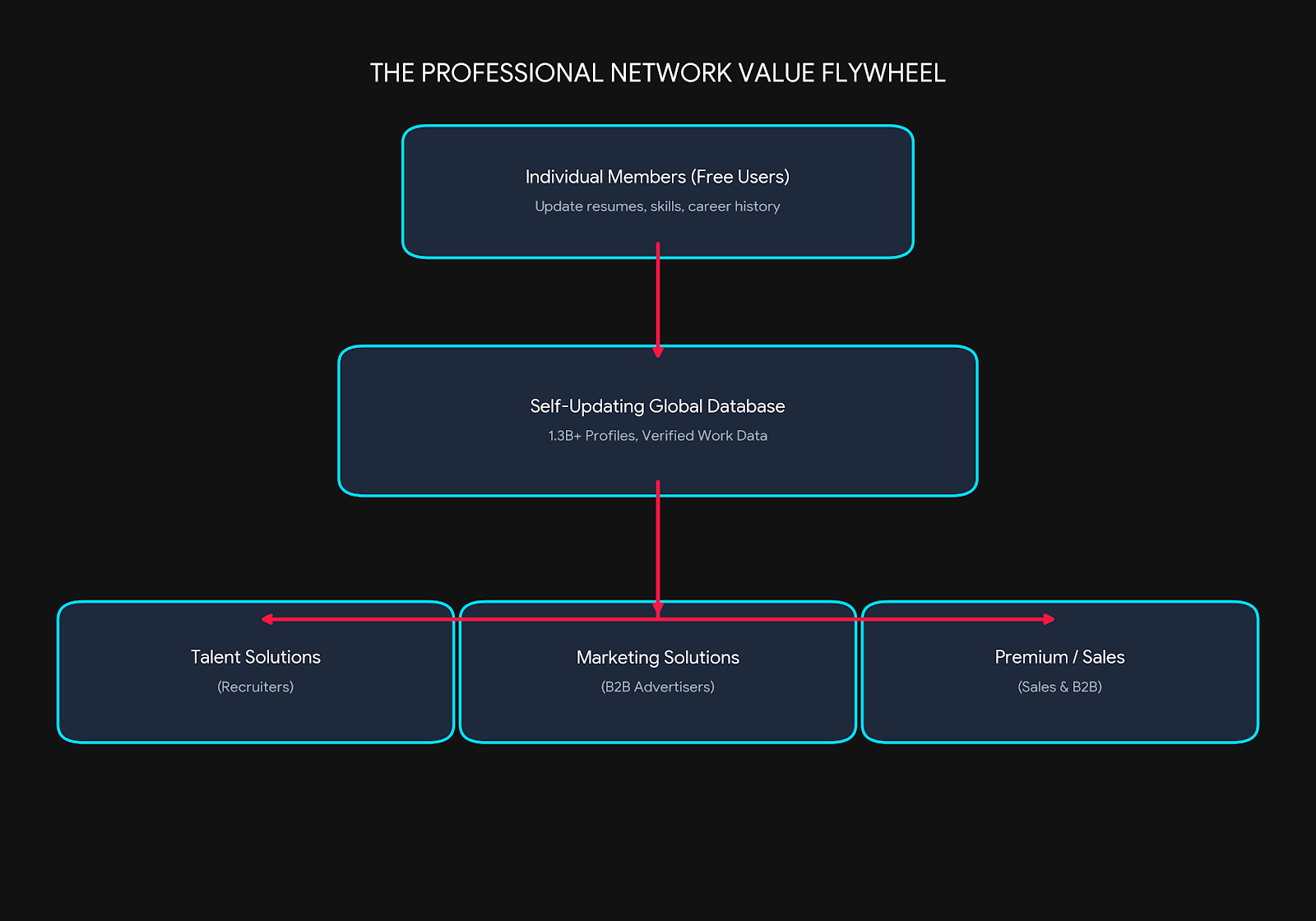
At its heart, LinkedIn runs a classic multi-sided freemium platform. What sets LinkedIn apart from almost every other platform on the internet is that its primary data creators—its users—willingly provide, update, and verify their personal data for free.
In traditional SaaS or data platforms, keeping database records accurate and up to date requires immense capital expenditure. On LinkedIn, members update their own profiles voluntarily because an accurate profile yields real-world economic returns: career advancement, headhunter inquiries, consulting gigs, and industry authority.
Professional Network Value Flywheel Chart
This self-updating data infrastructure forms the foundational layer for LinkedIn’s four distinct monetization engines. By keeping basic networking, profile creation, and job browsing completely free, LinkedIn eliminates friction for user growth. The free tier acts as a massive data-collection net, which is then commercialized through specialized enterprise tools.
Trajectory of Growth: From Pre-IPO to an $18 Billion SaaS Giant (2010–2026)
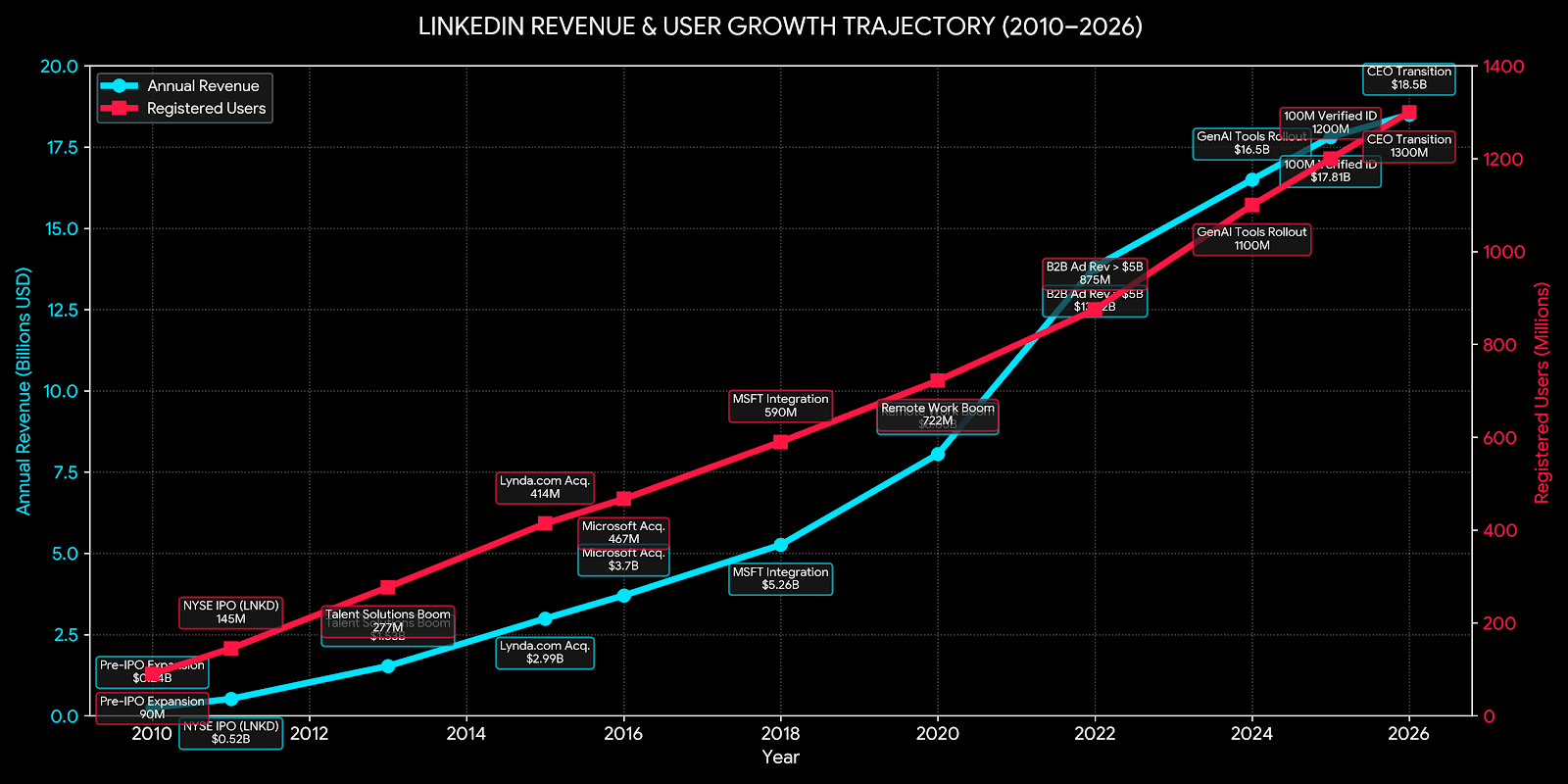
To appreciate LinkedIn’s current economic footprint, one must trace its financial and membership trajectory over the past decade and a half. Following its founding in 2002 and initial profitability in 2006, the platform experienced exponential compounding, culminating in its 2011 IPO and its landmark $26.2 billion acquisition by Microsoft in December 2016.
Below is the trajectory of LinkedIn’s annual revenue and registered global user base from 2010 to 2026:
LinkedIn Revenue and User Growth Trajectory Chart 2010 – 2026
Key Inflection Points in the Data Trajectory:
- The 2011 IPO Phase: In 2010, LinkedIn generated less than $250 million in revenue. Its successful IPO in 2011 validated that a professional social network could generate enterprise-grade Software-as-a-Service (SaaS) revenues rather than relying solely on display ads.
- The 2016 Microsoft Acquisition: Microsoft purchased LinkedIn for $26.2 billion ($196/share) in cash. At the time, critics questioned the valuation multiple. Today, with LinkedIn generating over $18 billion annually and holding an estimated implied standalone valuation between $120 billion and $150 billion, it stands as one of the most successful tech acquisitions in history.
- The AI and Verification Shift (2024–2026): Over the last two years, LinkedIn introduced identity verification partnerships (reaching over 100 million verified members) and deeply embedded OpenAI technology into profile writing, recruiter search prompts, and B2B ad targeting.
Unpacking the Four Revenue Pillars
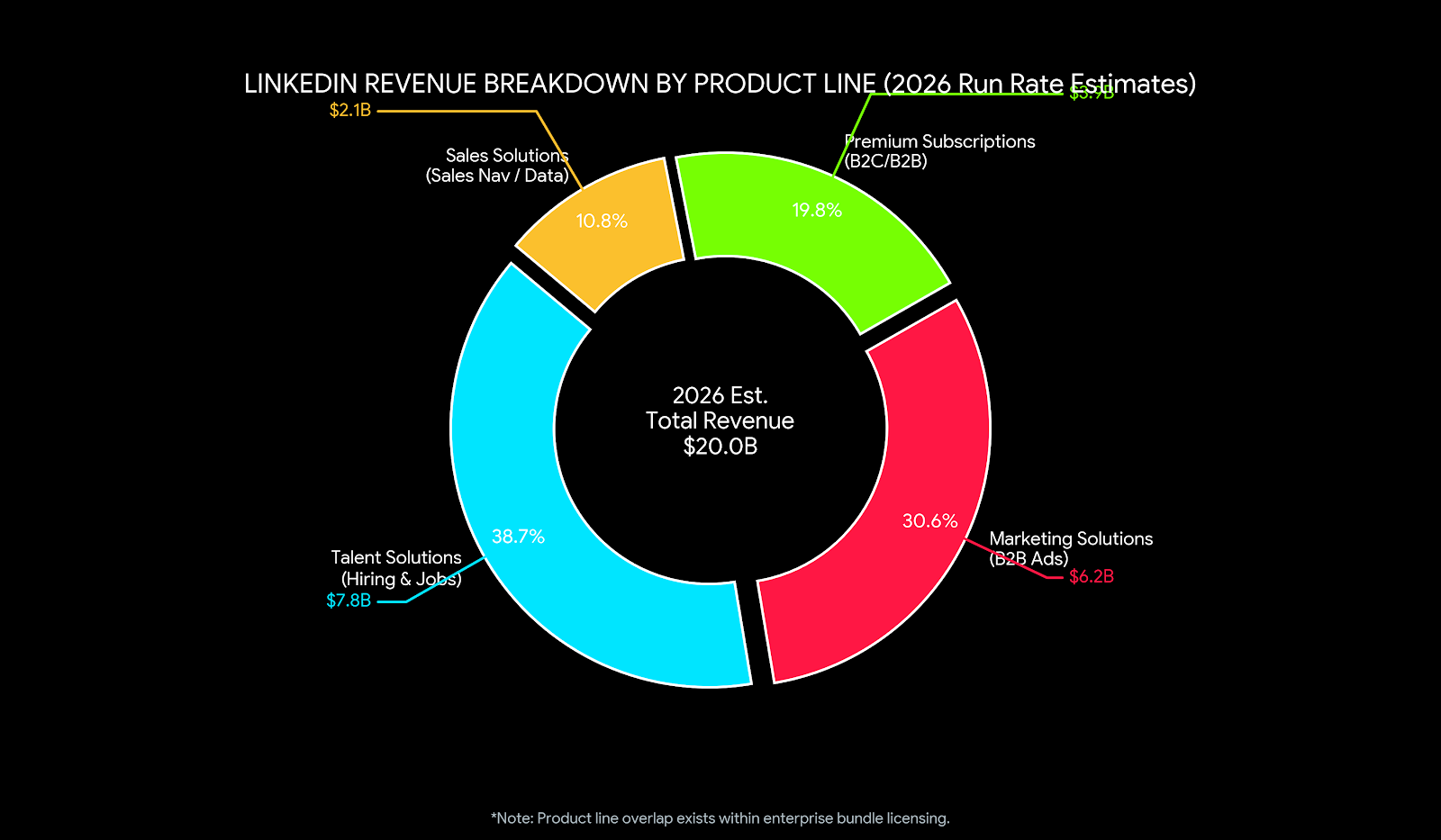
LinkedIn does not rely on a single monetization channel. Instead, it operates four high-margin business units built on top of its member database.
LinkedIn Revenue Breakdown Donut Chart
1. Talent Solutions (The Hiring Engine – ~43% of Revenue)
Talent Solutions is LinkedIn’s largest revenue generator, producing approximately $7.8 billion annually. It turns LinkedIn into an indispensable operational platform for HR departments, corporate recruiters, and staffing agencies globally.
- LinkedIn Recruiter: Enterprise accounts pay upwards of $10,000 per seat annually for LinkedIn Recruiter. It grants headhunters unrestricted access to the entire 1.3 billion member database, advanced search filters (e.g., candidates open to work, specific skill combinations, years of experience), and direct messaging via InMail.
- Paid Job Postings: Companies pay to promote job openings. LinkedIn’s recommendation algorithms match these listings against member profiles, skills, and past behaviors, serving targeted career opportunities directly into user feeds.
- Employer Branding & Talent Insights: Enterprise products like LinkedIn Career Pages and Talent Insights allow corporations to showcase their culture and analyze global workforce trends (e.g., competitor hiring patterns, attrition rates, and talent availability).
2. Marketing Solutions (The B2B Advertising Goldmine – ~34% of Revenue)
While Meta and Google dominate B2C advertising, LinkedIn holds a near-monopoly on high-value B2B digital advertising, generating roughly $6.2 billion annually.
- The Power of Zero-Party Professional Data: On Facebook or Instagram, advertisers target users based on inferred interests or online browsing activity. On LinkedIn, advertisers target users based on zero-party, self-reported facts: exact job titles, company size, industry sector, decision-making seniority, and specific software proficiencies.
- High Cost-Per-Click (CPC) Justification: The average Cost-Per-Click on LinkedIn sits at roughly $6.93 USD (€5.98). While this is significantly higher than Meta or Google Search ads, B2B marketers gladly pay the premium. Reaching a Chief Information Officer (CIO) with a $500,000 enterprise software budget yields an exceptional Return on Ad Spend (ROAS)—with 2026 industry benchmark reports indicating a 121% average ROAS across B2B campaigns.
- Format Diversification: In 2026, sponsored video ads, thought-leadership creator ads, and frictionless Lead Gen Forms (which pre-fill user data without leaving the platform) represent the fastest-growing ad formats.
3. Premium Subscriptions (~22% of Revenue)
Generating roughly $3.9 billion annually, LinkedIn Premium represents a massive, high-margin recurring SaaS engine. In Q2 2025, LinkedIn Premium officially surpassed a $2 billion annual run rate on its own, proving that individual users are willing to pay directly for professional leverage.
- Premium Career: Targeted at job seekers ($39.99/month), unlocking profile views, competitive applicant insights, AI resume feedback, and direct recruiter InMails.
- Premium Business: Designed for freelancers, consultants, and business leaders seeking unlimited network searching and company growth analytics.
- LinkedIn Learning: Integrated into subscription tiers following the $1.5 billion acquisition of Lynda.com, providing over 20,000 video courses for professional upskilling and corporate training.
4. Sales Solutions (Sales Navigator – ~12% of Revenue)
Generating approximately $2.1 billion annually, Sales Solutions turns LinkedIn into a modern B2B sales intelligence platform.
- Sales Navigator: The industry standard for Business Development Representatives (BDRs) and account executives. It offers hyper-specific lead-generation filters (e.g., finding VP-level executives who recently changed jobs or companies that recently expanded headcount).
- CRM Integration: Sales Navigator integrates seamlessly into Microsoft Dynamics 365, Salesforce, and HubSpot, embedding LinkedIn’s real-world relationship data directly into enterprise sales pipelines.
The Microsoft Advantage: Enterprise Synergies in the AI Era
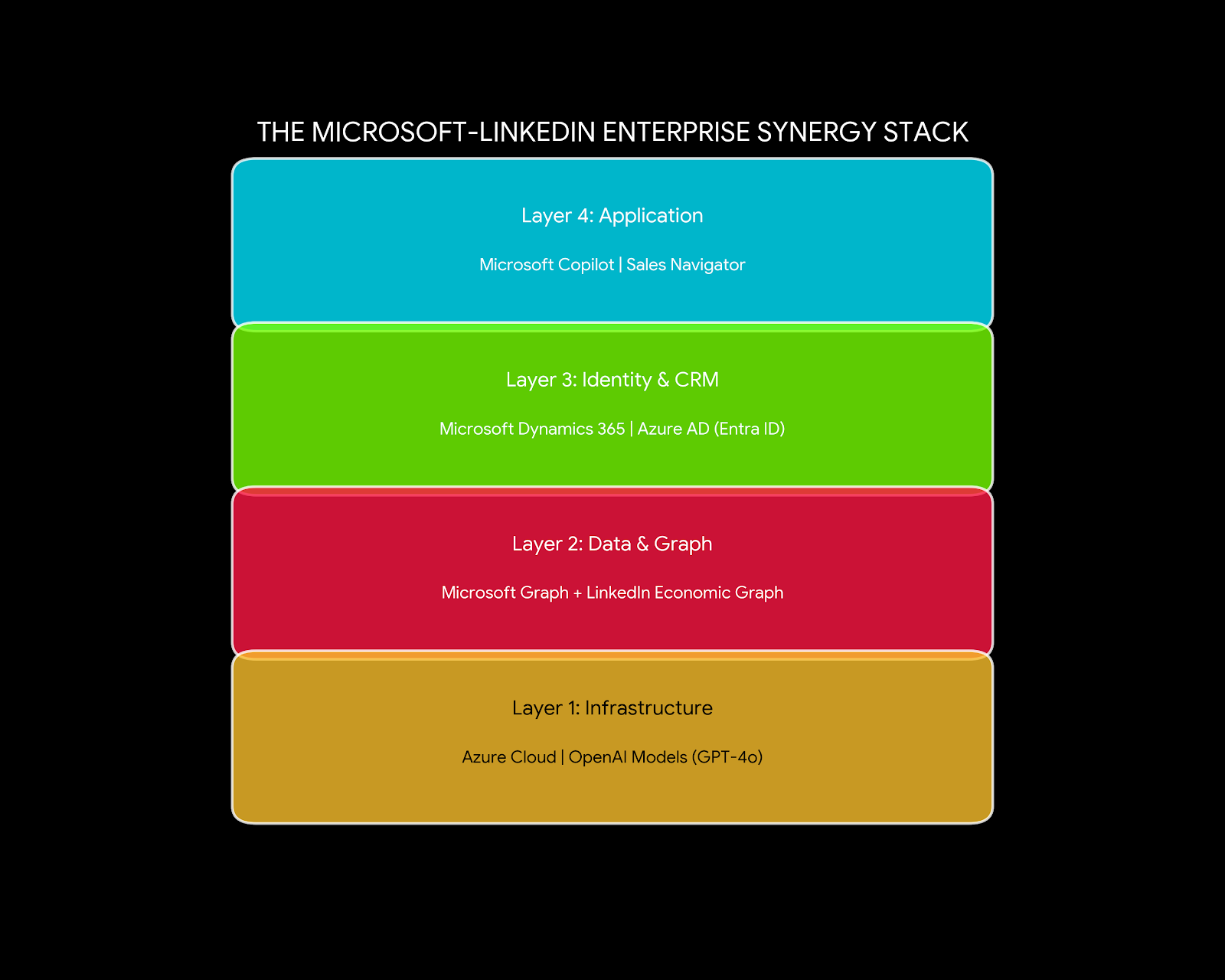
When Microsoft acquired LinkedIn in 2016, many Wall Street analysts viewed it as a risky social media gamble. Today, it is recognized as a masterclass in enterprise synergy.
Microsoft LinkedIn Synergy Stack Chart
- The Economic Graph + Microsoft Graph: Microsoft combined its internal organizational data (emails, calendar meetings, documents via Microsoft 365) with LinkedIn’s external Economic Graph (mapping 1.3 billion workers, 67 million companies, and hundreds of thousands of skills). This creates an unmatched, single-view intelligence engine for global workforce dynamics.
- Azure Infrastructure Efficiency: Migrating LinkedIn’s infrastructure to Microsoft Azure drastically reduced operating overhead while providing the massive compute required to run real-time machine learning algorithms across billions of feed interactions.
- The Generative AI Co-Pilot Era: In 2024–2026, Microsoft embedded advanced OpenAI models directly into the LinkedIn suite. Recruiters can now type natural language prompts (e.g., “Find me senior Rust developers in Austin who have worked at series-B startups”), and LinkedIn Recruiter generates candidate slates instantly. Similarly, sales reps utilize AI to draft hyper-personalized InMail outreach based on mutual connection history and recent prospect posts.
Economic Moats and Strategic Challenges in 2026
LinkedIn enjoys what Warren Buffett calls a “wide economic moat.” However, maintaining an $18 billion empire does not come without friction.
The Immense Moats:
- Indirect Network Effects: Candidates go where recruiters are; recruiters go where candidates are; advertisers go where decision-makers are. Breaking this tri-sided network effect is nearly impossible for a new entrant.
- High Switching Costs: A professional’s decade-long recommendation history, endorsement network, and chronological work record cannot be easily exported or recreated on a rival platform.
- Identity Legitimacy: Unlike anonymous platforms, LinkedIn is built on real-world identity. The introduction of verified government ID badges and employer domain verifications has further elevated trust metrics compared to rival social platforms.
The Modern Challenges:
- The “AI Slop” and Content Saturation Crisis: As generative AI tools proliferation accelerated, LinkedIn faced a wave of low-quality, AI-generated posts and comments. In response, LinkedIn introduced algorithmic suppression tools and community reporting options (such as the 2026 “Seems like AI slop” flag) to protect feed quality.
- InMail Fatigue: With millions of sales representatives utilizing automated outreach platforms, candidate InMail response rates have faced downward pressure, forcing LinkedIn to tighten InMail quotas and prioritize warm introduction tools like TeamLink.
- Data Privacy & Scraping Regulations: Following landmark court battles regarding third-party data scraping (such as hiQ Labs v. LinkedIn), LinkedIn continues to invest heavily in anti-scraping security to prevent external AI models from harvesting its member database without paying for API access.
Conclusion: The Ultimate Proof of B2B Context
LinkedIn’s journey from a 2002 startup to an $18+ billion subsidiary of Microsoft is a masterclass in business model design. While consumer social networks fight in a red ocean for volatile human attention, LinkedIn built a blue ocean centered on professional economic utility.
By creating a platform where individual members willingly keep their data accurate for their own career benefit, LinkedIn unlocked a zero-cost data engine. It then monetized that exact same data across four distinct B2B markets: hiring, advertising, sales, and professional education.
As the world transitions deeper into the AI era, LinkedIn’s core asset—1.3 billion verified, real-world human identities and their economic connections—remains one of the most valuable, defensible, and profitable data moats on the planet.
* Conceptual illustration generated using AI