

The era of manually typing out a cover letter, saving a generic PDF resume, and endlessly clicking “submit” on corporate career portals is officially a relic of the past. As we close out 2026, the recruitment ecosystem has been entirely re-engineered by artificial intelligence. Today, major corporations and boutique agencies alike deploy highly sophisticated Applicant Tracking Systems (ATS) governed by AI to instantly filter, rank, and discard up to 85% of incoming applications before a human recruiter even opens the folder.
In this hyper-automated environment, approaching the job market armed with only a traditional word processor is equivalent to bringing a knife to a drone fight. The modern job seeker must respond in kind, fighting algorithms with algorithms.
However, the sheer volume of “AI career tools” flooding the internet is overwhelming, and relying on the wrong web app can result in hallucinated resume bullet points that instantly disqualify you. To successfully navigate this digital gauntlet, you need a curated, highly effective “AI Job Application Stack.” Here is an investigative breakdown of the most powerful web tools and applications you must rely on to optimize your search, beat the corporate bots, and secure your next role in 2026.
Visualizing the Shift: The Trajectory of AI Job Tools
To understand why these web tools are now mandatory, one must examine the explosive growth of AI adoption in both the HR sector and candidate toolkits over the last four years.
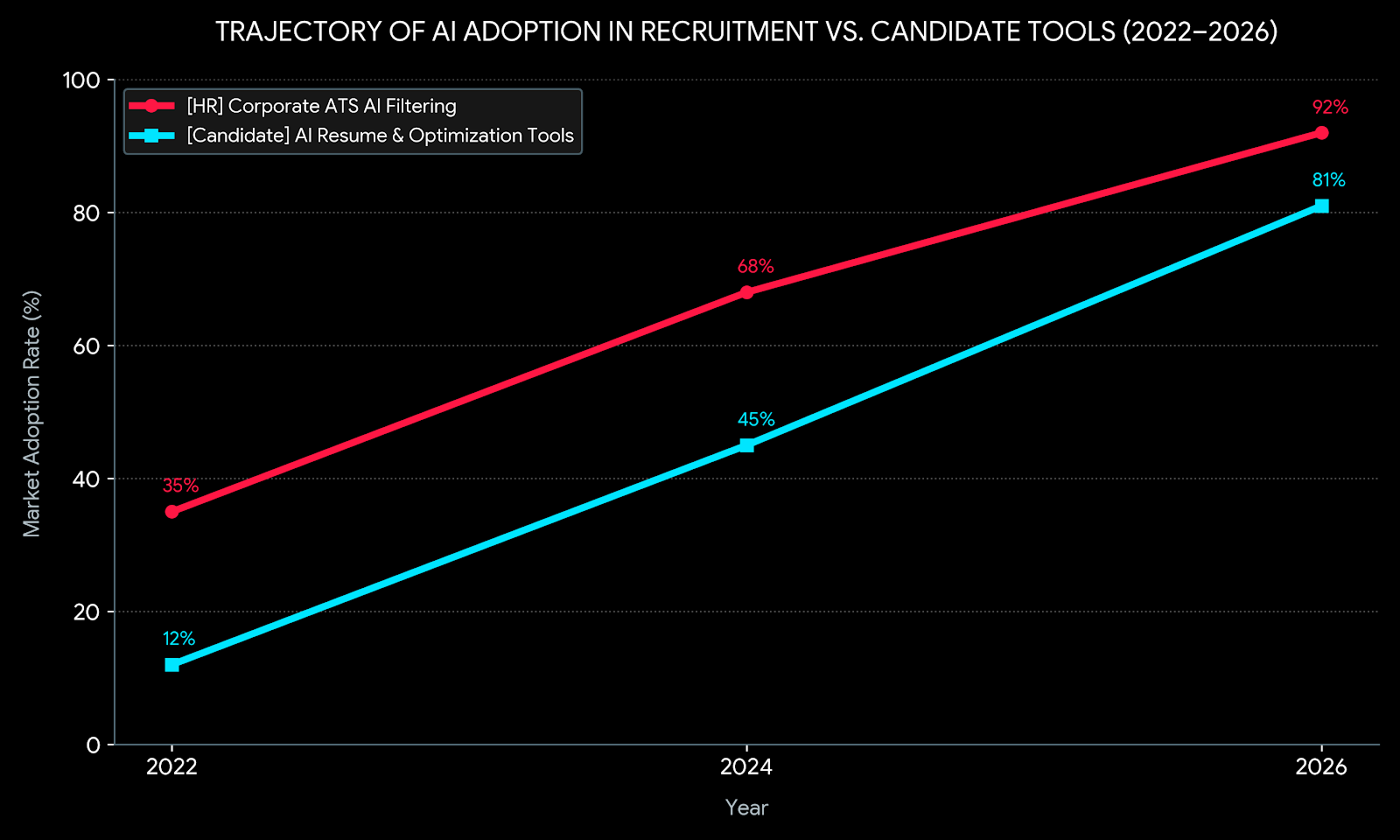
AI Adoption Recruitment Chart
Phase 1: The Master Resume and Generation Engines
Your first step is not applying for a job; it is building a dynamic database of your professional history. You should no longer maintain a single “resume.” Instead, you must maintain a “Master Resume”—a comprehensive, unformatted document containing every project, metric, and skill you possess. From this master document, web apps will generate bespoke, targeted resumes for individual roles.
1. Teal (tealhq.com) Teal has evolved into the absolute centerpiece of the 2026 job search. It is far more than a resume builder; it is a holistic career growth platform. Teal allows you to import your LinkedIn profile to instantly generate a master career history. Its most powerful feature is the “Matching Mode.” You paste the URL of the job you want, and Teal’s AI analyzes the job description, cross-referencing it with your resume. It actively suggests which of your master bullet points to include, highlighting missing keywords that the employer’s ATS will be searching for.
2. Rezi (rezi.ai) If Teal is your database, Rezi is your precision writer. Rezi focuses exclusively on creating ATS-compliant resumes. Many candidates make the mistake of using heavily designed, multi-column Canva templates that ATS software cannot parse, resulting in a blank profile on the recruiter’s end. Rezi forces you into a clean, machine-readable format. Furthermore, its integrated AI acts as a strict editor, scoring your bullet points in real-time. If you write a vague statement like “managed a team,” Rezi will prompt you to inject quantifiable metrics and active verbs, raising your “Rezi Score” until the document is mathematically optimized.
Phase 2: Semantic Matching and ATS Evasion
Once you have a tailored document, you must verify that it will survive the corporate firewall. ATS platforms in 2026 do not just look for exact word matches; they use semantic analysis and Natural Language Processing (NLP) to understand the context of your skills.
3. Jobscan (jobscan.co) Jobscan remains the undisputed heavyweight champion of ATS evasion. It reverse-engineers the exact algorithms used by major HR platforms like Workday, Taleo, and Greenhouse. By uploading your resume alongside the specific job description, Jobscan provides a Match Rate percentage. It categorizes its findings into hard skills, soft skills, and formatting issues. If a company uses Taleo and requires a specific date format for your employment history, Jobscan will flag it. In 2026, you should aim for a match rate of 80% or higher before clicking submit.
4. SkillSyncer (skillsyncer.com) A slightly leaner alternative to Jobscan, SkillSyncer is exceptional for rapid, high-volume keyword analysis. It is highly favored by tech and analytics professionals who need to ensure specific software proficiencies (e.g., Python, Snowflake, GA4) are contextualized correctly within their experience sections, ensuring the ATS recognizes the depth of their technical stack rather than just spotting a buzzword.
Phase 3: Automated Application and Pipeline Management
Applying to jobs manually is a massive drain on cognitive energy and time. Managing the sheer volume of applications, follow-ups, and interview stages requires dedicated project management tools.
5. Simplify (simplify.jobs) Simplify is a game-changing browser extension for the modern job seeker. When you land on a corporate career page (like Workday or Lever), Simplify’s AI auto-fills the notoriously tedious multi-page application forms in seconds using your saved profile data. It eliminates the soul-crushing redundancy of typing out your work history after you have already uploaded your resume. Furthermore, Simplify curates highly vetted lists of companies currently hiring, heavily focused on tech, finance, and remote-first roles.
6. Huntr (huntr.co) The job hunt is a sales funnel, and you are the product. Huntr provides a visual Kanban board (similar to Trello) specifically designed for tracking job applications. It features a web clipper extension allowing you to save jobs from any site directly to your board. You can move cards from “Saved” to “Applied” to “Interviewing,” while keeping track of the specific bespoke resume you used for that application, interview dates, and recruiter contact information. In 2026, staying organized is the key to preventing burnout, and Huntr automates the administrative overhead.
Phase 4: Interview Preparation and Communication
Getting past the ATS only gets you to the starting line. The final phase of the job hunt is human-to-human (or human-to-AI) interviewing. Web tools have now evolved to simulate and critique the live interview experience.
7. Yoodli (yoodli.ai) Yoodli is an AI-powered communication coach that is revolutionizing interview prep. You can record yourself answering practice questions, and Yoodli provides instant, highly detailed analytics on your delivery. It tracks your pacing (words per minute), flags your filler words (“um,” “like,” “you know”), and analyzes your eye contact and tone. In an era where remote, on-camera interviews are the default, Yoodli ensures your digital executive presence is flawless before you ever speak to a hiring manager.
8. Google Interview Warmup (grow.google/certificates/interview-warmup) Initially launched as a tool for Google Career Certificate graduates, this free web app has become a staple for all professionals. It utilizes voice-to-text to let you practice answering industry-specific questions. The AI then analyzes your answers, pointing out where you successfully highlighted a core skill, where you relied on generic corporate speak, and where you need to elaborate on specific metrics.
9. Generative Chatbots (ChatGPT-4o / Google Gemini) While not specifically job-hunting apps, leading LLMs remain critical for the “soft” aspects of the job hunt. They should not be used to write your resume from scratch (as they tend to hallucinate and use easily detectable, repetitive phrasing). However, they are exceptional for generating first drafts of networking outreach messages on LinkedIn, drafting highly specific post-interview thank-you emails, or asking the AI to adopt the persona of a strict hiring manager to grill you on your resume’s weak points.
The Warning: The Trap of Over-Automation
While this web stack is incredibly powerful, a critical warning is necessary for the 2026 job market. Tools like LazyApply—which use bots to apply to hundreds of jobs automatically on your behalf—are facing severe backlash. Corporate ATS platforms are now deploying counter-AI measures to detect and auto-ban “bot applicants.”
Furthermore, recruiters have developed a deep fatigue for “AI-sounding” cover letters and resumes. If your application sounds like it was written by a machine—devoid of human nuance, struggle, and personality—it will be discarded, even if it passes the keyword filter.
Conclusion
The job market of 2026 demands a hybrid approach. You must be ruthless and algorithmic in how you build, optimize, and track your applications, utilizing Teal, Jobscan, and Simplify to conquer the ATS gatekeepers. However, once those web tools open the door, you must pivot immediately back to raw, authentic human communication.
The web tools do not get you the job; they simply clear the digital debris out of your path so that your genuine expertise can be seen. By mastering this AI application stack, you level the playing field, turning the very technology that was designed to filter you out into the engine that drives your career forward.
* Conceptual illustration generated using AI