

In the flat pine scrub and former cattle pastures of Sumter County, Central Florida, lies an economic and sociological phenomenon unlike anywhere else on Earth. The Villages—a sprawling, age-restricted enclave covering more than 57,000 acres—is already home to over 170,000 residents, making it the largest retirement community on the planet. Equipped with more than 50 golf courses, hundreds of pickleball courts, private commercial town squares, and a sprawling network of golf-cart superhighways, it operates as a self-contained, age-segregated metropolis.
Now, the juggernaut is expanding once again.
The Villages is preparing to issue $180 million in high-yield, unrated municipal debt to finance the infrastructure and ground development for an additional 3,860 residential units. At a time when global real estate markets face high interest rates and broader corporate borrowing has cooled, this massive debt issuance highlights the extraordinary financial power—and appetite—of the aging demographic boom.
Here is an in-depth analysis of how a former parcel of Florida farmland transformed into a multi-billion-dollar bond-issuing enterprise, what the $180 million debt deal reveals about the municipal bond market, and what this mega-expansion signifies for the future of senior housing economics in 2026.
1. The $180 Million Expansion: Fueling the Next Horizon
The newly proposed $180 million debt offering is designed to fund essential infrastructure—roads, water lines, sewage systems, utility networks, and land preparation—across thousands of newly acquired acres in Central Florida. The development plan calls for 3,860 new single-family homes, targeting the thousands of retirees who continue to migrate from the U.S. Midwest and Northeast in search of warm weather, low state taxes, and an active lifestyle.
What makes this debt issuance notable is not merely its size, but its structure. The bonds are expected to be issued as unrated high-yield municipal debt through specialized local government entities known as Community Development Districts (CDDs).
In traditional municipal finance, cities issue rated bonds backed by general tax revenues to build public schools or bridges. In contrast, CDD bonds issued on behalf of real estate developers like The Villages are backed by special assessments levied directly on the future home sites. When a retiree buys a newly constructed home in the community, they assume a proportional share of that $180 million debt infrastructure burden, paying it off over 20 to 30 years via annual property tax bills.
2. Inside the Empire: The Unique Business Model of The Villages
To understand why investors are eager to snap up $180 million in unrated debt from a single retirement enclave, one must understand the unique, vertically integrated business model engineered by the Morse family, the developers behind The Villages.
Originating in the 1970s as a modest mobile home park, the developer transformed the property into a master-planned “active adult” lifestyle haven. The business model relies on several distinct revenue streams:
- Land Acquisition and Horizontal Development: Purchasing agricultural land at low per-acre costs (such as a massive 8,300-acre acquisition in Sumter County) and converting it into high-density residential subdivisions.
- Vertical Home Construction: Building standardized, highly popular single-family homes and villas at immense scale, achieving massive supply-chain efficiencies.
- Commercial Real Estate Control: The developer retains ownership of the commercial town squares, leasing storefronts to restaurants, healthcare providers, banks, and retail chains that cater exclusively to the resident base.
- Utility and Infrastructure Monopolies: Through controlled utility companies and CDD structures, the developer earns recurring revenue from water, trash, cable, and maintenance services.
By utilizing CDDs to issue $180 million in municipal debt, the developer effectively offloads the upfront capital costs of horizontal infrastructure onto the municipal bond market—and ultimately onto the end homebuyers—while retaining the profits from home sales and commercial leasing.
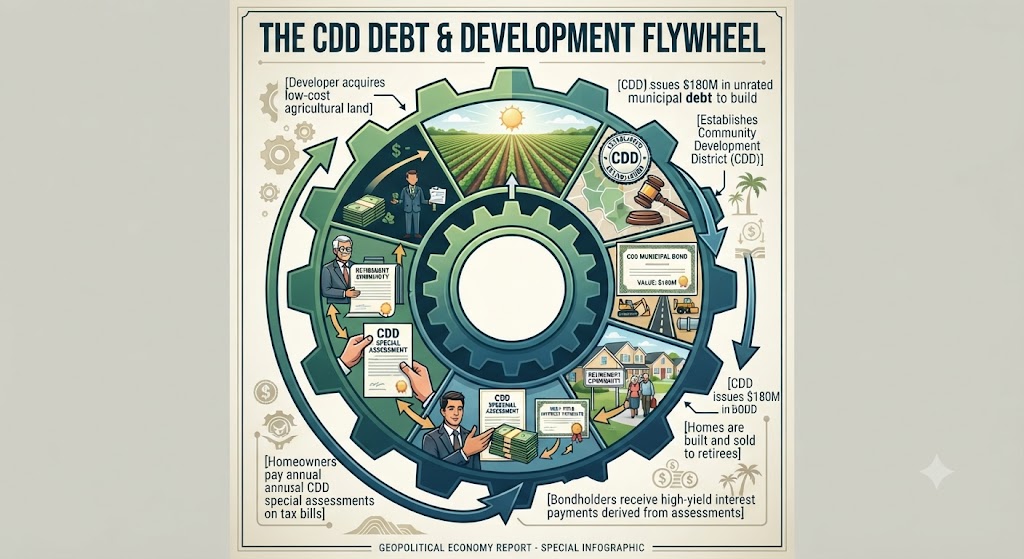
The COD Debt and Development Flywheel
When an entire sector experiences six consecutive weeks of systematic liquidation, it means institutional managers are aggressively trimming exposure across the board. The selling is no longer confined to a single troubled regional bank or a specific niche lender; the market is fundamentally repricing the risk profile of the entire American banking engine.
The Earnings Illusion: Backward-Looking Comfort vs. Forward-Looking Dread
The core source of friction in the market today is the dramatic disconnect between retrospective earnings statements and forward-looking economic expectations.
On paper, Q3 quarterly reports from top-tier lenders like JPMorgan Chase, Citigroup, PNC, and Bank of America did not present an immediate horror story. In aggregate, the four largest U.S. lenders showed nearly 10% year-over-year portfolio growth in their loan books, while immediate write-offs and realized loan losses remained relatively contained.
Why, then, are bank stocks falling every single week?
1. The Death of Net Interest Margin (NIM) Expansion
For the past two years, banks enjoyed an environment where they could charge significantly higher interest rates on loans while keeping deposit yields relatively low. That era of easy profitability has ended. As depositors actively move funds into high-yield money market accounts and Treasury bills, banks have been forced to aggressively raise the rates they pay to retain deposits. At the same time, demand for high-yielding new loans (such as mortgages and commercial lines of credit) has slowed. The resulting squeeze on Net Interest Margins (NIM) means banks are earning less profit on every dollar in their balance sheets.
2. Provisioning for Future Default Spikes
While realized loan losses over the last 90 days look manageable, bank risk committees are quietly building up massive credit loss provisions for 2027. Equity analysts are discounting earnings because they see these reserves eating directly into future net income. Lenders are preparing for a wave of defaults in commercial real estate (CRE) and leveraged corporate debt as multi-year fixed-rate loans come due for refinancing at drastically higher rates.
3. The 18-Month Debt Maturity Wall
Trillions of dollars in corporate and commercial real estate debt negotiated during the low-rate environment of 2020–2021 must be refinanced over the next two years. If a commercial property owner who borrowed at 3.5% in 2020 is forced to refinance at 7.5% or 8.5% in 2026, the underlying property cash flows often can no longer service the debt. Equity markets recognize that banks will inevitably bear the brunt of these restructurings through foreclosures, debt write-downs, and capital impairment.
The Three Structural Pillars Driving Sector Anxiety
Beyond balance sheet mechanics, three broader macroeconomic and technological forces are compounding the six-week slide in banking equities:
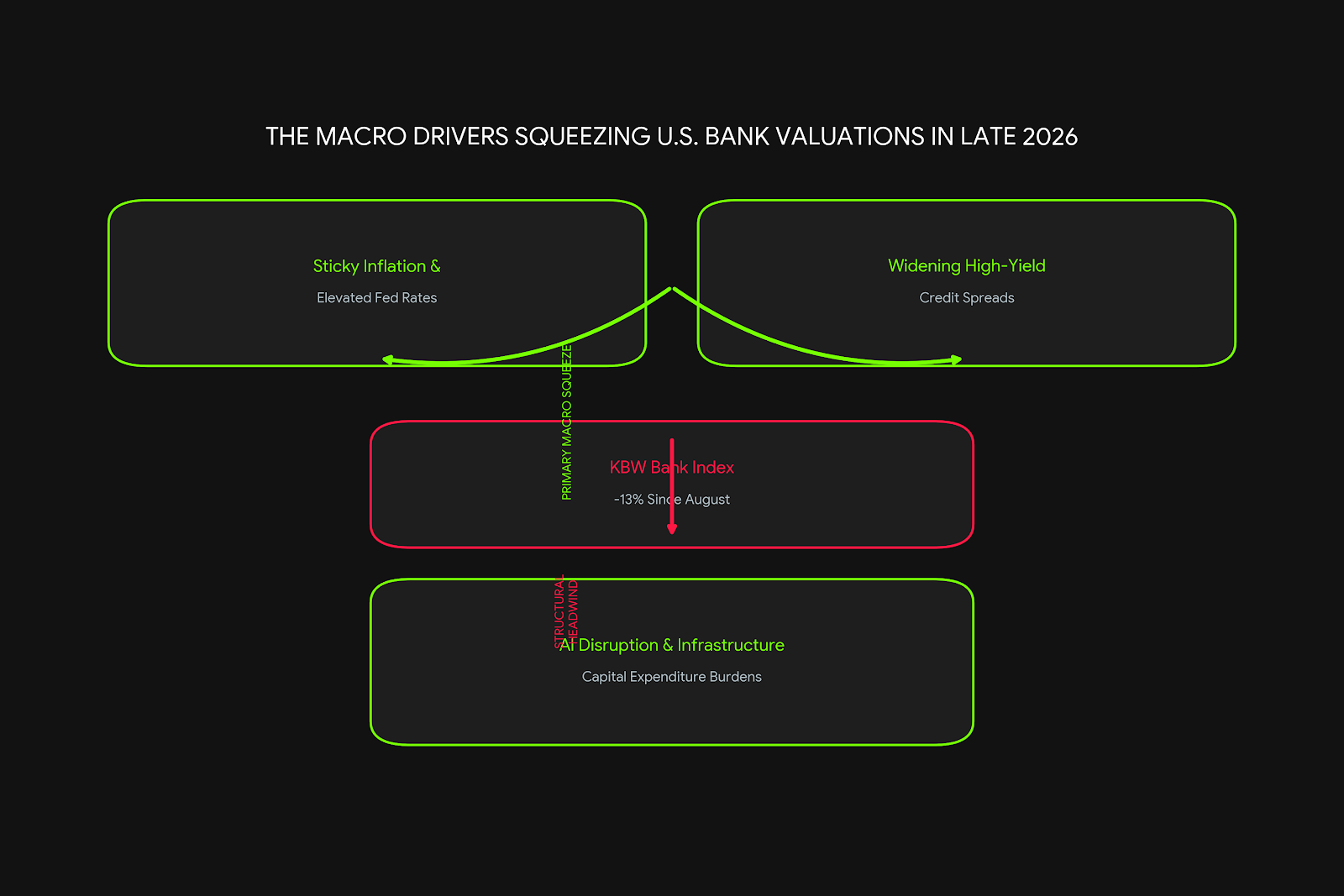
The Macro Drivers Squeezing US Bank Valuations in Late 2026
Pillar 1: Sticky Inflation and the “Higher-for-Longer” Rate Trap
Persistent inflationary pressures in the late-2026 global economy have severely limited the Federal Reserve’s room to maneuver. Rather than embarking on a rapid series of rate cuts to stimulate economic activity, monetary authorities are trapped. High interest rates act as a double-edged sword for banks: while they yield higher interest on new floating-rate debt, they depress the market value of banks’ massive holdings of existing long-term Treasury bonds and mortgage-backed securities, recreating the “unrealized loss” anxieties that plagued the sector during the 2023 regional banking panic.
Pillar 2: Widening Credit Spreads in Corporate Debt
Fixed-income markets are flashing warning signs that equity markets can no longer ignore. Credit managers report a widening of spreads on high-yield corporate bonds. When credit spreads widen, it indicates that bond investors are demanding a significantly higher risk premium to lend to non-investment-grade corporations. Widening credit spreads have historically served as a reliable leading indicator of rising corporate bankruptcies—a direct threat to bank loan portfolios.
Pillar 3: The AI Disruption Wildcard and CapEx Inflation
An emerging vector of anxiety unique to the 2026 market cycle is the impact of Artificial Intelligence on financial services. Investors are questioning the long-term moat of traditional commercial banks as autonomous AI agents and fintech platforms disintermediate traditional fee-based services, wealth management, and payment processing. To avoid obsolescence and protect against increasingly sophisticated, AI-driven cyber threats, major banks are being forced to execute multi-billion-dollar capital expenditure programs to overhaul their legacy IT infrastructure. This massive CapEx strain drags down return on equity (ROE) at the exact moment margins are already compressing.
Is This 2008 Replayed, or a Different Economic Beast?
Whenever financial commentators draw parallels to 2008, it is essential to separate structural reality from emotional hype.
In 2008, the U.S. banking system was fundamentally undercapitalized, holding massive off-balance-sheet exposure to opaque, toxic subprime mortgage derivatives. Leverage ratios across major Wall Street investment banks were dangerously high, leading to a classic liquidity and solvency cascade when asset values collapsed.
Today, in 2026, the structural foundation of the U.S. banking system is significantly more resilient. Mandated by post-2008 Dodd-Frank and Basel regulations, major American banks hold historically high levels of Tier-1 common equity capital and maintain strict liquidity coverage ratios. Balance sheets are cleaner, and direct exposure to speculative subprime consumer debt is far lower.
However, a crisis does not need to mirror 2008 to inflict severe damage on stock valuations. The crisis of 2026 is not one of sudden, explosive counterparty insolvency; it is a slow, grinding erosion of profitability and credit quality. It is a world where banks are caught between elevated funding costs, a looming commercial debt refinancing wall, stagnant loan growth, and heavy technological modernization costs.
Conclusion: What the Losing Streak Signal Means for Investors
The six-week losing streak in U.S. bank stocks is a classic market warning shot. It demonstrates that stock markets are forward-looking discounting mechanisms that refuse to be lulled into complacency by retrospective Q3 earnings beats.
For broader equity markets, sustained weakness in financial stocks has historically been a harbinger of macroeconomic deceleration. Banks are the central nervous system of the economy; when lenders pull back, tighten credit standards, and see their equity valuations compressed, the flow of capital to businesses, home buyers, and consumers inevitably slows down.
As we look toward the remainder of 2026, the banking sector faces a pivotal test. Until inflation stabilizes, interest rate trajectories become predictable, and the upcoming corporate debt refinancing wall is navigated without a systemic spike in defaults, bank stocks will likely remain under pressure. Investors should look past headline earnings beats and pay close attention to net interest margins, loan loss provisions, and credit spread trends—because the market has made it abundantly clear that the real fight for Wall Street’s balance sheets is just beginning.
* Conceptual illustration generated using AI