
For the past two years, millions of American households operated under a comforting economic assumption: that the era of aggressive interest rate policy had peaked, and that a swift return to cheap credit was just around the corner. However, as the Federal Reserve releases its latest financial stability updates and policy meeting notes, that optimistic timeline has vanished.
The central bank’s recent communications deliver a stark warning to the American consumer. Fueled by sticky inflation metrics, surging 10-year Treasury yields, and record federal deficit spending, borrowing costs are set to remain elevated for significantly longer than financial markets had priced in.
The most acute threat is directed at two distinct but heavily overlapping groups: an estimated 3.1 million homeowners sitting on resetting Adjustable-Rate Mortgages (ARMs) or variable-rate Home Equity Lines of Credit (HELOCs), and every single American carrying a revolving credit card balance.
With total U.S. credit card debt hovering near an unprecedented $1.28 trillion and average variable credit card APRs surging past 21.5%, the mathematical margin for error for the average household has evaporated. Here is an in-depth analysis of the Federal Reserve’s warning, the compounding mechanics of variable debt, and how everyday Americans can protect their balance sheets before the next interest rate adjustment window.
The 3.1 Million Homeowners in the Crosshairs
While the vast majority of U.S. homeowners locked in ultra-low, 30-year fixed mortgages below 4% during the pandemic era, a significant minority—roughly 3.1 million property owners—are now entering a severe financial pressure cooker.
These 3.1 million households fall into three vulnerable categories:
- Resetting Hybrid ARMs: Borrowers who took out 3/1 or 5/1 Adjustable-Rate Mortgages between 2021 and 2023 are reaching their first adjustment caps. Mortgages that originated with teaser rates around 3% to 4% are resetting to prevailing market rates of 6.5% to 7.5%, instantly adding $400 to $900 to monthly mortgage payments.
- HELOC Borrowers: Over the last three years, millions of homeowners tapped into their surging home equity to cover home repairs, medical bills, or consolidate high-interest debt using Home Equity Lines of Credit. Unlike fixed mortgages, HELOCs carry variable interest rates directly tied to the Prime Rate. As the Prime Rate remains elevated, the monthly interest-only payments on these loans have doubled.
- The Double Whammy: Insurance & Rate Resets: According to recent Federal Reserve research on housing stability, rising property insurance premiums—which have jumped over 30% in states like Texas, Florida, and California—are compounding with interest rate resets. This dual escalation is pushing mortgage delinquency rates higher, particularly among low-to-moderate-income census tracts.
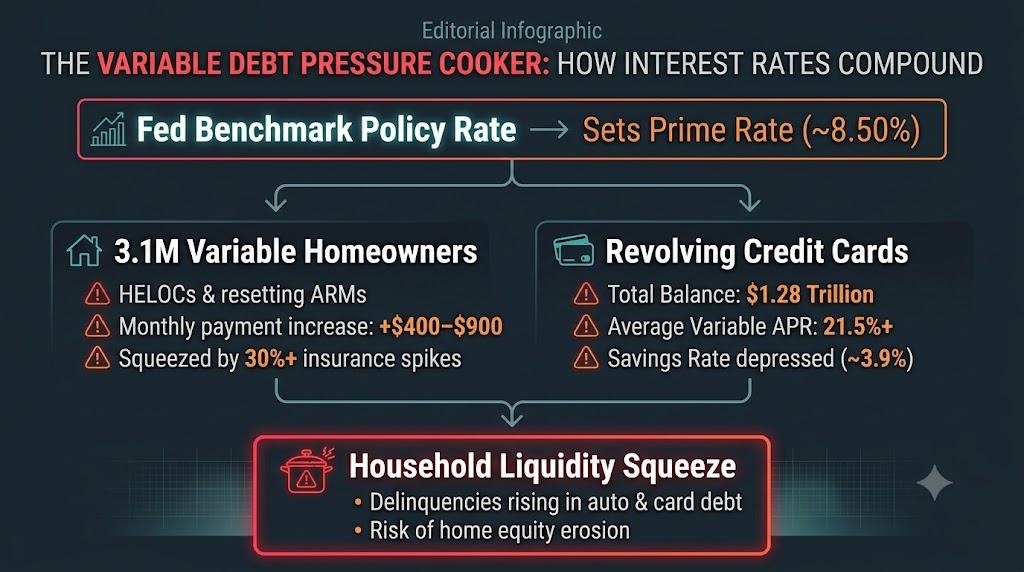
Fed Benchmark Policy Rate
The Credit Card Trap: $1.28 Trillion at Historic APRs
While 3.1 million homeowners face localized housing stress, the Federal Reserve’s warning on credit card debt applies universally to nearly 175 million cardholders across the United States.
Total U.S. credit card balances reached an astounding $1.26 trillion to $1.28 trillion, fast approaching all-time highs. More alarming than the total debt is the cost of servicing it.
Almost all consumer credit cards feature variable interest rates governed by a simple formula: Prime Rate + Margin. When the Federal Reserve maintains or adjusts its benchmark target, card issuers adjust their Annual Percentage Rates (APRs) automatically within one to two billing cycles. No bank calls to warn the consumer; the higher finance charge simply appears on the next monthly statement.
The Math of Minimum Payments
In 2020, the average credit card APR sat around 14.5%. Today, average APRs stand at 21.5% to 22.8%, with store-branded cards routinely topping 29.99%.
To understand how brutal this math is for everyday households, consider an average family carrying a $8,000 credit card balance at a 21.5% APR:
- Minimum Monthly Payment: Approximately $200 (covering interest plus 1% of principal).
- Time to Pay Off (Minimum Payments Only): Over 23 years.
- Total Interest Paid: More than $11,500 on an initial $8,000 balance.
As personal savings rates hover at a sluggish 3.9%—well below pre-pandemic historical averages—more households are utilizing credit cards not for discretionary luxury, but as a secondary income buffer to pay for groceries, utilities, and auto repairs. This practice creates a compounding debt trap where interest charges consume a growing percentage of monthly take-home pay.
The Macroeconomic Paradox: Why Rates Aren’t Dropping Fast
Why is the Federal Reserve issuing these warnings now rather than rapidly slashing rates to relieve consumer stress? The answer lies in a complex macroeconomic tug-of-war.
1. Sticky Inflation Metrics
Consumer Price Index (CPI) numbers have proven exceptionally stubborn, driven by elevated energy prices, rising insurance costs, and persistent wage growth in service sectors. The Fed’s primary statutory mandate is price stability; lowering rates prematurely risks reigniting an inflationary spiral that would devalue consumer purchasing power even further.
2. The 10-Year Treasury Yield Surge
Mortgage rates do not directly mirror the Fed’s short-term rate; instead, they track the yield on 10-year U.S. Treasury notes. Due to massive federal debt issuance—with the national debt breaching $40 trillion—global investors are demanding higher yields to hold U.S. government debt. This keeps 30-year fixed mortgage rates firmly entrenched between 6% and 7%, preventing a wave of refinancing that could otherwise liberate trapped homeowners.
3. Rising Delinquency Signals
Data from the Federal Reserve Bank of New York indicates that transition rates into early delinquency (30+ days late) for auto loans and credit cards have crossed pre-pandemic baselines. Low-to-moderate-income households are showing distinct signs of financial fatigue, prompting the Fed to urge commercial banks to tighten credit standards and increase loss reserves.
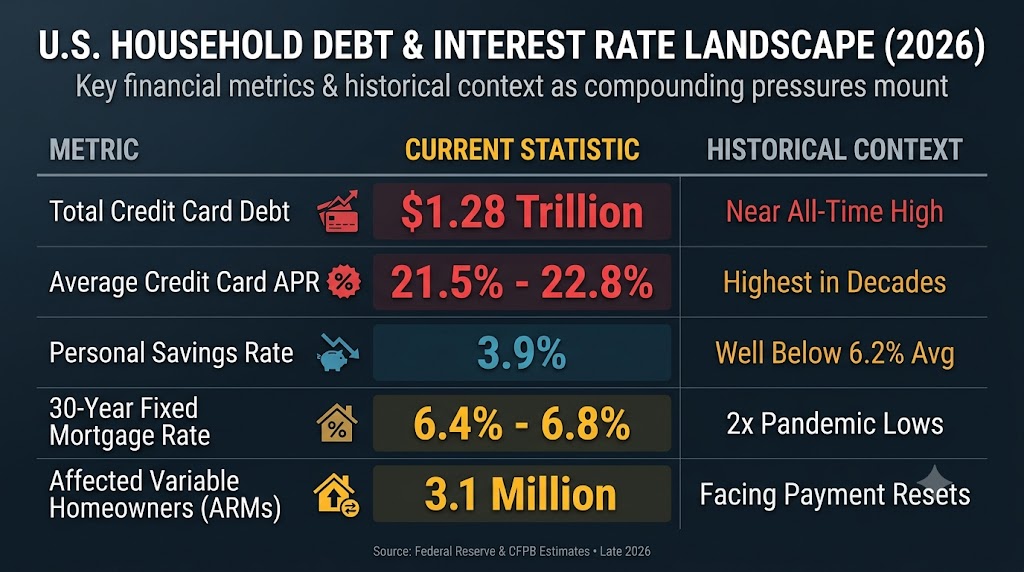
Key Financial Metrics and Historical Context as Compounding Pressures Mount
Strategic Survival Guide: Defending Your Household Balance Sheet
In light of the Fed’s warning, financial advisors and credit counselors emphasize that waiting for federal policy intervention is a losing strategy. Household financial defense requires immediate, proactive restructuring.
1. Audit and Lock In Variable Home Loans
If you are among the 3.1 million homeowners with a resetting ARM or an active HELOC:
- Convert to Fixed Rate: Inquire if your lender offers a fixed-rate conversion option on your HELOC balance to eliminate interest rate volatility.
- Prioritize Principal Paydown: Redirect excess cash flow toward reducing the principal balance on variable lines before the next scheduled adjustment window.
2. Execute a High-Interest Debt Elimination Plan
With credit card APRs exceeding 21%, holding cash in a traditional savings account earning 1% while carrying card debt at 21% is a net financial loss of 20% annually.
- 0% APR Balance Transfer Cards: Consumers with good credit (700+ FICO) should explore 0% APR balance transfer credit cards, which offer 12 to 21 months of zero interest for a nominal 3% to 5% transfer fee.
- The Avalanche Method: Target extra payments toward the card with the highest APR first while making minimum payments on others to minimize cumulative interest loss.
3. Build a Tiered Emergency Buffer
Because rising interest rates increase the likelihood of broader economic slowing and labor market softening, maintaining a 3-to-6-month liquid emergency reserve in a high-yield savings account (HYSA) earning 4%+ remains essential to prevent turning to credit cards during an unexpected emergency.
Conclusion: The New Reality of Credit
The Federal Reserve’s warning serves as a definitive end to the illusion that cheap, zero-cost borrowing will return to rescue overleveraged balance sheets. Whether you are one of the 3.1 million homeowners navigating a variable loan reset or one of the millions of cardholders carrying a monthly balance, the message from Washington is unequivocal: high interest costs are the new normal.
By recognizing the mechanics of variable rate compounding, auditing debt structures, and aggressively eliminating high-cost credit card balances, American households can insulate their home equity and personal savings from the tightening grip of central bank policy.
* Conceptual illustration generated using AI