
In a landmark transaction that formally ends its multi-year moratorium on large-scale M&A, enterprise software giant Salesforce ($CRM) announced on Tuesday, October 20, 2026, an agreement to acquire cloud-based customer engagement platform Braze ($BRZE) in an all-cash deal valued at approximately $5.66 billion in enterprise value.
Under the terms of the agreement, Salesforce will pay $47.50 per share in cash for New York-based Braze. The purchase price represents a staggering 58.1% premium over Braze’s prior closing price, prompting a sharp 52% surge in Braze shares following the market opening. The transaction has been approved by the boards of directors of both companies and is projected to close in Salesforce’s fiscal year 2028, pending shareholder approval and required regulatory clearances.
The acquisition marks Marc Benioff’s boldest inorganic move since the $27.7 billion buyout of Slack in 2021. More importantly, it signals a strategic transformation in how enterprise software leaders view the intersection of real-time mobile data, cross-channel customer engagement, and autonomous artificial intelligence.
Here is an in-depth analysis of why Salesforce broke its M&A fast for Braze, how the platform will be integrated into Salesforce’s Agentforce AI strategy, and what this $5.7 billion consolidation means for the broader SaaS landscape.
The Evolution of Salesforce’s M&A Strategy
To understand the significance of this deal, one must look at the recent history of Salesforce’s corporate strategy. Between late 2022 and 2024, Salesforce came under intense pressure from activist investment firms—including Elliott Management, Starboard Value, and Inclusive Capital. The activist coalition demanded that the software giant curb its aggressive, mega-deal shopping habit, disband its internal M&A committee, and focus squarely on expanding non-GAAP operating margins.
Salesforce responded by pivoting toward operational discipline. It restructured its workforce, raised operating margins from the low 20s to above 30%, and launched a massive share buyback program. On the product front, the company turned its focus toward organic innovation, developing its foundational Data Cloud and launching “Agentforce”—Salesforce’s flagship architecture for autonomous AI agents capable of executing tasks across sales, service, and marketing without constant human prompting.
However, as the enterprise software market transitioned into late 2026, a critical bottleneck emerged in the digital marketing ecosystem. While Salesforce’s Data Cloud was exceptionally effective at aggregating customer records, its core Marketing Cloud platform—built on historical acquisitions like ExactTarget (acquired in 2013 for $2.5 billion), Pardot, and Datorama—was increasingly viewed by modern, mobile-first enterprises as architecturally complex, batch-processed, and slow.
In the fast-moving consumer internet era, enterprises cannot wait hours for batch data processing. They require sub-second, event-driven engagement. Recognizing that building a modern, streaming mobile-engagement engine from scratch would take years of organic R&D, Benioff and his executive team decided the time was ripe to deploy Salesforce’s expanding cash reserves to acquire the premier asset in real-time customer engagement.
What Makes Braze an Enterprise Prize?
Founded in 2011 (originally as Appboy) by Bill Magnuson, Jon Hyman, and Mark Ghermezian, Braze was engineered specifically for the smartphone and app-centric economy. Unlike legacy marketing platforms built around batch email distributions, Braze’s architecture was designed from day one around real-time event streams, push notifications, in-app messaging, SMS, web triggers, and personalized content cards.
Braze’s underlying engine processes billions of behavioral data points in real time, allowing brands to instantly respond to user actions—such as abandoning a cart inside a mobile app, pausing a streaming video, or walking past a geotagged physical store.
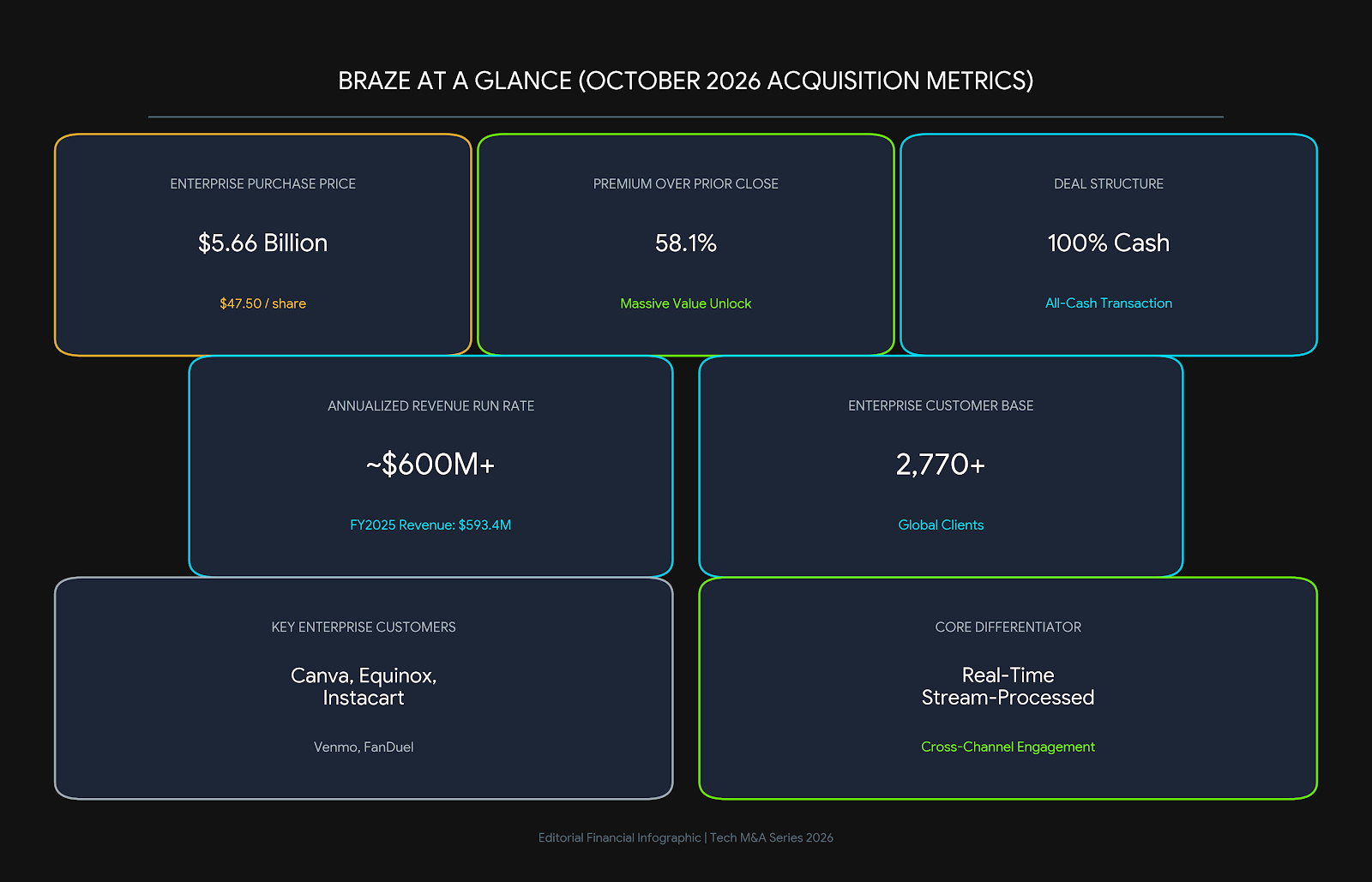
Braze Acquisition Metrics Dashboard
Braze’s ability to capture high-velocity behavioral data from mobile environments made it an indispensable tool for consumer tech giants like Canva, Equinox, Instacart, Venmo, and FanDuel. By acquiring Braze, Salesforce instantly captures over 2,770 high-value enterprise accounts that rely on Braze as the central nervous system for their consumer-facing communications.
The Strategic Synergy: Agentforce Meets Streaming Mobile Data
The true value of the $5.7 billion acquisition lies at the intersection of Braze’s real-time communication pipeline and Salesforce’s Agentforce AI framework.
In the current era of enterprise AI, an autonomous agent is only as good as the real-time context provided to it. If an AI agent receives customer data that is 12 hours old, its automated interventions will be tone-deaf or irrelevant.
By integrating Braze into Salesforce Data Cloud and Agentforce, Salesforce creates a zero-latency feedback loop:
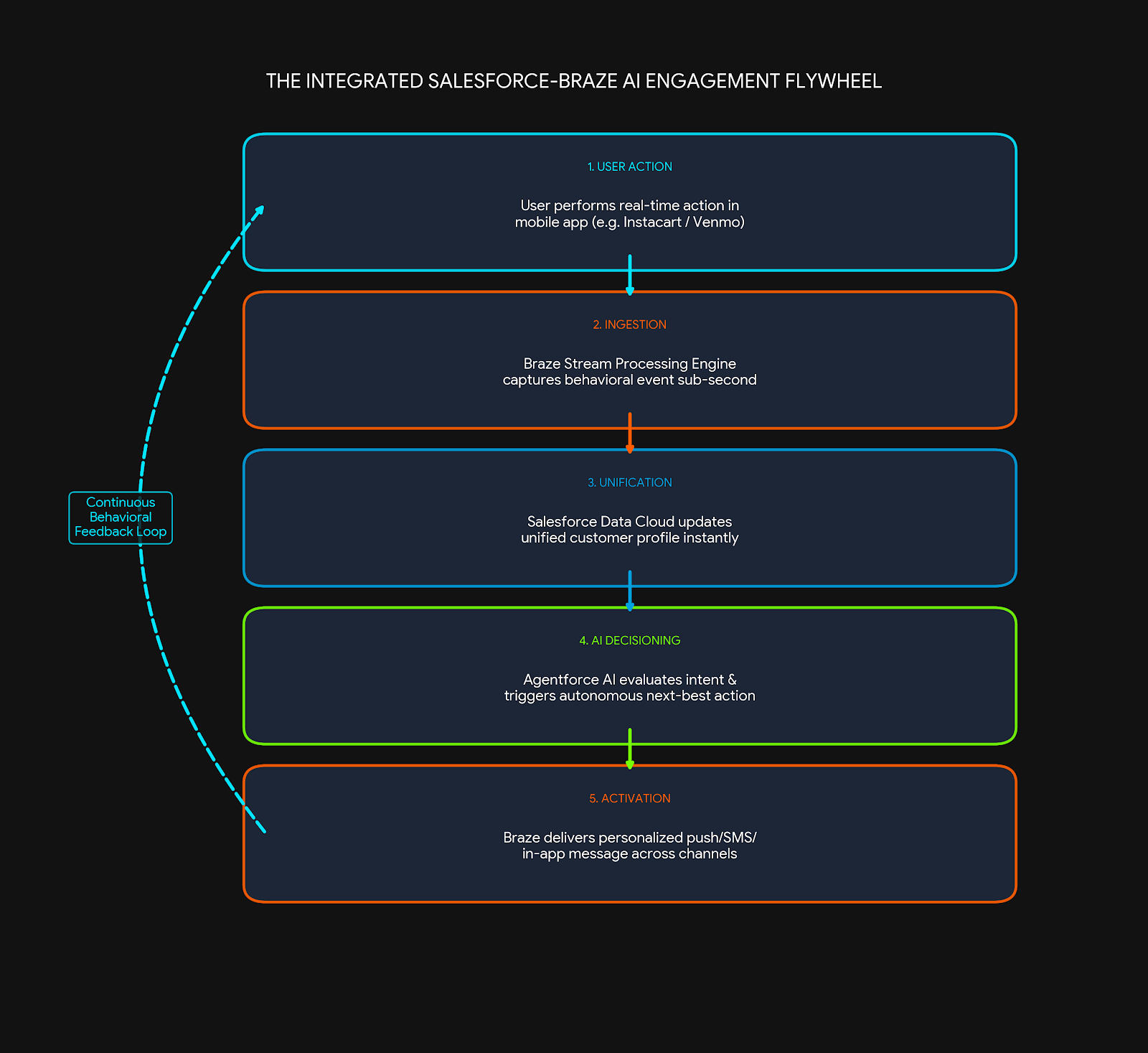
Integrated Salesforce Braze Flywheel Chart
1. Reimagining the Campaign Model
Traditional marketing operates on static campaigns: a marketer crafts an email, selects a segment, and schedules a blast for Tuesday morning. The combination of Braze and Agentforce shifts the paradigm to continuous, event-driven engagement. AI agents can dynamically craft, test, and dispatch hyper-personalized messages across push, WhatsApp, SMS, or in-app channels the exact millisecond a consumer exhibits high intent or friction.
2. Upgrading Legacy Marketing Cloud
Existing Salesforce Marketing Cloud clients will no longer need to stitch together complex custom APIs or rely on third-party middleware like Segment or Twilio to push real-time data from native mobile apps into Salesforce. Braze will serve as the modern, high-speed front-end ingestion layer for Marketing Cloud, dramatically lowering implementation friction for enterprise clients.
3. Expanding Revenue per Account
Salesforce can now cross-sell Braze’s multi-channel messaging platform directly into its massive global install base of Sales Cloud and Service Cloud customers, while simultaneously introducing Braze’s mobile-first client base to Salesforce’s broader enterprise data ecosystem.
Market Ripple Effects & Competitor Dynamics
Salesforce’s acquisition of Braze creates immediate seismic waves across the martech and customer engagement landscape.
- Impact on Standalone MarTech Players: Independent platforms like Klaviyo ($KVYO), Attentive, Postscript, and Iterable face an increasingly consolidated competitive landscape. While Klaviyo maintains a dominant grip on the SMB and Shopify e-commerce ecosystem, Salesforce’s backing of Braze creates a formidable wall around enterprise accounts.
- Pressure on Adobe & HubSpot: Adobe Experience Cloud, which has historically competed head-to-head with Salesforce for enterprise marketing suite dominance, will be forced to respond to Salesforce’s enhanced mobile-native capabilities. Similarly, mid-market leader HubSpot will face heightened pressure as Salesforce offers a more streamlined, real-time engagement stack for scaling enterprises.
- The End of the M&A Freeze: Salesforce’s willing deployment of $5.66 billion in cash proves that mega-cap tech leaders are ready to re-enter the M&A market to secure strategic AI and data assets. Other tech titans sitting on significant cash piles—such as Alphabet, Microsoft, and Oracle—may be prompted to initiate similar acquisitions of high-growth, public SaaS companies trading at reasonable revenue multiples.
Regulatory Realities and Path to Closing
While the $5.66 billion deal represents a 58.1% premium for Braze shareholders, both companies must navigate an intensely vigilant regulatory environment before the transaction closes in fiscal 2028.
Antitrust regulators in the United States (FTC/DOJ) and the European Union have consistently scrutinized Big Tech acquisitions that consolidate digital infrastructure. However, legal analysts expect the deal to eventually gain approval for two primary reasons:
- High Market Fragmentation: The customer engagement, email, and SMS marketing sectors remain highly fragmented. Dozens of viable alternatives exist across both SMB and enterprise tiers, preventing Salesforce from establishing a legal monopoly in digital marketing software.
- Complementary Tech Stacks: Salesforce can demonstrate that Braze operates primarily as an event-driven mobile engagement engine, whereas legacy Salesforce Marketing Cloud focused on traditional CRM, email, and B2B automation.
Conclusion: The Future of Autonomous Engagement
Salesforce’s $5.7 billion purchase of Braze is far more than a routine SaaS consolidation deal. It is a strategic statement about the future of software. The era of static customer relationship management is over; the era of real-time, autonomous, agentic engagement has arrived.
By acquiring Braze, Marc Benioff has equipped Salesforce with the high-velocity mobile data pipeline it desperately needed to fuel its Agentforce AI platform. For enterprise brands, the message is clear: customer engagement is no longer about sending scheduled marketing blasts—it is about orchestrating continuous, intelligent, real-time conversations across every digital screen a consumer touches.
* Conceptual illustration generated using AI