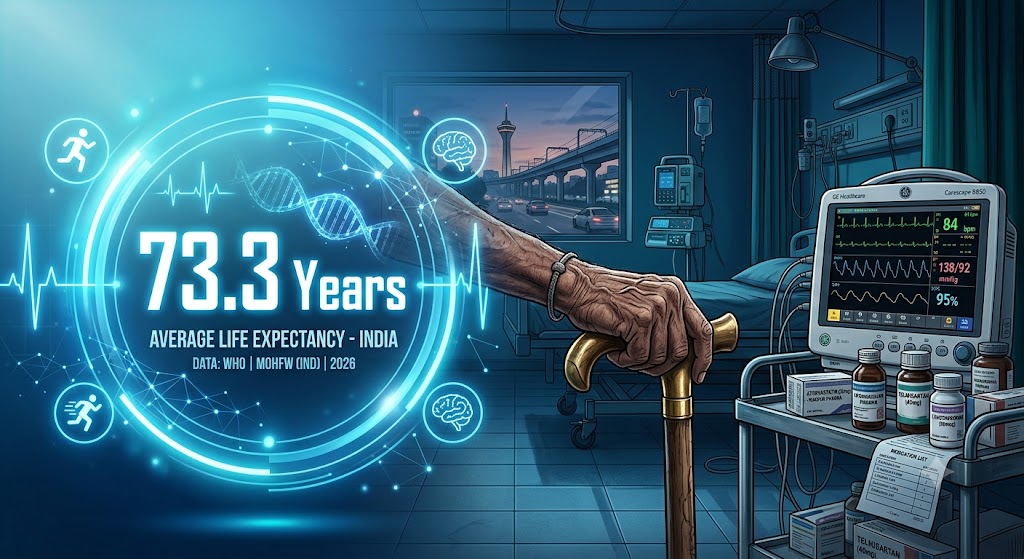
The world has formally clawed back the years stolen by the COVID-19 pandemic, but the fundamental nature of how humans live and die has permanently shifted. According to the latest Global Health Estimates released by the World Health Organization, global life expectancy at birth reached 73.3 years in 2023, almost perfectly mirroring the 73.4 years recorded in 2019 before the coronavirus upended global demographics.
However, beneath this statistical victory lies a profound structural crisis in global public health. Humanity is living longer, but it is not necessarily living healthier. The data confirms a massive epidemiological transition: non-communicable diseases (NCDs) such as heart disease, cancer, diabetes, and dementia accounted for a staggering 74% of all deaths globally in 2023, a sharp increase from 58% in the year 2000.
To put the current landscape in perspective, eight of the top ten leading causes of death worldwide are now classified as NCDs, cementing chronic illness as the defining health challenge of the 21st century.
The Longevity vs. Healthspan Gap
The true narrative of the WHO’s latest dataset lies in the divergence between standard life expectancy and “healthy life expectancy” (HALE). While overall life expectancy has recovered to 73.3 years, healthy life expectancy—the metric measuring the number of years a person can expect to live in full health, free from disabling chronic conditions—has recovered at a much slower pace. In 2023, global healthy life expectancy sat at 62.8 years, which remains 0.4 years below its pre-pandemic 2019 baseline.
This statistical gap paints a stark reality for the average global citizen. It means that roughly a decade of a person’s life is now spent grappling with chronic illness, disability, and declining cognitive or physical function. The modern medical apparatus is exceedingly efficient at keeping people alive through pharmaceutical interventions, surgical procedures, and continuous care devices, but it is struggling to preserve their baseline quality of life during those extended twilight years.
Dr. Alain Labrique, Director of the WHO’s Department of Data, Digital Health, Analytics and AI, synthesized the dilemma perfectly: “Living longer is one of the great achievements of public health… The next challenge is to ensure that those additional years are lived in good health, while health systems are equipped to respond to the changing needs of populations”.
The Ascendancy of Chronic Killers
The specific breakdown of global mortality reveals the absolute dominance of cardiovascular and degenerative conditions over infectious diseases. As COVID-19 officially dropped out of the world’s top 10 causes of death for the first time since the pandemic began, chronic conditions rushed in to fill the void.
Cardiovascular diseases remain the undisputed apex predator of human health. Ischemic heart disease alone was responsible for an estimated 9.5 million deaths in 2023. Beyond the raw mortality figures, this single condition accounted for approximately 210 million disability-adjusted life years (DALYs), representing an incomprehensible loss of human productivity and quality of life.
Perhaps the most alarming trend highlighted by the WHO estimates is the meteoric rise of neurological and cognitive disorders. Between 2000 and 2023, Alzheimer’s disease and other forms of dementia catapulted from the 19th leading cause of death globally to the fifth. In less than a quarter of a century, global deaths attributed to dementia have tripled. This exponential growth directly correlates with aging populations, presenting a complex challenge for which modern medicine currently has very few curative answers. While targeted cancer therapies and cardiovascular interventions can actively prolong life, the global medical infrastructure is woefully under-equipped to manage the long-term, high-intensity care required by hundreds of millions of dementia patients.
Mental health conditions have also surged in their impact on the global disease burden. The WHO noted that between 2019 and 2023, the global age-standardized DALY rate skyrocketed by roughly 20% for depressive disorders and nearly 45% for anxiety disorders. Together, these two conditions quietly siphoned off an estimated 110 million years of healthy life, representing a silent epidemic that severely limits the economic and social potential of the global workforce.
A Paradigm Shift in the Developing World
Historically, the division between communicable diseases (infections, viruses, parasites) and non-communicable diseases ran parallel to the divide between the developing and the developed world. Wealthy nations battled heart disease and cancer, while low-income nations focused their limited resources on malaria, tuberculosis, and HIV/AIDS.
The 2023 WHO data definitively shatters that paradigm. The shift in NCD-related deaths is now highly visible across absolutely all income levels. For the first time in recorded medical history, communicable diseases accounted for less than half of all deaths in low-income countries in 2023.
This transition places an agonizing “double burden” on the healthcare systems of developing nations. These countries must still maintain robust public health infrastructure to combat lingering infectious diseases and maternal mortality, while simultaneously treating a massive, surging wave of complex chronic illnesses like type-2 diabetes, hypertension, and renal failure. The financial and logistical strain is immense. Treating a bacterial infection usually requires a short, inexpensive course of antibiotics; managing diabetes or chronic kidney disease requires decades of continuous medication, specialized monitoring equipment, and regular clinical oversight.
The Economic and Policy Imperative
The epidemiological shift outlined by the WHO demands an immediate, radical restructuring of global healthcare policy. Modern medical systems were largely designed in the 20th century to respond to acute episodes: a patient contracts a disease or suffers an injury, is admitted to a hospital, receives treatment, and is discharged.
Today’s crisis is chronic, not acute. The infrastructure required to manage an aging global population suffering from multiple overlapping NCDs is vastly different. It demands a pivot toward preventative medicine, early diagnostics, and continuous, decentralized care.
Governments must prioritize aggressive public health interventions aimed at the root behavioral and environmental causes of NCDs: tobacco use, physical inactivity, the global proliferation of ultra-processed foods, and urban air pollution. Relying solely on pharmaceutical interventions after a disease has taken root is economically unsustainable.
Furthermore, the private sector is already reading the demographic tea leaves. The rising burden of chronic disease is driving immense demand for medical devices, remote patient monitoring technology, and eldercare infrastructure. As global life expectancy stabilizes in the mid-70s, the economic winners of the next decade will be the pharmaceutical, tech, and healthcare companies that successfully bridge the gap between keeping a patient alive and actually preserving their baseline health.
Humanity has successfully engineered a longer lifespan. The World Health Organization’s latest estimates make it abundantly clear that the singular challenge of our era is engineering a healthspan to match it.