
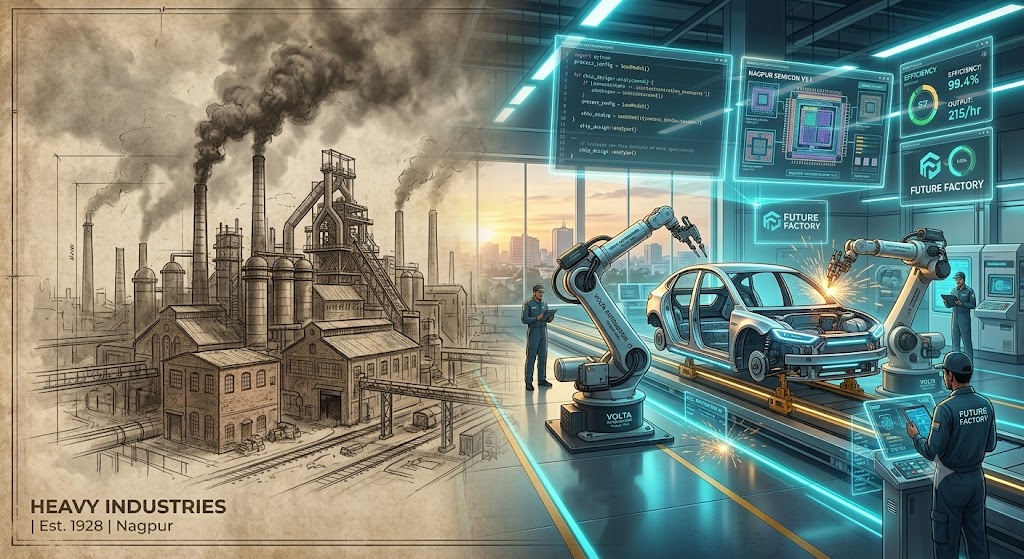
For the better part of the last two decades, global economists and geopolitical strategists have persistently asked a single, reductive question: When will India become the next China? The assumption has always been that to achieve double-digit economic growth and lift hundreds of millions out of poverty, New Delhi must meticulously replicate Beijing’s late-20th-century playbook. That playbook was straightforward: leverage a massive, low-cost labor force, heavily suppress domestic consumption to fund debt-fueled infrastructure, and transform the nation into the unquestioned, export-driven factory of a rapidly globalizing world.
As we navigate the economic landscape of 2026, it is abundantly clear that this premise is fundamentally flawed. India is currently undergoing a massive industrial renaissance, but it looks nothing like the Chinese miracle of the 1990s and 2000s. Driven by a radically different geopolitical climate, a software-first industrial base, and a consumption-heavy domestic economy, India is forging a distinct manufacturing identity. Attempting to copy the China model today would not only be economically disastrous for India—it is practically impossible.
The Obsolescence of the 1990s Playbook
To understand why India must chart its own course, one must first recognize that the macroeconomic conditions that enabled China’s meteoric rise no longer exist. When China opened its economy and joined the World Trade Organization in 2001, it was stepping into a hyper-globalized world eager to offshore production to the cheapest available bidder. Western nations were happy to export their manufacturing bases, assuming that economic integration would eventually lead to political liberalization in Beijing.
Today, that era of frictionless free trade is dead. The global economy in 2026 is defined by protectionism, high tariffs, and deep geopolitical suspicion. The United States and Europe are actively attempting to re-shore critical supply chains, erecting massive trade barriers to protect their own domestic industries. Furthermore, the advent of advanced robotics, artificial intelligence, and extreme automation has severely depreciated the value of cheap, unskilled human labor. A nation can no longer simply herd tens of thousands of low-wage workers into a mega-factory and expect to undercut global competitors on price alone. The entry barriers to global manufacturing are now defined by technological sophistication and energy efficiency, not just headcounts.
Additionally, the political structure of the two nations dictates wildly different economic strategies. The Chinese Communist Party possessed the authoritarian leverage to forcibly acquire land, suppress wages, and disregard environmental regulations to build vast industrial parks overnight. India’s noisy, chaotic, and vibrant democracy inherently prevents such unilateral state action. Land acquisition is a complex legal battle, labor unions possess real political power, and environmental concerns are actively litigated in independent courts. India cannot simply pave over its societal complexities to build ghost cities and empty highways in the name of state-mandated GDP targets.
The PLI Paradigm: Precision Over Blanket Subsidies
Because India cannot rely on brute-force state capitalism, it has pivoted to a strategy of extreme, targeted precision. The cornerstone of this approach is the Production Linked Incentive (PLI) scheme. Rather than attempting to subsidize every conceivable manufacturing sector, the Indian government has identified 14 strategic verticals—ranging from electronics and pharmaceuticals to solar photovoltaics and auto components—with a budgetary outlay of nearly ₹1.97 lakh crore (over $26 billion).
The mechanism is aggressively capitalist: the government does not fund the initial factory setup; rather, it offers a 4% to 7% cash incentive strictly on incremental sales produced domestically. It is a reward for verified output, not a handout for intent.
The results in specific sectors have been staggering, most notably acting as the primary catalyst for the “China Plus One” global de-risking strategy. The definitive proof of concept is Apple. As of early 2026, India is manufacturing approximately 17% of all global iPhones, with domestic electronics exports surging past $17 billion. By offering targeted incentives, India successfully neutralized the initial cost disadvantages of operating outside of established Chinese supply chains. However, policymakers are acutely aware that mere assembly is not the endgame. The true test of the PLI strategy over the next decade will be moving beyond final assembly to attract deep-tier component manufacturers, reducing the current, dangerous reliance on Chinese-imported sub-components.
Software-Defined Manufacturing: India’s True Moat
If China’s manufacturing miracle was built on hardware and concrete, India’s industrial future is being built on silicon and code. For decades, India’s primary economic engine has been its IT services sector and its vast network of Global Capability Centers (GCCs), which power the back-end operations of the world’s largest Fortune 500 companies.
Historically, this service-heavy economy was viewed as a weakness in the context of physical manufacturing. In 2026, it is India’s greatest competitive moat. We have entered the era of “Software-Defined Vehicles” (SDVs), smart grids, and Industry 4.0. The value of a modern electric vehicle or a specialized drone lies less in its stamped metal chassis and more in its Battery Management System (BMS), its autonomous AI algorithms, and its semiconductor architecture.
India is uniquely positioned to merge the shop floor with the server room. The nation is steadily emerging not just as a consumer of chips, but as a global hub for semiconductor design. While building multi-billion-dollar fabrication plants (fabs) takes years, India’s massive pool of semiconductor design engineers is already dictating the architecture of global tech. By leveraging its software supremacy, India is pursuing “Servitization”—offering high-margin engineering, design, and software integration alongside physical assembly. This is a value proposition that a strictly hardware-focused Chinese model cannot easily replicate.
The Domestic Consumption Engine
Another critical divergence lies in the ultimate destination of the manufactured goods. The Chinese model was structurally dependent on generating massive trade surpluses by exporting goods to the West. Chinese domestic consumption was deliberately kept low to funnel capital into industrial expansion.
India, conversely, is a consumption-driven economy that consistently runs a trade deficit. With a population of 1.4 billion and a rapidly expanding middle class that is experiencing real wage growth, India is a massive terminal market in its own right. When global giants like Samsung, Hyundai, or Foxconn establish mega-factories in Tamil Nadu or Gujarat, they are not solely looking to export; they are desperate to capture the Indian consumer.
This dual-engine approach—manufacturing for domestic consumption while simultaneously utilizing the same facilities as export hubs for the Middle East, Africa, and the West—provides India with a highly resilient economic buffer. It insulates the Indian manufacturing sector from the severe global trade shocks and tariff wars that currently threaten export-dependent nations.
Escaping the Low-Value Trap
Despite these structural advantages, the Indian manufacturing sector faces profound challenges. The greatest risk in adopting a global assembly role is falling into the “low-value trap.” Academic studies of global supply chains reveal that in the assembly of high-end electronics, the country providing the cheap labor often captures less than 4% of the total profit margin, while the brand owners and core technology designers walk away with the lion’s share.
India cannot afford to be satisfied with merely generating low-paying assembly jobs while the vast majority of profits flow back to Cupertino, Tokyo, or Seoul. The government and domestic conglomerates must aggressively invest in indigenous Research and Development (R&D) to foster domestic champions capable of owning their own intellectual property. The goal must be to design, patent, and brand products in India, not just screw them together.
The narrative that India is trailing decades behind China is based on a fundamental misreading of where the global economy is heading. India cannot build its future by copying China’s past. By combining targeted state incentives with its unparalleled software talent, and by leveraging its massive domestic market, India is not striving to become the anonymous, low-wage “factory of the world.” Instead, it is methodically building the foundation to become the high-tech, software-integrated manufacturing lab of the 21st century.
* Conceptual illustration generated using AI