
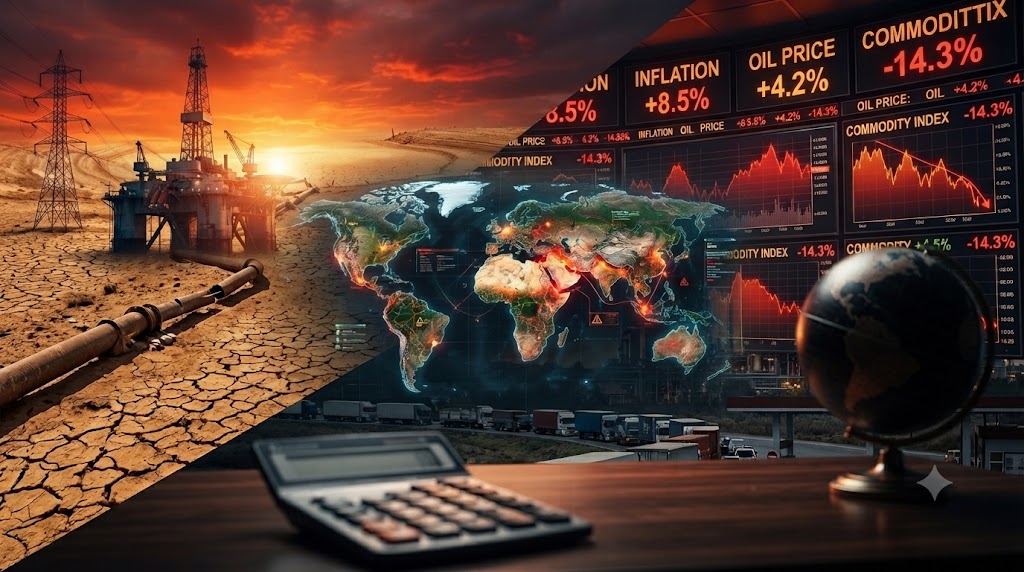
For the past three years, global central banks operated under a comforting economic theory: that monetary policy alone—adjusting interest rates, tweaking reserve requirements, and managing quantitative tightening—could permanently tame the inflationary spike that followed post-pandemic supply chain disruptions.
As we navigate the final quarter of 2026, that central banking orthodoxy has run headfirst into a harsh, undeniable physical truth. Inflation is not merely a monetary phenomenon; it is a thermodynamic one.
According to the World Bank’s latest Commodity Markets Outlook, global energy prices surged by over 24%, with West Texas Intermediate (WTI) and Brent crude oil climbing past $98 per barrel. Natural gas prices have followed suit, driving electricity tariffs to multi-year highs across Europe, Asia, and the Americas.
This energy shock has spilled over into transportation, manufacturing, fertilizer production, and retail food prices. The lesson of 2026 is brutal in its clarity: an economy can manipulate paper currency and interest rates, but if the foundational inputs of modern civilization—electricity, crude oil, diesel, and natural gas—become scarce, expensive, or volatile, global inflation cannot remain suppressed.
Here is an in-depth, data-driven analysis of the “Energy Reality,” how it fuels structural global inflation, and why central banks are struggling to control an economic crisis born in the physical world.
1. The Molecule of Everything: Why Energy Rules Prices
To understand why rising energy costs trigger systemic inflation, one must appreciate that energy is not just another consumer product category inside a Consumer Price Index (CPI) basket. Energy is the “molecule of everything”—the fundamental, indispensable input required to harvest, process, manufacture, transport, and digitize every good and service on Earth.
When the price of crude oil increases from $60 to $98 per barrel, the economic damage does not stop at the gas station pump. It cascades across four distinct economic layers:
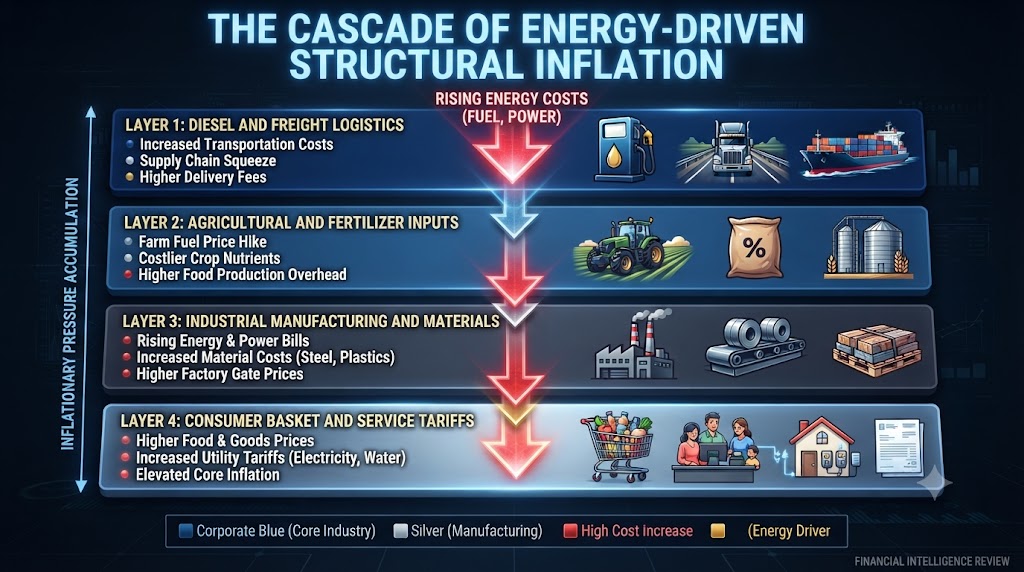
The Cascade of Energy Driven Structural Inflation
Unlike discretionary consumer spending, which can be deferred during economic downturns, energy consumption is highly inelastic. A container ship cannot cross the Pacific Ocean on good intentions; a tractor cannot harvest wheat without diesel; and a modern semiconductor fab cannot operate without a uninterrupted supply of high-voltage electricity. When energy costs rise, businesses have only two choices: absorb the higher cost and suffer margin collapse, or pass the cost directly to the consumer in the form of higher prices.
2. The Trilemma of 2026: Geopolitics, Underinvestment, and AI Power Strain
Why are energy markets so constrained in late 2026? The current price surge is the result of three compounding structural forces that have coalesced simultaneously:
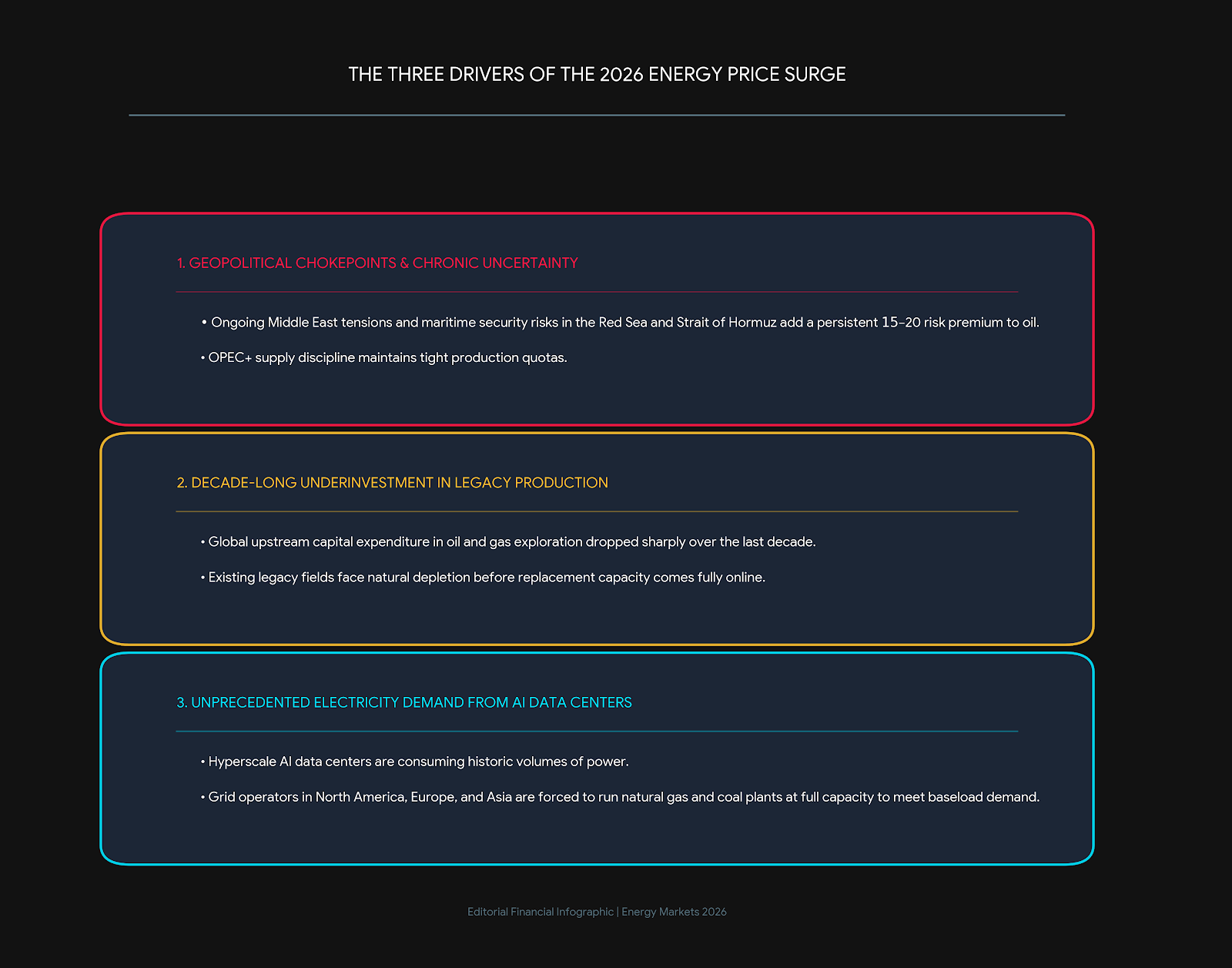
The Three Drivers of the 2026 Energy Price Surge
The Unexpected AI Power Shock
A unique vector driving the 2026 energy reality is the explosive growth of Artificial Intelligence infrastructure. The World Economic Forum highlights that hyperscale AI data centers require up to ten times more electricity per rack than traditional cloud servers.
In regions like North America, Western Europe, and East Asia, utility companies are scrambling to provide multi-gigawatt power hookups. Because renewable energy generation (wind and solar) remains weather-dependent and requires expensive grid-scale battery storage, utilities are turning back to natural gas and coal to ensure continuous power for data centers. This sudden, massive demand surge has created fierce competition between tech conglomerates, industrial factories, and residential households for grid capacity, directly driving up electricity prices across major economies.
3. The Greenflation Dilemma: Capital Costs in the Energy Transition
A central paradox facing world leaders in 2026 is that the clean energy transition—while essential for long-term climate stability and energy security—is intrinsically inflationary in its initial execution phase.
Economists refer to this phenomenon as “Greenflation”:
- Critical Mineral Scarcity: Building solar panels, offshore wind turbines, high-voltage transmission lines, and electric vehicle batteries requires vast quantities of copper, lithium, nickel, cobalt, and rare earth elements. As nations race to construct clean energy infrastructure simultaneously, the prices of these critical materials have skyrocketed, raising the capital cost of transition projects.
- The Cost of Capital Trap: Central bank rate hikes designed to curb inflation have inadvertently made the green transition far more expensive. Renewable energy projects require immense upfront capital investment compared to fossil fuel plants, which carry higher operational costs later. When benchmark interest rates sit at 5% or 6%, the cost of financing a $2 billion offshore wind farm or grid expansion increases dramatically, slowing down deployment and forcing utilities to pass higher capital costs onto rate-paying consumers.
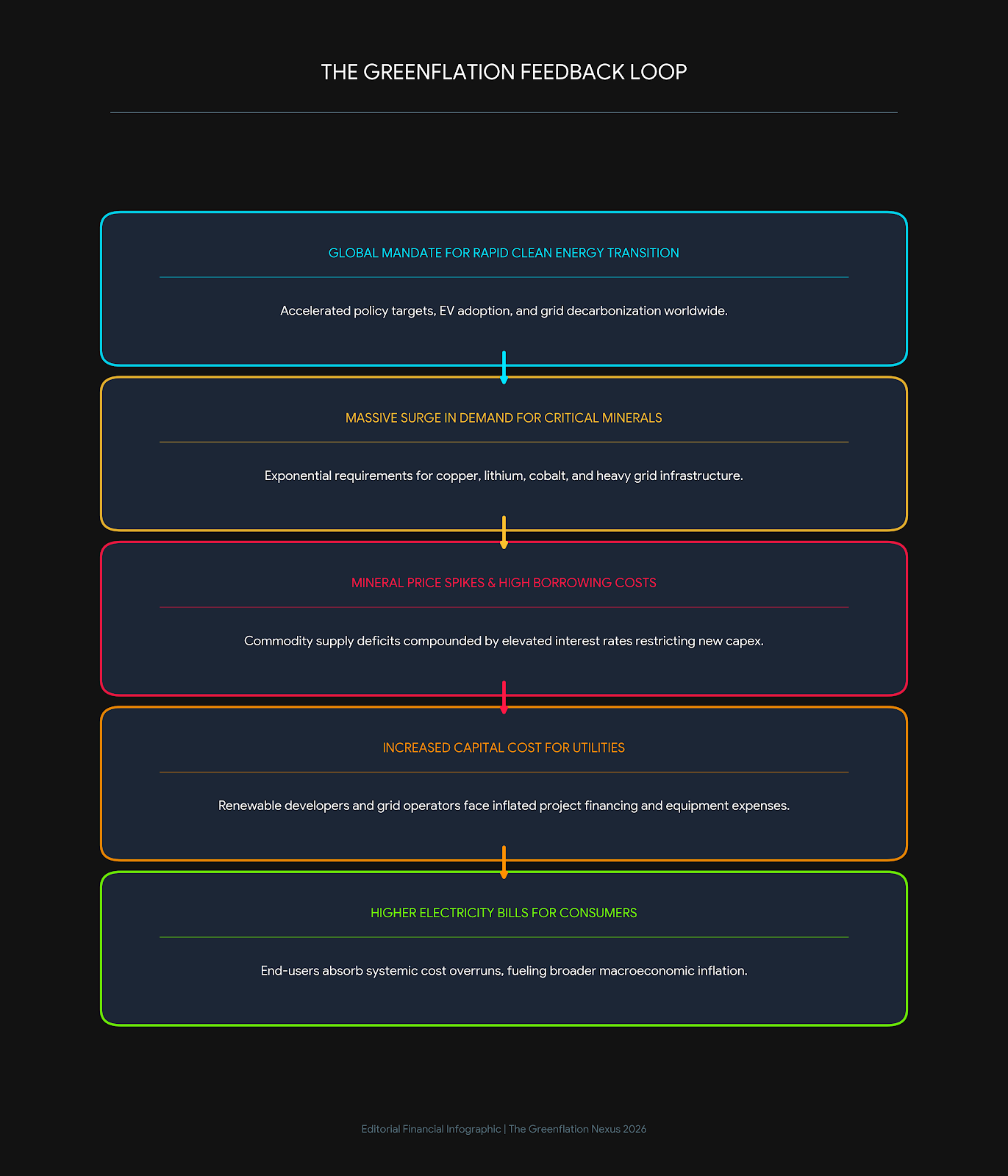
The Greenflation Feedback Loop
4. The Central Bank Impasse: Fighting Scarcity with Paper Tools
This brings us to the central policy crisis of late 2026. Central banks—including the Federal Reserve, the European Central Bank, and the Reserve Bank of India—are facing the structural limits of monetary policy.
When inflation is driven by excess consumer demand (e.g., post-lockdown stimulus spending), raising interest rates works effectively. Higher borrowing costs cool consumer spending, dampen home buying, and bring demand back into alignment with supply.
However, when inflation is driven by physical energy supply shortages, geopolitical shipping bottlenecks, and elevated electricity tariffs, interest rate hikes are a blunt, ineffective tool:
- Interest rates cannot drill an oil well: Raising benchmark rates does not produce additional barrels of crude oil or build natural gas pipelines.
- Interest rates cannot manufacture fertilizer: Raising interest rates does not lower the price of natural gas required to manufacture agricultural fertilizer.
- Interest rates risk stagflation: If central banks keep rates artificially high to fight energy-driven inflation, they risk crashing consumer demand, stalling industrial investment, and triggering severe economic recessions—a toxic combination known as stagflation.
The International Monetary Fund (IMF) has already warned that global economic growth is slowing toward 3.1% in 2026 precisely because persistent energy price pressures are squeezing real household incomes and corporate profitability worldwide.
Conclusion: Embracing Energy Realism
The economic turbulence of 2026 demonstrates that the world can no longer afford ideological posturing on energy policy. The idea that nations could abruptly dismantle legacy fossil fuel systems before clean energy infrastructure, storage technology, and grid resilience were fully mature was an economic miscalculation that consumers are now paying for through elevated inflation.
Surviving the energy reality requires a pragmatic policy pivot:
- Dual-Track Energy Policy: Governments must secure reliable, affordable baseline energy—including domestic natural gas, nuclear power, and hydro—to maintain economic stability while clean energy infrastructure is actively constructed.
- Accelerated Grid Modernization: Prioritizing high-voltage transmission lines, localized solar storage, and grid-scale efficiency to reduce transmission losses and integrate renewable power seamlessly.
- Targeted Supply-Side Investment: Rather than relying exclusively on monetary tightening, governments must incentivize capital investment in critical minerals, energy exploration, and industrial efficiency to address the root physical causes of scarcity.
Until global leaders align their economic policies with the physical laws of energy generation and distribution, inflation will remain an persistent threat. Real prosperity is built on real energy security—and the sooner the global economy embraces this truth, the sooner stable growth can return.
* Conceptual illustration generated using AI