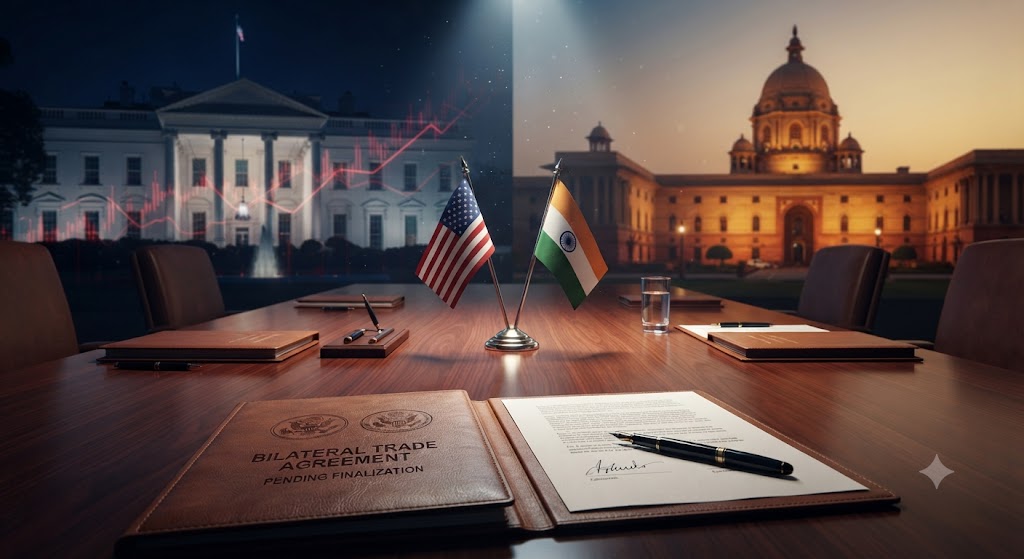
In late October 2026, a familiar yet perplexing diplomatic spectacle unfolded in Washington D.C. Speaking to reporters from the Oval Office on October 20, U.S. President Donald Trump declared that a long-awaited bilateral trade agreement with India was “pretty close”. Lavishing personal praise on Indian Prime Minister Narendra Modi, Trump described him as a “smart man” and a “great friend,” expressing confidence that ongoing negotiations would soon produce a “much different kind of deal.” His optimistic remarks coincided with a high-stakes visit by U.S. Secretary of State Marco Rubio to New Delhi and Mumbai for strategic talks with External Affairs Minister S. Jaishankar.
Yet, this sudden surge of public warmth stands in stark contrast to the aggressive economic posture Washington has projected toward New Delhi over the past year. From imposing multi-tiered tariffs ranging from 25% to 50% over India’s trade policies and energy purchases to threatening sweeping secondary penalties under the Lindsey Graham Sanctioning Act, the Trump administration has maintained intense pressure on Indian exports.
This dramatic juxtaposition raises a fundamental geopolitical question: Is Donald Trump’s sudden wave of praise a calculated, tactical maneuver—a “hidden agenda” to extract economic concessions—or is it a pragmatic admission that Washington ultimately has no choice but to accommodate an indispensable Asian power?
The “Praise and Punish” Playbook
To understand the current state of U.S.-India trade talks, one must analyze what geopolitical observers describe as Trump’s signature “praise and punish” strategy. Throughout his political career, Trump has deployed public rhetoric as a flexible instrument of leverage in bilateral negotiations. By separating the personal relationship with a foreign head of state from the institutional trade apparatus, he creates a deliberate strategic wedge.
In the case of India, this dynamic has played out in full view:
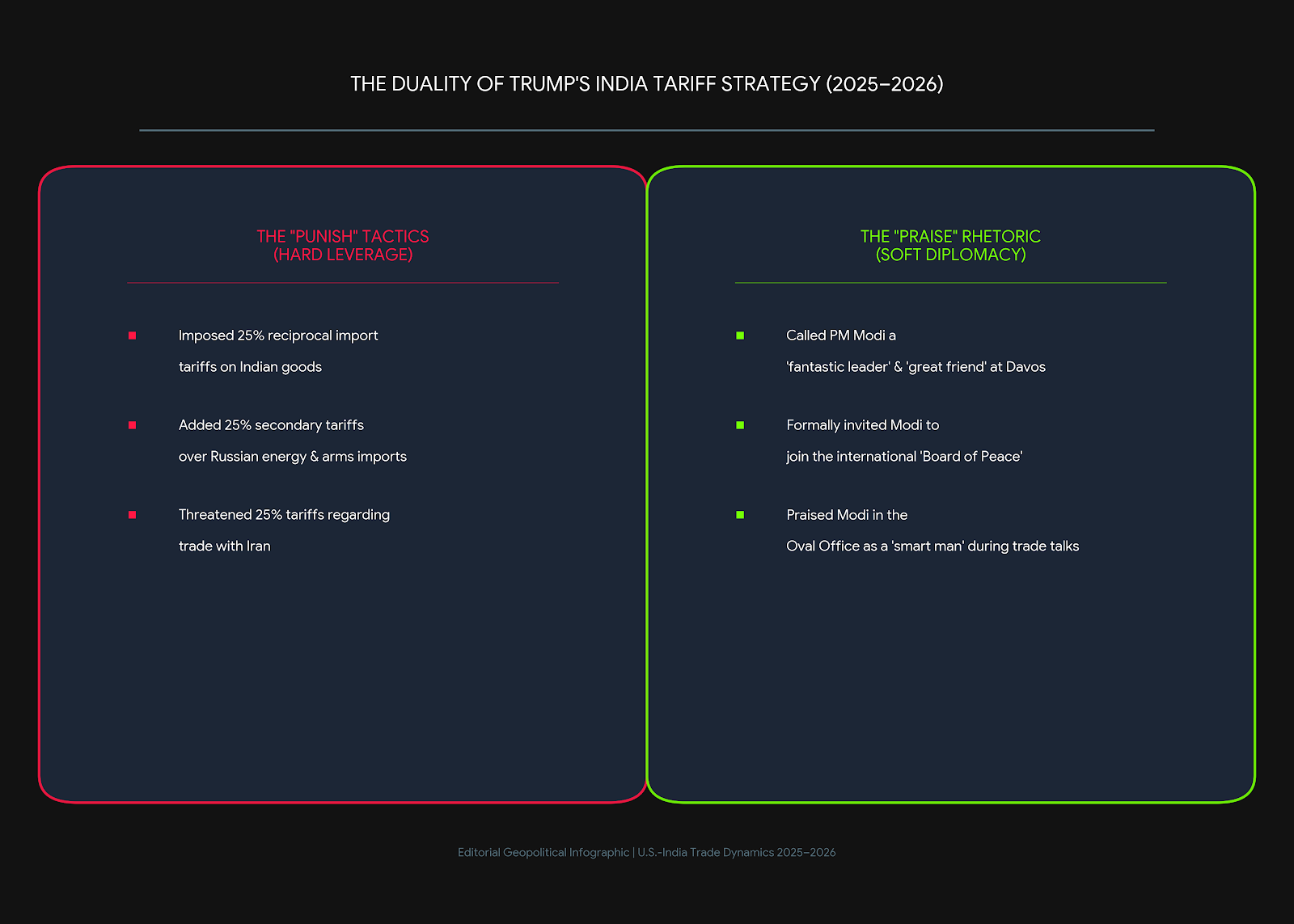
The Duality of Trump’s India Tariff Strategy (2025-2026)
By showering PM Modi with personal accolades while threatening Indian commercial sectors with punitive duties, Trump seeks to create a psychological environment where Indian leadership feels respected, yet the negotiating apparatus remains under immense pressure. Flattery isolates the leader from the bureaucratic machinery, softening the ground for hard-nosed compromises at the negotiating table.
The “No Choice” Realities: Why Washington Cannot Push Too Far
While aggressive tariff threats generate headlines, structural economic and geopolitical realities severely constrain how far Washington can actually push New Delhi. In truth, the U.S. executive branch faces several hard limits that make a prolonged trade war with India counterproductive to American interests.
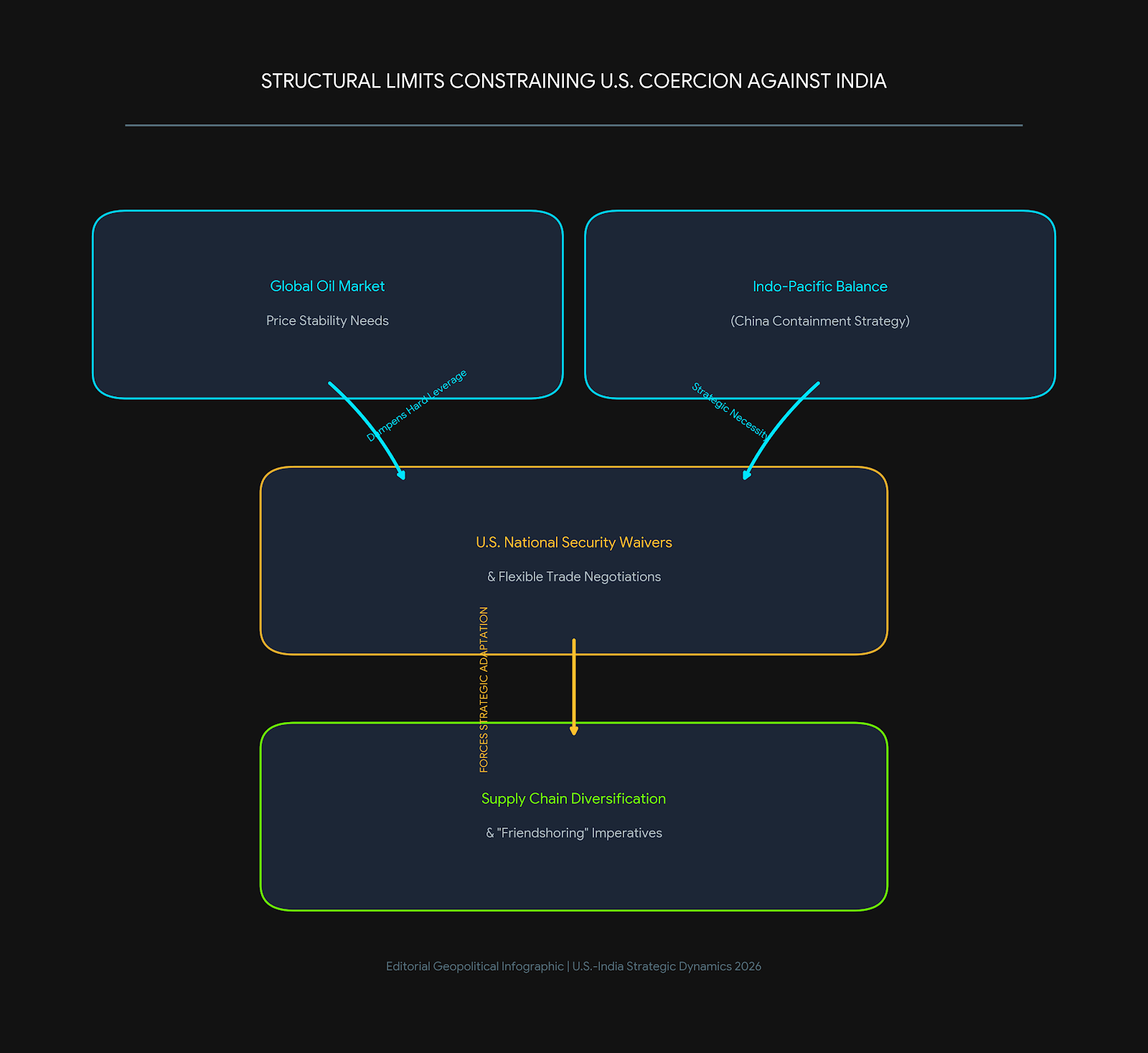
Structural Limits Constraining US Coercion Against India
1. The Energy Reality and Global Inflation
The most immediate limit on American coercion became evident during recent legislative debates regarding secondary sanctions on Russian crude oil. India imports approximately 4 to 4.5 million barrels of crude oil per day to sustain its 1.4 billion population. If severe U.S. tariffs or sanctions were to abruptly force Indian refiners off the global market, international crude supplies would collapse, sending global oil prices surging past $120 a barrel.
This price shock would immediately spill over into the United States, reigniting domestic inflation at the gas pump. Recognizing this mathematical reality, Secretary of State Marco Rubio explicitly noted that “geography is real” and that the U.S. had to issue national security waivers because treating India like a straightforward adversary is impossible when managing global energy equilibrium.
2. The Indo-Pacific Security Anchor
From a grand strategy perspective, India remains the central anchor of the U.S. strategy to balance China in the Indo-Pacific. The Pentagon and the State Department rely heavily on the Quad framework (comprising the U.S., India, Japan, and Australia) to maintain maritime security, defense interoperability, and intelligence sharing across critical sea lanes. Pushing economic hostilities to a breaking point risks driving New Delhi toward deeper strategic hedging with non-Western blocs like BRICS or SCO. Washington simply cannot afford to alienate its most capable democratic partner in Asia.
3. Supply Chain “Friendshoring” Dependencies
As Western multinational corporations aggressively de-risk their manufacturing operations away from mainland China, India has emerged as the premier alternative for advanced electronics assembly, pharmaceuticals, active pharmaceutical ingredients (APIs), and global capability centers. American tech and healthcare firms depend heavily on Indian industrial capacity. Imposing destructive, across-the-board tariffs on Indian manufactured goods would disrupt U.S. corporate supply chains, defeating the entire purpose of friendshoring.
The “Hidden Agenda”: Transactional Leverage and Strategic Pivots
While structural limits prevent a total fallout, Donald Trump’s sudden wave of praise also serves very specific, calculated objectives within the trade negotiations.
1. Pivoting India Toward U.S. Energy and Arms
The primary objective behind the “different kind of deal” signaled by Trump is altering the composition of bilateral trade. By keeping tariff threats hanging over Russian oil and legacy hardware, Washington is incentivizing New Delhi to substitute a portion of those imports with American Liquefied Natural Gas (LNG), crude oil, and advanced U.S. defense systems. During Rubio’s meetings with External Affairs Minister S. Jaishankar, expanding U.S. energy shipments and defense sales to India were central topics. Trump’s praise serves as a clear signal: economic friction will evaporate as soon as purchase orders are redirected toward American suppliers.
2. Bypassing Bureaucratic Gridlock for a Limited “Win”
Historically, U.S.-India trade negotiations have routinely stalled over deep structural disagreements surrounding domestic agriculture, dairy subsidies, and digital data localization. Indian negotiators have maintained firm red lines to protect hundreds of millions of domestic farmers and small retailers.
Recognizing that a comprehensive Free Trade Agreement (FTA) is politically unviable, the Trump administration has pivoted toward a limited, phased trade package. By describing the pending agreement as “much different than earlier pacts,” Trump is setting the stage to exclude unresolved, sensitive sectors while securing targeted tariff reductions on specific U.S. industrial exports. This allows both Washington and New Delhi to declare a high-profile diplomatic victory without triggering domestic backlash.
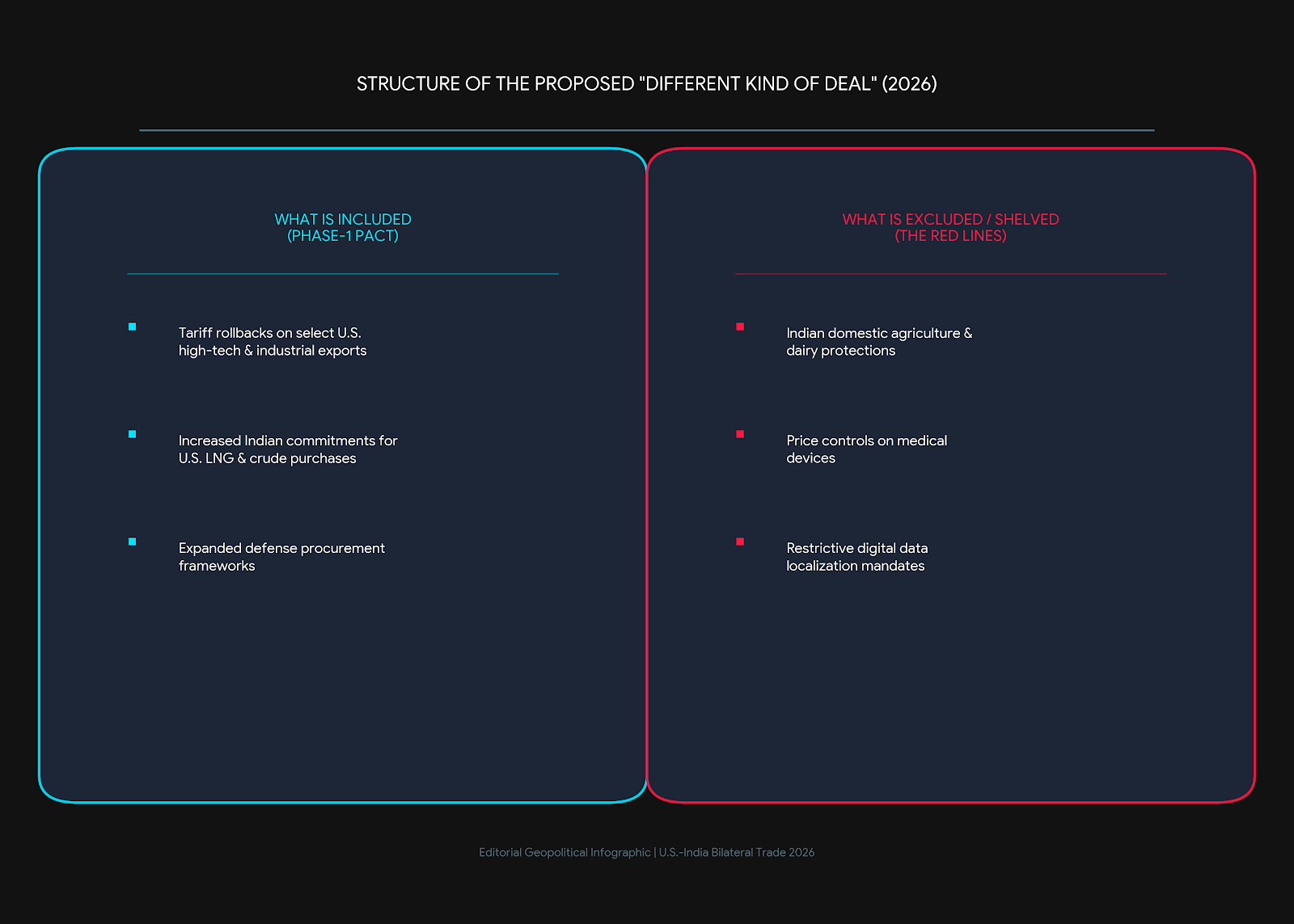
Structure of the Proposed – Different Kind of Deal (2026)
Conclusion: Pragmatism Wrapped in Rhetoric
The evolving dynamic between Washington and New Delhi is neither a story of personal affection nor one of irreconcilable economic war; it is a masterclass in transactional realpolitik. Donald Trump’s warm praise for Prime Minister Modi is simultaneously a tactical carrot designed to extract commercial concessions and an implicit recognition of geopolitical necessity.
India’s economic scale, strategic posture in the Indo-Pacific, and crucial role in global energy stability mean that Washington cannot treat New Delhi like a subordinate trade partner. The Modi government has demonstrated that while it is willing to engage flexibly and adjust tariffs on select American products, it will not surrender its core domestic interests or strategic autonomy under external pressure.
Ultimately, Trump’s praise reflects a fundamental reality of the 2026 global order: in an increasingly multi-polar world, the United States needs a strong, independent India just as much as India needs access to the American market.
* Conceptual illustration generated using AI