
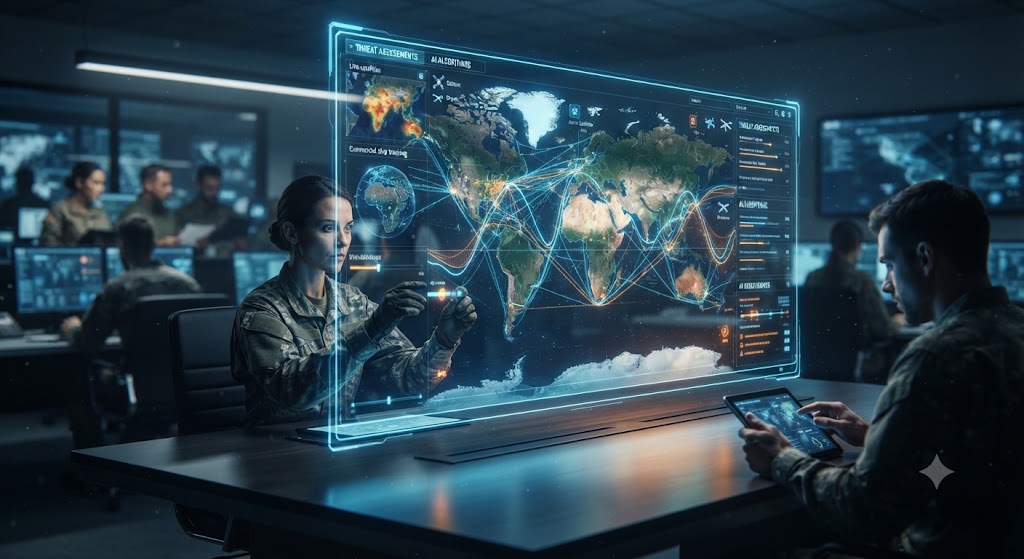
For decades, the traditional paradigm of geopolitical intelligence was defined by shadows, classified cables, and human assets embedded in foreign capitals. When military conflicts, civil unrest, or border escalations occurred, the retrospective narrative often pointed to missed signals subtle indicators that were buried under mountains of intelligence noise or trapped behind stovepiped bureaucratic agencies.
Today, that paradigm has fundamentally inverted. In the modern security architecture of 2026, intelligence agencies, defense ministries, and private defense contractors no longer wait for secret diplomatic memos to warn them of impending conflict. Instead, they are turning outward, harnessing the vast, chaotic sea of Open-Source Intelligence (OSINT) and weaponizing advanced Artificial Intelligence to predict geopolitical flashpoints before a single shot is fired.
Driven by frameworks like the U.S. Intelligence Community’s modernized OSINT strategy and cutting-edge military AI platforms like Palantir’s Maven Smart System, modern security apparatuses are turning the public internet, commercial satellites, and social media feeds into an early-warning crystal ball.
Here is an in-depth analysis of how intelligence agencies and defense contractors fuse AI with open-source data to forecast the future of global conflict.
1. The Open-Source Revolution: From Fringe to First Resort
Historically, OSINT was viewed by intelligence agencies as a secondary, low-value supplement to classified human intelligence (HUMINT) and signals intelligence (SIGINT). It was mostly used to monitor foreign media broadcasts or cross-reference public corporate registries.
That hierarchy has completely flipped. In 2026, OSINT is officially recognized as the “intelligence of first resort”. Why? Because the modern world broadcasts its intentions in real time. Every military movement, economic shift, supply chain choke, and political maneuver leaves an inescapable digital exhaust in the public domain.
The sheer scale of this data is staggering:
- Commercial Satellite Imagery: High-revisit constellations capture sub-meter daily imagery of military bases, airfields, naval shipyards, and border fortifications.
- Commercial Maritime and Aviation Telematics: Transponder tracking (AIS for ships, ADS-B for aircraft) provides live telemetry on global logistics, cargo rerouting, and military transport movements.
- Social Media and Local Messaging: Millions of geo-tagged videos, forum posts, and local news broadcasts reflect public sentiment, military logistics, and troop mobilization at the hyper-local level.
- Commercial IoT and Telematics: Anonymized truck GPS data, smartphone location pings, and industrial power consumption metrics offer a real-time pulse of economic and industrial mobilization.
The challenge is no longer accessing this data; the challenge is processing a petabyte-scale flood of multi-lingual, unstructured information before it becomes obsolete. This is where Artificial Intelligence enters the operational pipeline.
2. The AI-OSINT Integration Pipeline: How Machines Read the World
Humans alone can no longer monitor the global information space. Intelligence analysts drowning in data require automated systems to separate signal from noise. Modern defense technology stacks utilize a sophisticated, multi-layered AI pipeline to convert raw public data into predictive foresight.
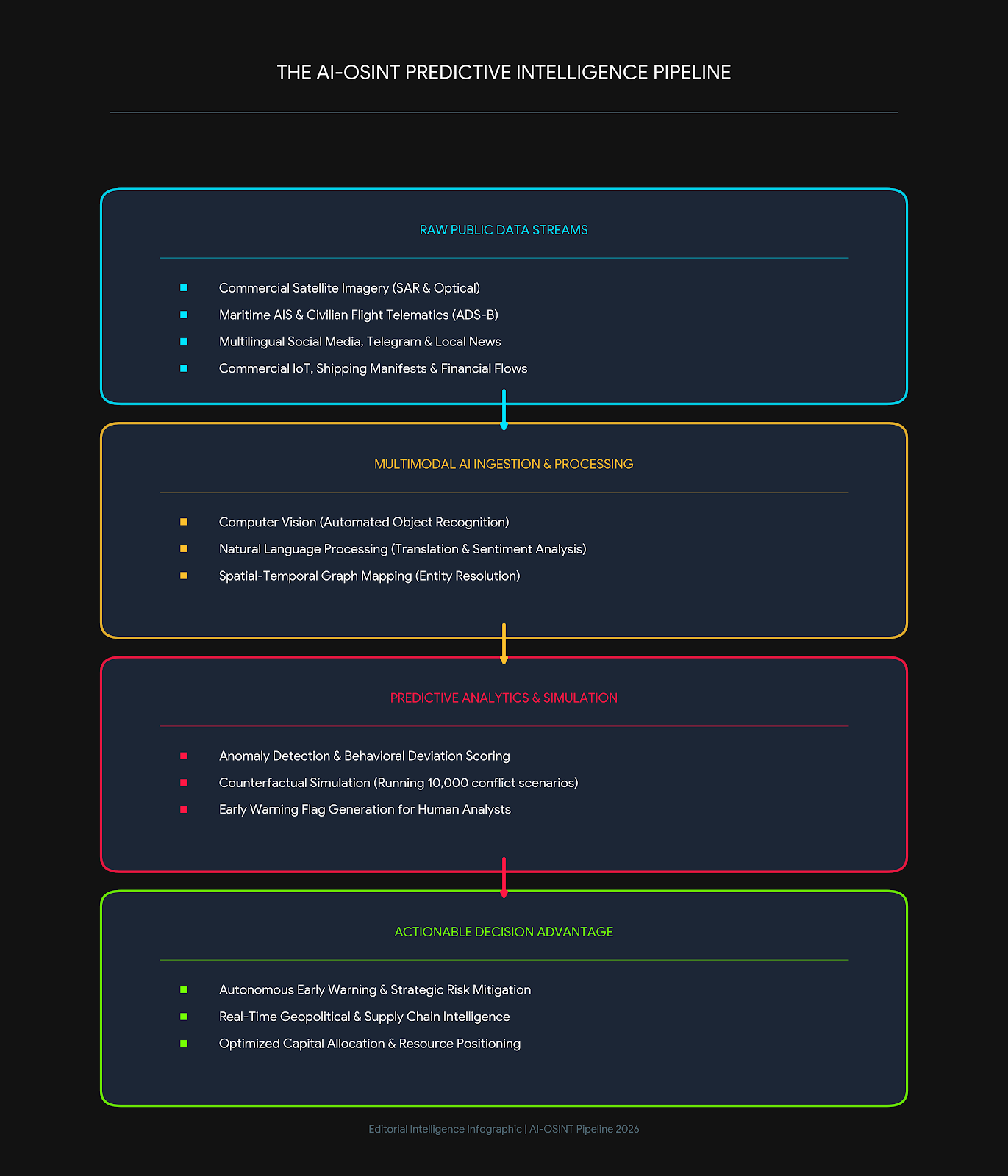
The AI-OSINT Predictive Intelligence Pipeline
A. Computer Vision and Geospatial Pattern Recognition
Defense contractors deploy advanced computer vision models trained to scan high-resolution satellite imagery automatically. Rather than human analysts manually reviewing thousands of parking lots at an air base, AI models instantly flag anomalies: Are bomber aircraft being dispersed from main hangars to revetments? Has a pontoon bridge been assembled across a contested river? Are logistics trucks clustering near an active rail depot? By quantifying these micro-changes, AI scores the probability of offensive operational readiness.
B. Natural Language Processing (NLP) and Multilingual Sentiment Analysis
Intelligence AI models continuously ingest millions of public social media posts (on platforms like Telegram, X, and regional networks), local newspaper editorials, and government press releases across dozens of languages. Using advanced sentiment analysis and entity extraction, the AI can detect rising hostile rhetoric, track localized panic buying, or identify shifts in state-controlled media narratives that historically precede military mobilization.
C. Spatial-Temporal Graph Mapping
Modern systems link disparate data points into a unified knowledge graph. If an AI detects a sudden spike in commercial truck rentals near a military district, a simultaneous cancellation of civilian flights over a regional airspace, and an increase in blood bank donations in a border province, the graph links these isolated variables. It recognizes a multi-domain pattern indicating that a military exercise or an imminent offensive is underway.
3. The Role of Defense Contractors: Building the Digital Nervous System
The integration of AI and OSINT into national security is largely driven by elite defense technology contractors who build the software infrastructure for military and intelligence commands.
Platforms like Palantir’s Maven Smart System have become the operational backbone for U.S. and allied defense forces, serving as the connective tissue that fuses classified intelligence feeds with open-source telemetry. Maven utilizes automated object detection, computer vision, and machine learning orchestration to provide commanders with real-time battlefield awareness.
Similarly, specialized OSINT tech firms such as Primer AI, Fivecast, and Babel Street provide natural language processing and digital footprint analysis tools that allow intelligence agencies to track extremist networks, foreign influence operations, and military force postures across open data sources.
These contractors have transformed defense technology from heavy, hardware-centric systems (like tanks and ships) into software-defined, data-driven intelligence networks that can anticipate threats before kinetic action begins.
4. From Warning to Simulation: Counterfactual Forecasting
Predicting geopolitical conflict is not just about observing what is happening today; it is about simulating what might happen tomorrow.
Advanced intelligence units are increasingly utilizing AI-based simulation platforms. These systems ingest historical conflict datasets, current OSINT telemetry, and economic indicators to run thousands of counterfactual simulations simultaneously.
For example, if an AI detects rising economic pressure and troop movements along a disputed border, the simulation platform will test thousands of variables weather conditions, supply chain resilience, political leadership decision-making models, and third-party alliances to project the exact tipping points where a diplomatic dispute escalates into open warfare.
These simulations do not provide absolute certainties; rather, they provide decision-makers with probabilistic risk profiles, allowing national security teams to deploy pre-emptive diplomatic deterrence, economic sanctions, or military repositioning to defuse crises before they erupt.
5. Challenges and Vulnerabilities: The Fog of Digital War
Despite its revolutionary capabilities, the marriage of AI and OSINT for geopolitical prediction is fraught with significant technical and strategic challenges:
- Data Scarcity and Rare Events: Major geopolitical conflicts are statistically rare events. Training an AI model on historical conflicts leaves it vulnerable to “black swan” scenarios novel, unprecedented tactics employed by adversaries that do not match historical training data.
- Deepfakes, Disinformation, and Poisoned Data: Because OSINT relies heavily on public information, hostile actors can deliberately poison open-source data streams. Adversaries can inject synthetic satellite imagery, coordinate bot-driven social media panic, or manipulate public shipping manifests to trick predictive AI models into issuing false alarms.
- Modeling Human Intent: As intelligence experts note, predicting the rational movements of trucks or ships is mathematically straightforward; predicting the erratic, emotional, or opportunistic decisions of individual political leaders remains immensely difficult.
Conclusion: Maintaining the Decision Advantage
The integration of artificial intelligence and open-source data has permanently transformed the art of intelligence. Intelligence agencies and defense contractors have transitioned from passive observers of history into active, predictive forecasters.
In a volatile, multi-polar world where crises erupt at digital speed, the victor is no longer just the nation with the most powerful kinetic arsenal, but the nation with the sharpest cognitive advantage. By turning the open digital footprint of the planet into an early-warning system, AI and OSINT ensure that future geopolitical conflicts can be anticipated, managed, and whenever possible intercepted before they ever begin.
* Conceptual illustration generated using AI