
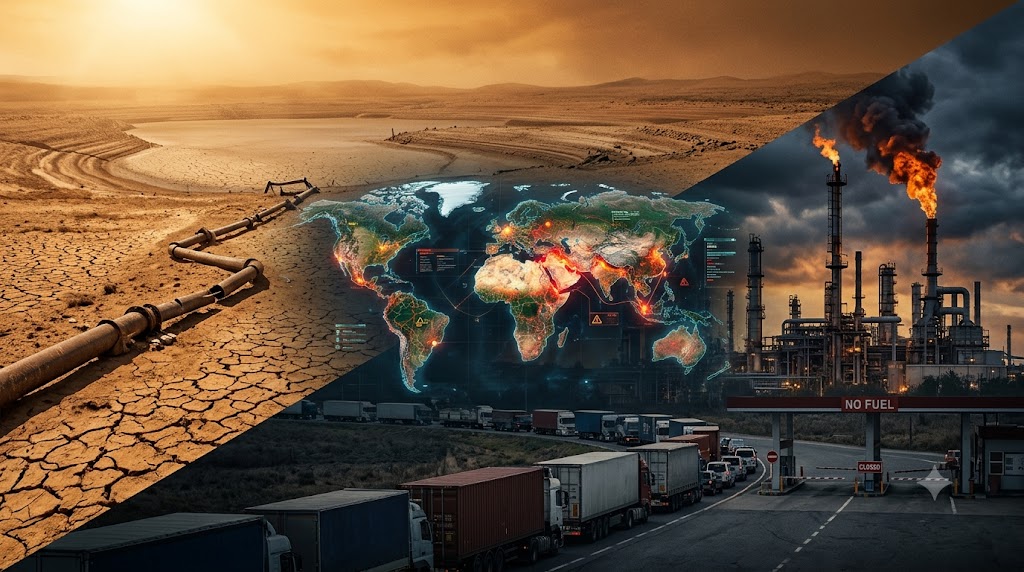
For the better part of two centuries, industrial civilization operated on a dangerous, implicit assumption: that the foundational inputs of modern life—cheap energy to power machines and abundant freshwater to sustain life—were essentially limitless, subject only to the temporary bottlenecks of technology and logistics.
As we navigate the final quarter of 2026, that comforting illusion has definitively shattered.
Humanity today finds itself trapped in a vicious, double-sided resource squeeze. On one side, geopolitical conflict in the Middle East and Eastern Europe has ignited a global fossil fuel crisis, throttling shipping lanes, driving oil prices to volatile highs, and sparking energy rationing from South Asia to South America. On the other side, a silent, accelerating ecological catastrophe has pushed global freshwater systems past their breaking point, plunging three-quarters of the human population into water insecurity.
These are not two separate crises operating in isolation; they are deeply entangled, compounding forces. It takes vast amounts of energy to extract, treat, and transport water; conversely, it takes vast volumes of water to cool power plants, refine petroleum, and produce agricultural biofuels. As the world simultaneously fights for fuel and water, the global order is being fundamentally rewritten around the cold mathematics of resource survival.
Pillar I: The Fuel Firestorm – Geopolitical Chokepoints and Economic Stagflation
The immediate shock to global stability in 2026 stems from the energy sector. Following military escalations in the Persian Gulf and the subsequent severe constriction of traffic through the Strait of Hormuz—the maritime artery responsible for one-fifth of the world’s seaborne crude and liquified natural gas (LNG)—the global energy grid experienced a seismic disruption.
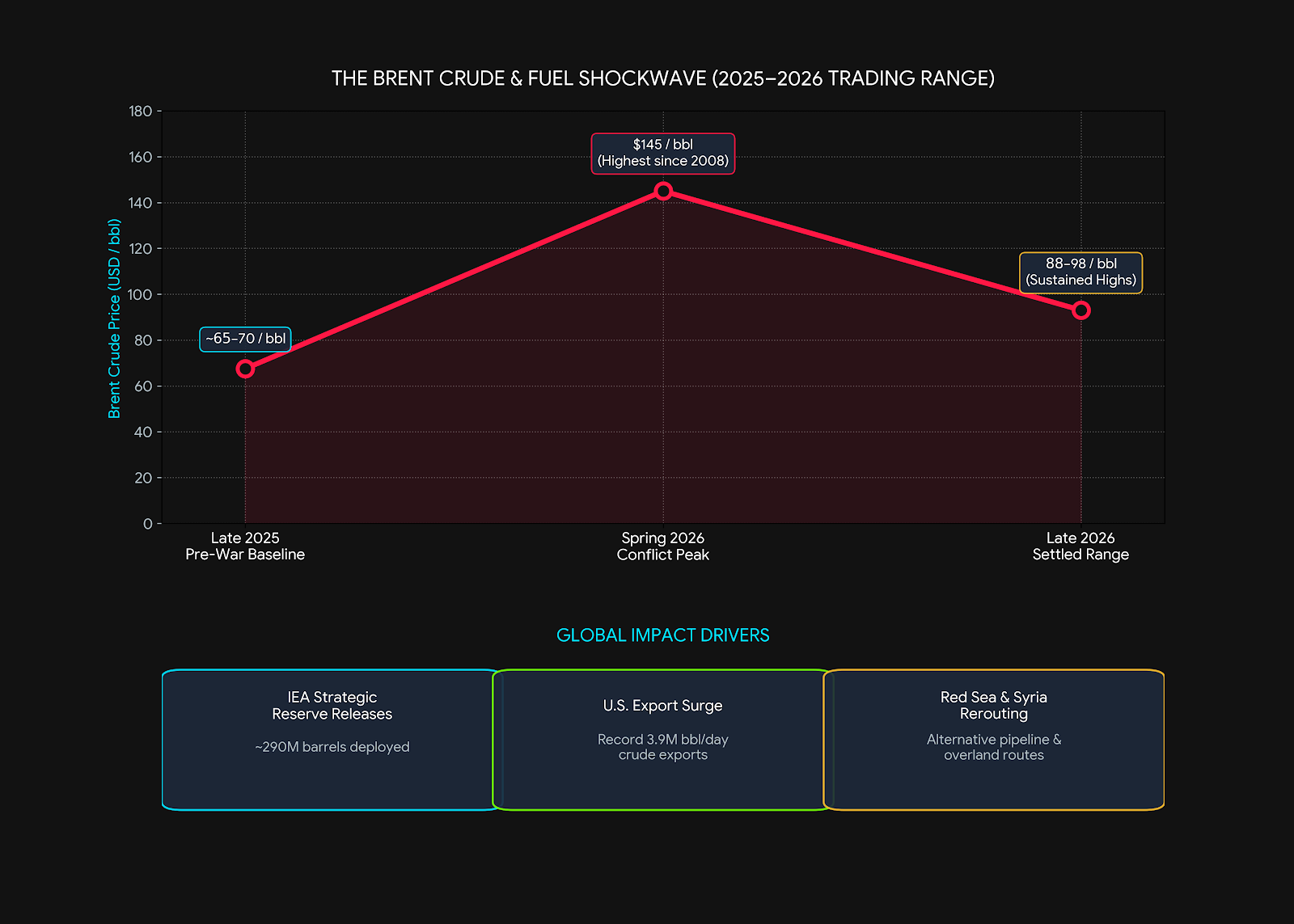
The Brent Crude and Fuel Shockwave (2025-2026 Trading Range)
Though emergency releases from the International Energy Agency’s (IEA) Strategic Petroleum Reserve and increased U.S. shale exports helped pull Brent crude back down from its spring peak of $145 per barrel to the $90 range, the baseline cost of fuel remains structurally elevated.
The consequences for developing economies have been devastating:
- Rationing and Industrial Closures: In nations like Bangladesh, Pakistan, and Vietnam, soaring LNG and diesel prices forced governments to enforce mandatory early closures for commercial centers, shut down universities to conserve fuel, and institute rolling industrial blackouts.
- The Biofuel Trap: With traditional fossil fuels remaining prohibitively expensive, European and North American energy markets saw biofuels become cheaper than petroleum-based shipping fuels for the first time in history. However, this shift triggered a dangerous “food vs. fuel” trade-off, encouraging agricultural producers to divert crops and vegetable oils toward fuel refining rather than food supply.
- Stagflationary Pressures: The International Monetary Fund (IMF) downgraded global GDP growth projections for 2026, citing the asymmetric burden of fuel inflation on energy-importing nations struggling with high national debt and weakening currencies.
Pillar II: The Water Bankruptcy – The Silent Ecological Collapse
While headlines remain dominated by fuel price spikes and military maneuvers around oil refineries, a far larger, slower-moving catastrophe is unfolding beneath the surface.
According to the UN-Water Global Water Bankruptcy benchmark metrics published in 2026, a staggering 75% of the global population now lives in nations categorized as water-insecure or severely water-insecure. More than 2.1 billion people lack access to safely managed drinking water at home, while over 106 million people drink directly from untreated surface water sources like rivers, ponds, and unmonitored streams.
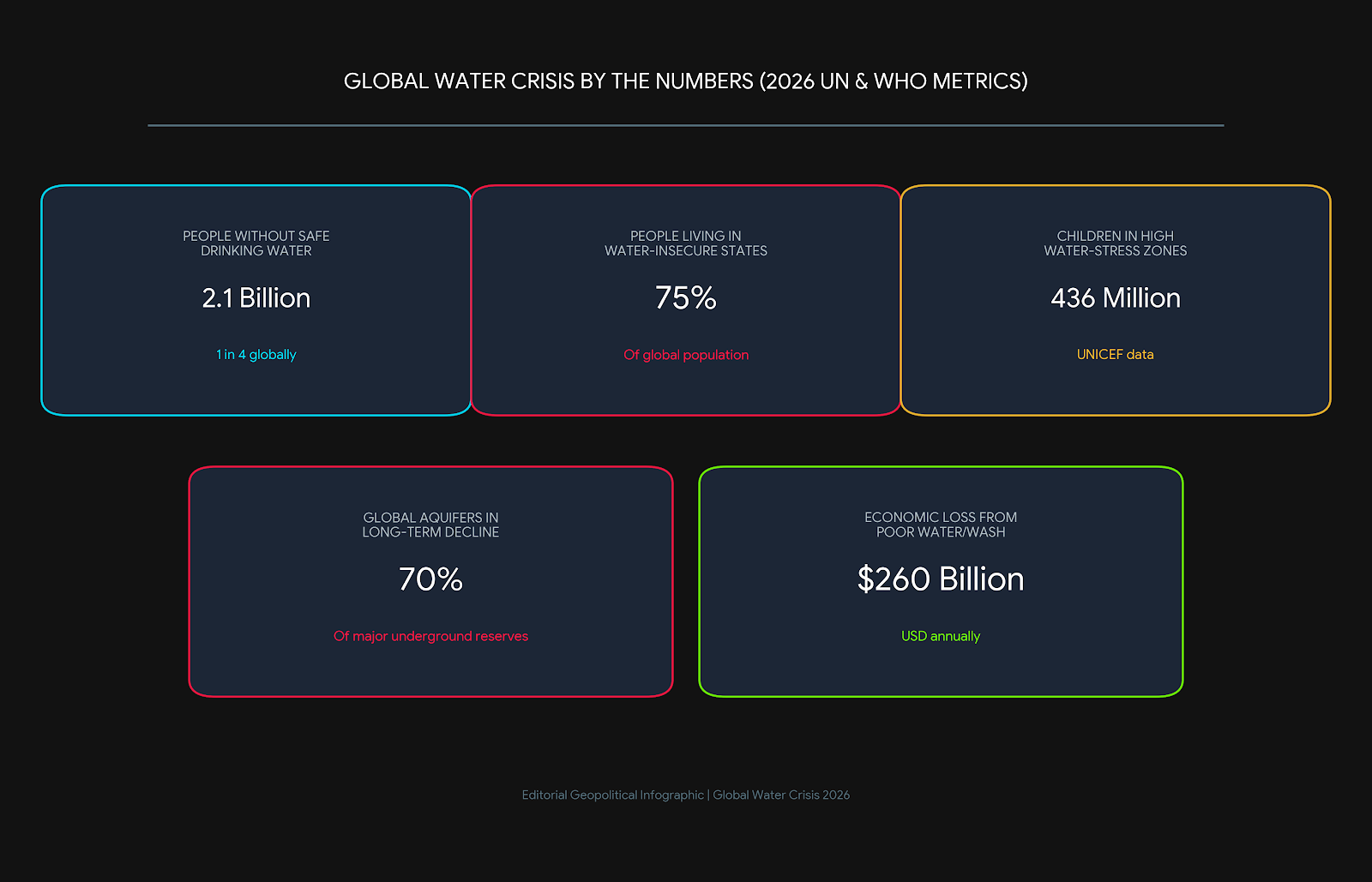
Global Water Crisis by the Numbers (2026 UN & WHO METRICS)
The crisis is no longer confined to localized droughts; it represents a systemic depletion of natural capital. Satellite hydrometric assessments show that 50% of the Earth’s large lakes have lost substantial water volume since the 1990s, while 70% of major underground aquifers are in long-term, irreversible decline.
Nations are over-extracting groundwater far faster than natural precipitation can replenish it, causing the ground beneath major agricultural hubs and cities in India, China, the Middle East, and the American Southwest to literally sink.
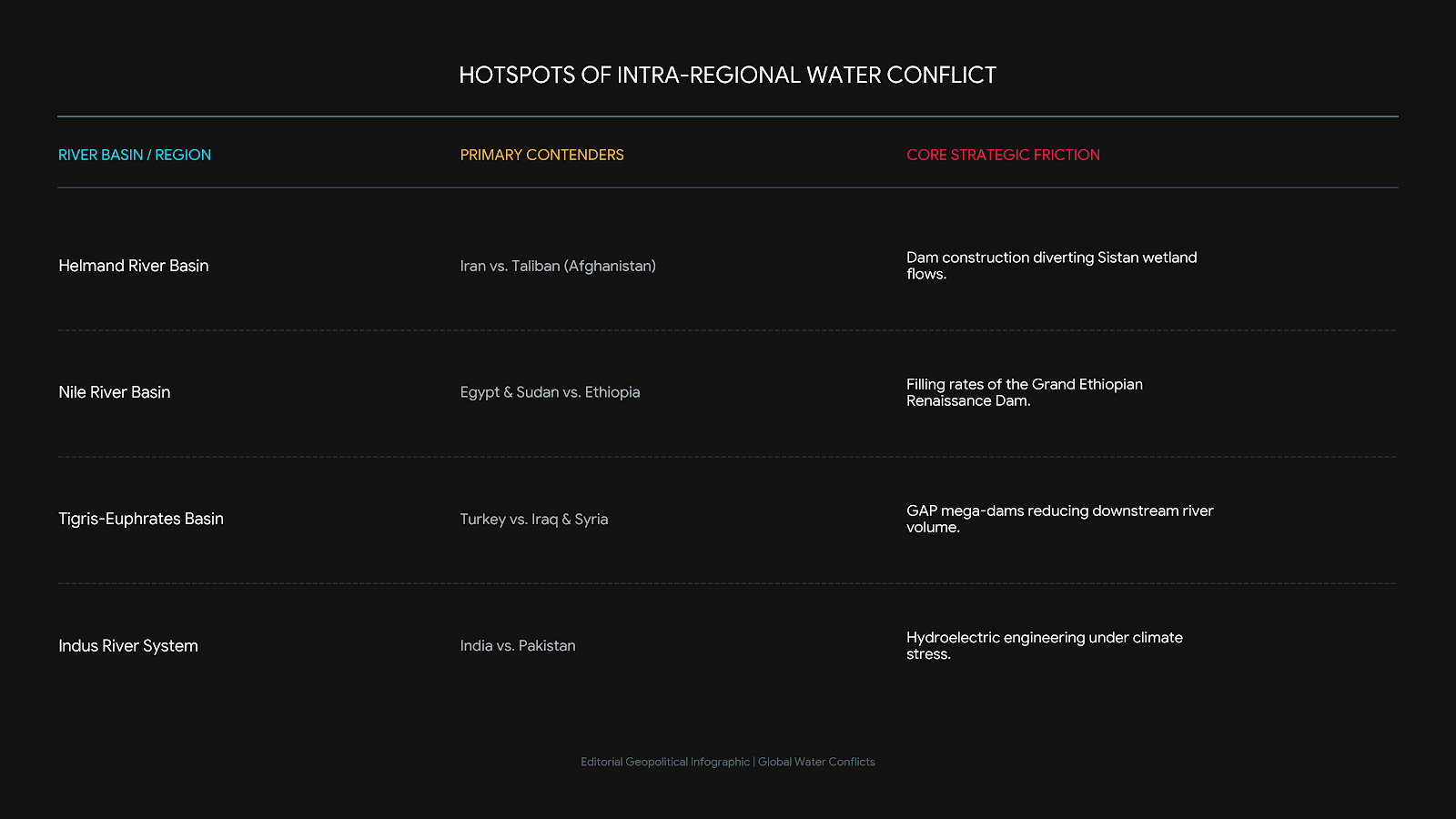
Hotspots of Intra-Regional Water Conflict
In regions like the Middle East and North Africa (MENA), where 83% of the population faces extremely high water stress, water has evolved from an environmental concern into a direct trigger for military engagement. From deadly border clashes between Iranian guards and Taliban fighters along the Helmand River to diplomatic deadlocks over the Nile, upstream nations are increasingly weaponizing water storage to secure domestic agriculture at the expense of downstream neighbors.
The Energy-Water Nexus: Where the Crises Intersect
The most dangerous aspect of the current global environment is the tight coupling between energy and water infrastructure—a feedback loop known to resource economists as the Energy-Water Nexus.
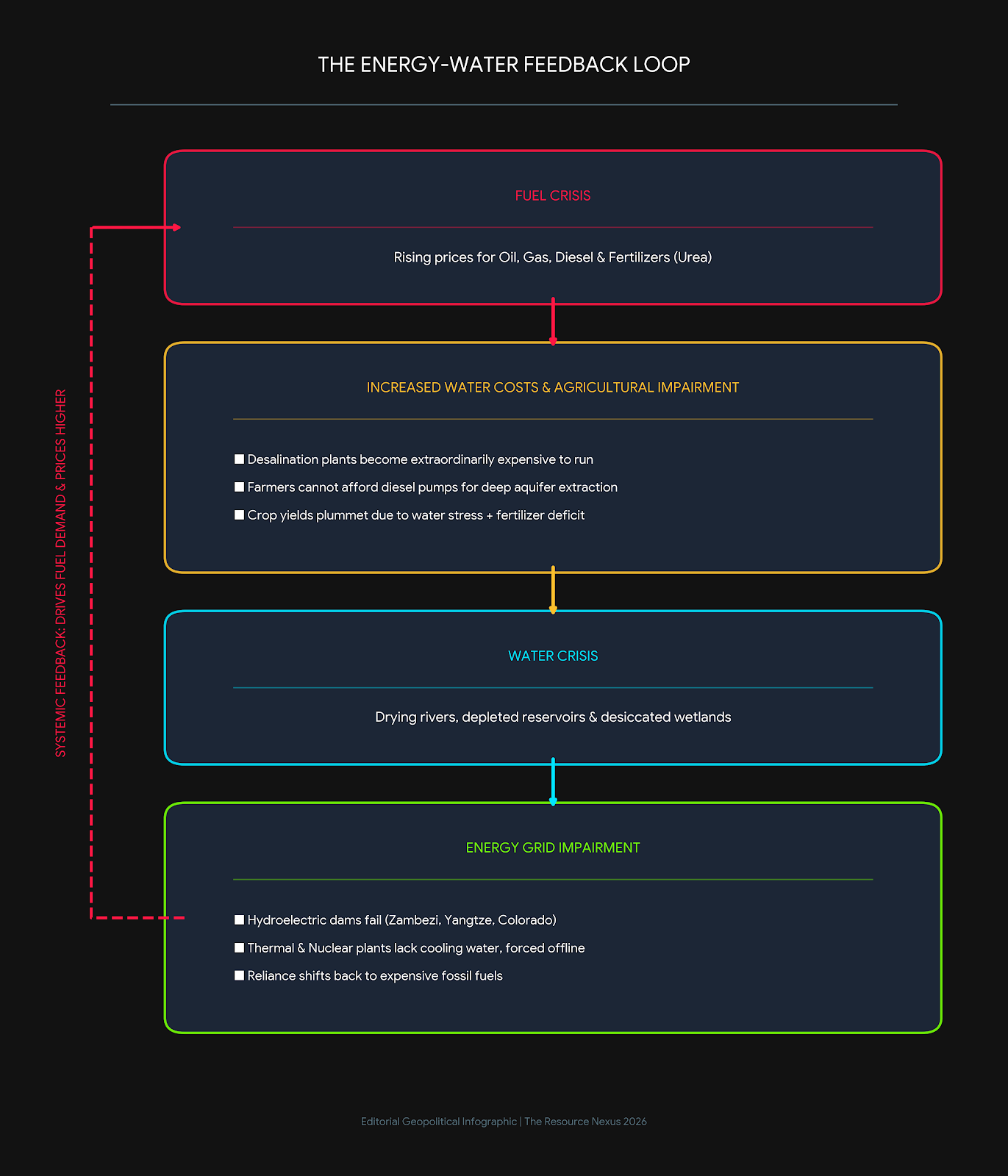
The Energy Water Feedback Loop
- Water Extraction Requires Fuel: Modern agriculture accounts for 70% to 72% of all global freshwater withdrawals. As water tables drop hundreds of feet underground, farmers require high-powered diesel or electric pumps to bring water to the surface. When diesel prices soar, smallholder farmers across India, Sub-Saharan Africa, and Latin America can no longer afford the fuel required to irrigate their crops, triggering local food production collapses.
- Clean Water Production Requires Energy: In arid regions like the Persian Gulf, urban populations survive entirely on seawater desalination. Desalination is an intensely energy-intensive process. High fuel and natural gas prices directly inflate the cost of producing municipal drinking water, straining state budgets that must subsidize water to prevent domestic unrest.
- Drying Rivers Paralyses Power Grids: The energy transition itself is being stalled by water scarcity. Hydroelectric dams—historically viewed as a stable, renewable baseload power source—are failing as river levels drop. From reduced output at the Hoover Dam in the United States to power shortages in Southern Africa caused by low water levels in the Zambezi River, drought is crippling clean energy generation, forcing nations back toward burning coal and oil at the worst possible moment.
Human and Economic Costs: The Rising Tide of Displacement
The convergence of fuel inflation and water bankruptcy is exacting a brutal human toll. According to UNICEF reports, over 436 million children currently reside in regions facing high or extremely high water vulnerability.
The economic drag is equally immense: poor water and sanitation services drain an estimated $260 billion USD from the global economy every year in lost productivity and healthcare costs, while energy price shocks threaten to push fragile economies into prolonged stagflation.
Furthermore, the world is witnessing the rise of a new demographic reality: the Resource Refugee. When local wells dry up and diesel prices make local farming economically unviable, entire rural communities have no choice but to abandon their lands. The UN estimates that up to 700 million people could be displaced by severe water scarcity and agricultural failure over the coming decades, driving massive migration waves from rural interiors toward overcrowded urban slums and across international borders.
Conclusion: From Zero-Sum Hoarding to Transboundary Survival
The dual struggle for fuel and water in 2026 highlights a fundamental truth: modern civilization cannot engineer its way around the basic laws of ecology and thermodynamics.
Attempting to solve energy security through aggressive military control of shipping lanes or solving water scarcity through unilateral dam construction are zero-sum tactics that guarantee long-term instability. Every dam built without downstream consensus creates a potential military conflict; every energy shock ignored accelerates domestic economic collapse.
To navigate this unprecedented double crisis, international governance must pivot toward multilateral resource diplomacy:
- Integrated Transboundary River Treaties: Establishing real-time, data-driven water-sharing agreements that adjust automatically for climate-induced droughts, removing water allocation from military brinkmanship.
- Decoupling Water from Fossil Fuels: Accelerating solar-powered and renewable-driven desalination and agricultural pumping, freeing municipal water systems from the volatility of oil and gas markets.
- Regenerative Agriculture and Aquifer Protection: Transitioning away from water-thirsty, chemical-intensive crop industrialization toward drought-resilient crops, precision drip irrigation, and strict regulatory caps on industrial groundwater extraction.
Humanity is learning a harsh lesson in 2026: money cannot buy water that does not exist, and military force cannot manufacture fuel from thin air. The nations that prosper in the coming decades will not be those that hoard resources behind militarized borders, but those that master the science of resource efficiency, cooperative diplomacy, and ecological preservation.
* Conceptual illustration generated using AI