
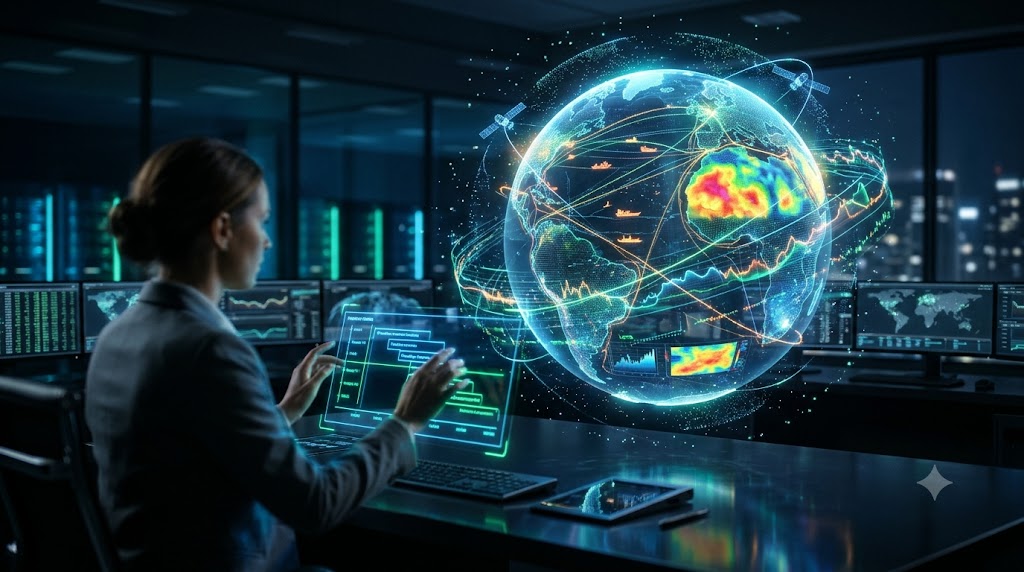
Every second of every day, humanity leaves behind a massive, continuous, and intricate digital footprint. A container ship idling three miles off the coast of Rotterdam; a sudden 4% dip in satellite-measured thermal radiation over an industrial park in East Asia; an anomalous spike in localized pharmacy purchases across a sub-Saharan province; a subtle shift in credit card transaction velocity in mid-tier American suburbs.
For most of human history, these micro-events were isolated blips of noise—dissipating into the background long before anyone could piece them together. By the time a supply chain collapsed, an epidemic erupted, or a market crashed, leadership teams could only respond reactively, sifting through the wreckage of retrospective data.
In 2026, that reactive paradigm is officially dead.
Driven by the convergence of multimodal Artificial Intelligence, real-time spatial analytics, open-source intelligence (OSINT) processing, and autonomous agentic workflows, AI systems are transforming the world’s day-to-day activity into an anticipatory engine. Modern AI models do not merely analyze history; they read the ambient pulse of the planet to predict events—from economic shifts and geopolitical friction to supply bottlenecks and social unrest—days, weeks, or even months before they formally manifest.
Here is an in-depth analysis of how everyday global activities are converted into predictive intelligence, the AI architectures driving this revolution, and the profound implications for global business and governance.
1. The Footprint of Existence: How Daily Activity Generates Signal
To understand how AI predicts major world events, one must first recognize the sheer volume and diversity of “ambient data” generated by modern human infrastructure.
In the hyper-connected ecosystem of 2026, almost every physical, financial, and biological action produces a data trail. These signals fall into four primary categories:
- Earth Observation and Spatial Telemetry: High-revisit satellite constellations continuously capture synthetic aperture radar (SAR), optical imagery, and thermal radiation. AI algorithms automatically monitor crop health, track maritime vessel Automatic Identification System (AIS) positions, evaluate industrial smog density, and measure water levels in reservoir dams without human intervention.
- Transactional and Economic Friction: Millions of daily credit card swipes, digital wallet transfers, freight bill of ladings, and wholesale energy purchases provide a real-time, high-definition view of consumer confidence and corporate liquidity.
- Human Behavior and Digital Communications: Search queries, social media sentiment, local news feeds, flight booking anomalies, and public health telemetry reflect collective human anxiety, intent, and mobility patterns.
- Internet of Things (IoT) and Industrial Edge Sensors: Telematics from commercial truck fleets, power grid frequency loads, smart city traffic cameras, and cellular network ping densities offer a continuous nervous system of urban and industrial life.
In isolation, a single satellite photo of a parking lot or a localized surge in social media searches means very little. However, when fed into enterprise AI pipelines, these disparate threads form a rich tapestry from which future realities can be mathematically deduced.
2. The Engine Room: How AI Converts Ambient Noise into Foresight
Traditional computer models relied on static, structured data—like historical quarterly financial statements or annual census reports. They looked backward to project forward. Modern predictive AI works in reverse: it ingests vast oceans of unstructured, real-time, multimodal data and identifies non-linear correlations that human analysts cannot perceive.
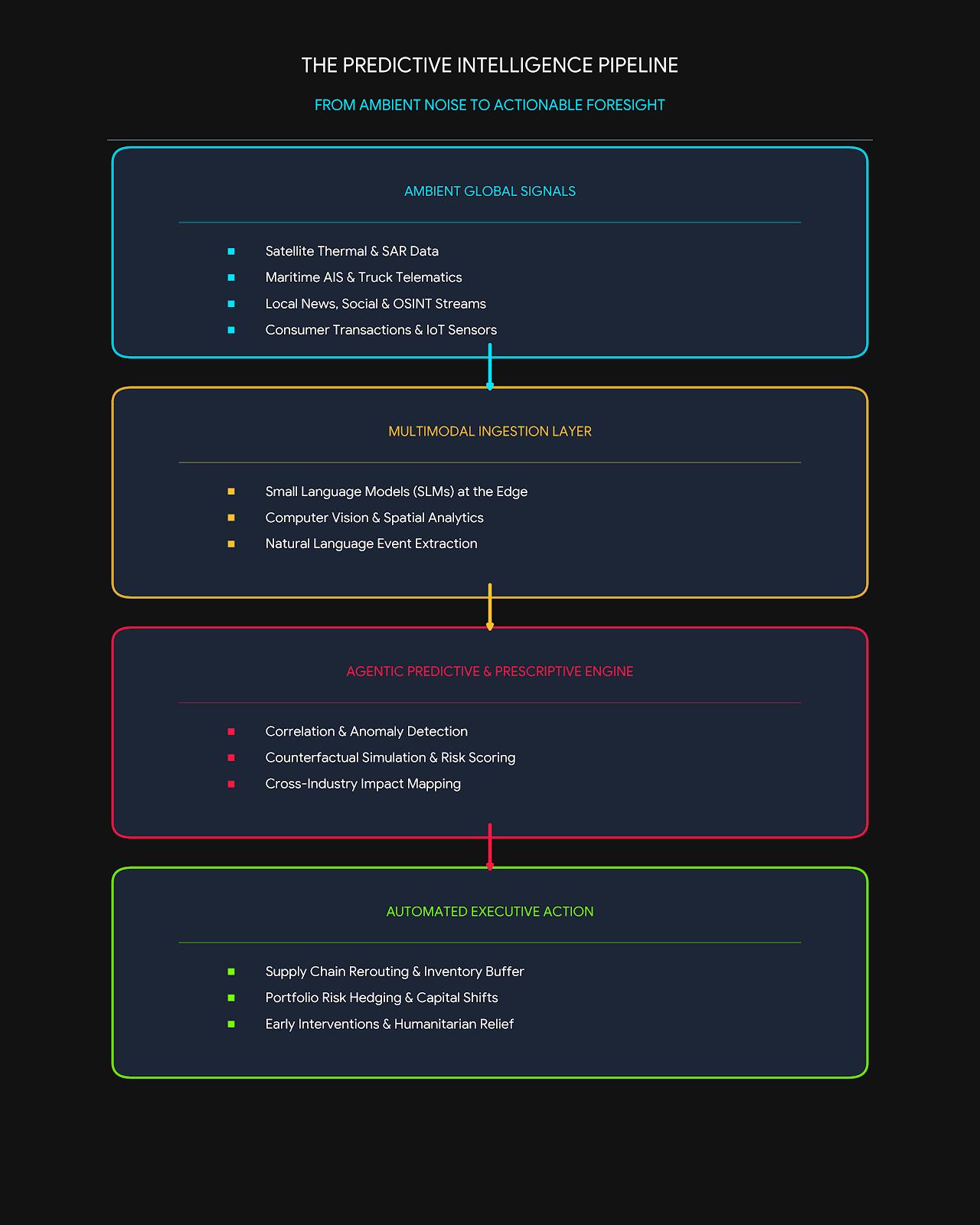
FROM AMBIENT NOISE TO ACTIONABLE FORESIGHT
Several key AI advancements in late 2026 make this predictive capability possible:
Multimodal Data Fusion
Earlier iterations of predictive analytics were constrained by text or tabular numbers. Today’s models seamlessly synthesize video feeds, satellite imagery, voice recordings, ship telemetry, and unstructured news articles simultaneously. An AI can correlate a sudden drop in agricultural satellite greenness in East Africa with rising local fertilizer prices in Europe and regional shipping delays in the Red Sea to predict a localized food price spike months before it hits retail markets.
Agentic Workflows and Prescriptive Simulation
Predictive analytics has evolved from merely asking “What will happen?” to prescriptive agentic AI asking “What should we do about it?” Autonomous AI agents continuously run thousands of Monte Carlo simulations against incoming daily data. If an AI detects early signs of a port strike in Western Europe based on union forum sentiment and localized truck idling patterns, it does not just issue an alert—it autonomously calculates alternate shipping routes, drafts vendor communications, and places advance logistics orders to protect corporate supply chains.
Edge Computing and Small Language Models (SLMs)
Rather than sending massive raw video or sensor streams to distant cloud data centers, compact, highly optimized Small Language Models (SLMs) running on edge devices (like cameras, maritime buoys, and drone swarms) process data locally. They flag anomalies instantly, reducing latency from hours to milliseconds and making real-time event sensing computationally affordable.
3. Domain Transformations: Real-World Applications
The capability to predict macro-level events from micro-level daily activities has revolutionized key sectors across the global economy.
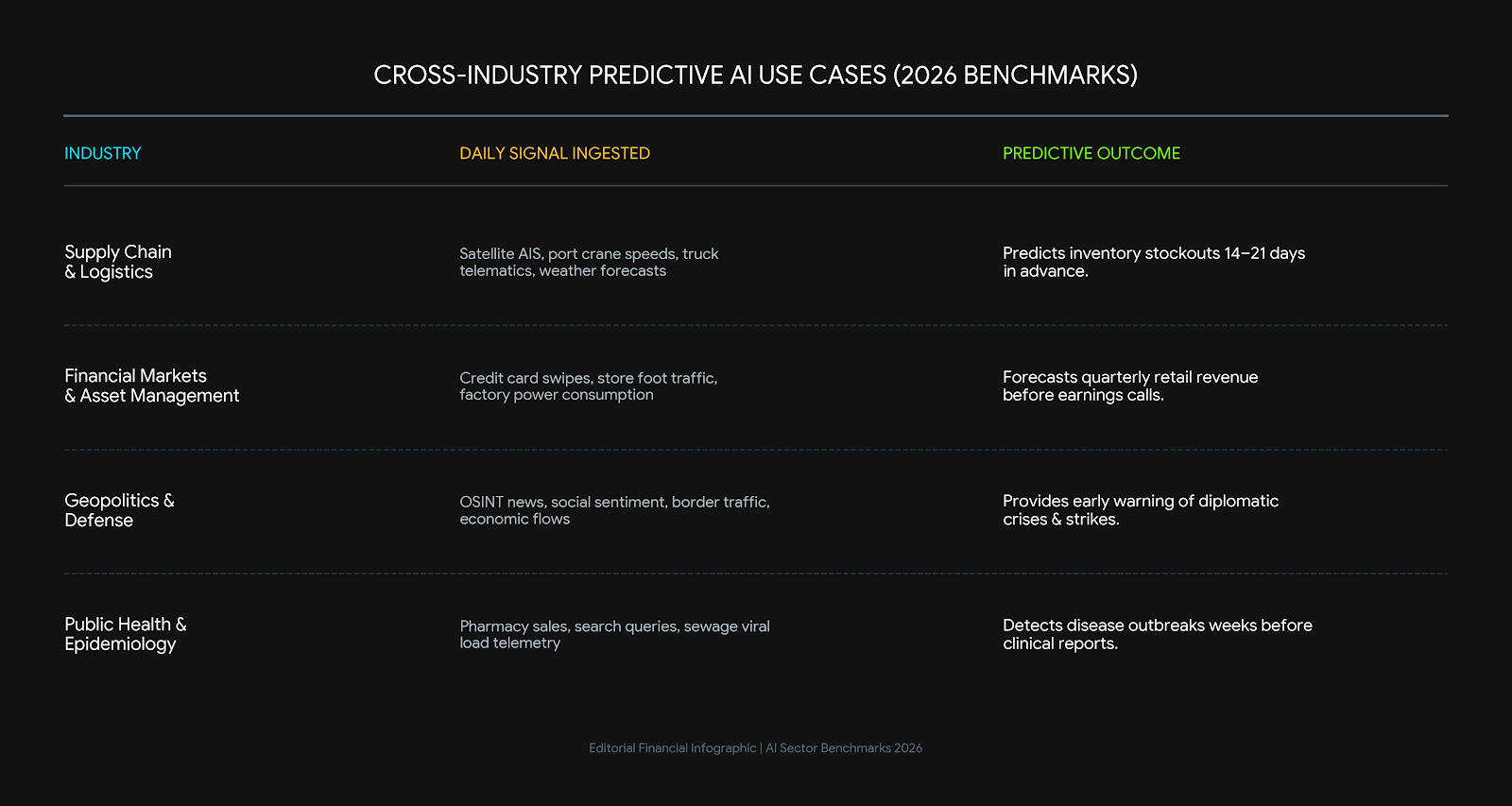
CROSS-INDUSTRY PREDICTIVE AI USE CASES (2026 BENCHMARKS)
A. Global Supply Chains and Logistics
Supply chains were historically reactive: a storm hits, a ship grounds, a factory closes, and managers scramble. In 2026, predictive supply chain analytics platforms use live satellite tracking and IoT sensor streams to forecast bottlenecks weeks before they occur. By analyzing crane movement speeds at major ports alongside regional labor sentiment and fuel prices, AI predicts demurrage risks, allowing demand planners to adjust safety stock and reroute cargo preemptively.
B. Financial Markets and Macroeconomic Forecasting
Hedge funds and central banks no longer wait for official government economic releases, which are often published weeks after a quarter ends. Instead, AI engines aggregate real-time alternative data—such as satellite imagery of factory parking lots, jet fuel burn rates, and mobile location pings near shopping districts—to construct a live “Nowcast” of GDP growth, industrial output, and consumer inflation with remarkable accuracy.
C. Geopolitical Risk and Conflict Anticipation
Open-Source Intelligence (OSINT) powered by AI has transformed national security. By analyzing satellite imagery of military staging areas, anomalous cross-border financial transactions, localized flight cancellations, and social media keyword density, AI systems can flag impending geopolitical escalation or civil unrest long before diplomatic cables confirm the crisis.
D. Disaster Management and Public Health
When a pandemic or natural disaster threatens a region, hours matter. AI models monitor localized pharmacy search anomalies, emergency room check-in logs, and wastewater telemetry to map infectious disease outbreaks weeks before official public health agencies issue formal warnings. Similarly, thermal satellite imagery combined with atmospheric moisture data enables AI to predict the exact path of wildfires and flash floods, giving emergency responders crucial time to evacuate high-risk communities.
4. The Ethical Frontier: Surveillance, Bias, and Determinism
While the ability to foresee events based on daily activity offers immense economic and humanitarian benefits, it also introduces profound ethical dilemmas that society is struggling to govern.
The Danger of Hyper-Surveillance
To predict human activity, machines must continuously monitor human activity. The widespread deployment of predictive AI raises grave concerns regarding privacy and the rise of “surveillance capitalism.” When state authorities or corporate monopolies monitor foot traffic, digital payments, and online conversations under the banner of “predictive safety,” the boundary between legitimate forecasting and oppressive social control becomes dangerously blurred.
Hallucinated Causality and Algorithmic Bias
AI models excel at finding correlations, but correlation is not causation. If an algorithm notices that a spike in a specific social media phrase historically precedes local civil unrest, it may falsely predict a crisis when that phrase is used innocently or satirically. If predictive models are trained on biased historical data—such as law enforcement algorithms predicting crime rates based on historically over-policed neighborhoods—the AI risks reinforcing systemic inequalities and creating self-fulfilling prophecies.
The “Observer Effect” in Predictive Systems
When a system accurately predicts an outcome, human actors change their behavior to prevent it. If an AI predicts a severe wheat shortage, and commodity traders respond by hoarding grain, the prediction itself causes the price spike it was trying to mitigate. Managing these complex feedback loops requires rigorous human-in-the-loop governance, transparent model auditing, and strict regulatory compliance frameworks.
Conclusion: From Reaction to Anticipation
Human civilization has spent millennia reacting to circumstances—building shelters after the storm, fixing supply chains after the shortage, and fighting wars after the diplomatic breakdown.
The integration of artificial intelligence into the fabric of daily life marks a fundamental evolutionary shift. By transforming the billions of mundane, physical, and digital actions taking place across the planet into a coherent, real-time predictive picture, AI allows humanity to step out of the reactive past and into an anticipatory future.
For business leaders, policymakers, and citizens in 2026, the imperative is clear: success is no longer defined by how quickly you can react to a crisis, but by how intelligently you can interpret the signals of today to navigate the world of tomorrow.
* Conceptual illustration generated using AI