
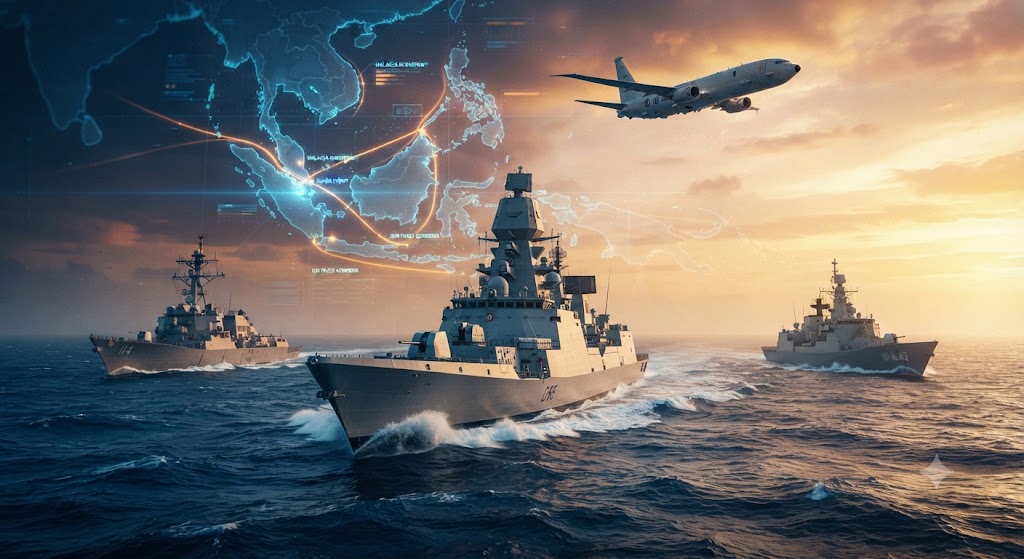
The global strategic center of gravity has permanently shifted away from the North Atlantic and settled firmly in the Indo-Pacific. Encompassing more than half of the world’s surface, 60% of global GDP, and over two-thirds of global maritime trade, this vast maritime domain has become the primary theater of 21st-century power competition. From the critical chokepoints of the Strait of Malacca and the Bab-el-Mandeb to the contested waters of the South China Sea and the vast expanses of the Indian Ocean, the stability of global commerce and international law hinges on regional equilibrium.
At the absolute geographical and strategic center of this theater stands India.
No longer viewed merely as a regional power confined to South Asia, India has emerged as the definitive Indo-Pacific Security Anchor. Occupying a central command position along the world’s most vital Sea Lines of Communication (SLOCs), India plays an indispensable role as a stabilizing force, a net security provider, and the balancing weight in an increasingly tense multi-polar order.
Here is an in-depth analysis of how India’s maritime geography, strategic autonomy, and defense partnerships define its role as the anchor of Indo-Pacific security.
1. The Power of Geography: Commanding the Indian Ocean Rim
Geography is destiny in maritime strategy. Jutting deep into the Indian Ocean with over 7,500 kilometers of coastline and two strategically vital island chains—the Andaman and Nicobar Islands in the east and the Lakshadweep Islands in the west—India naturally commands the sea lanes connecting the oil-rich Persian Gulf to the industrial engines of East Asia.
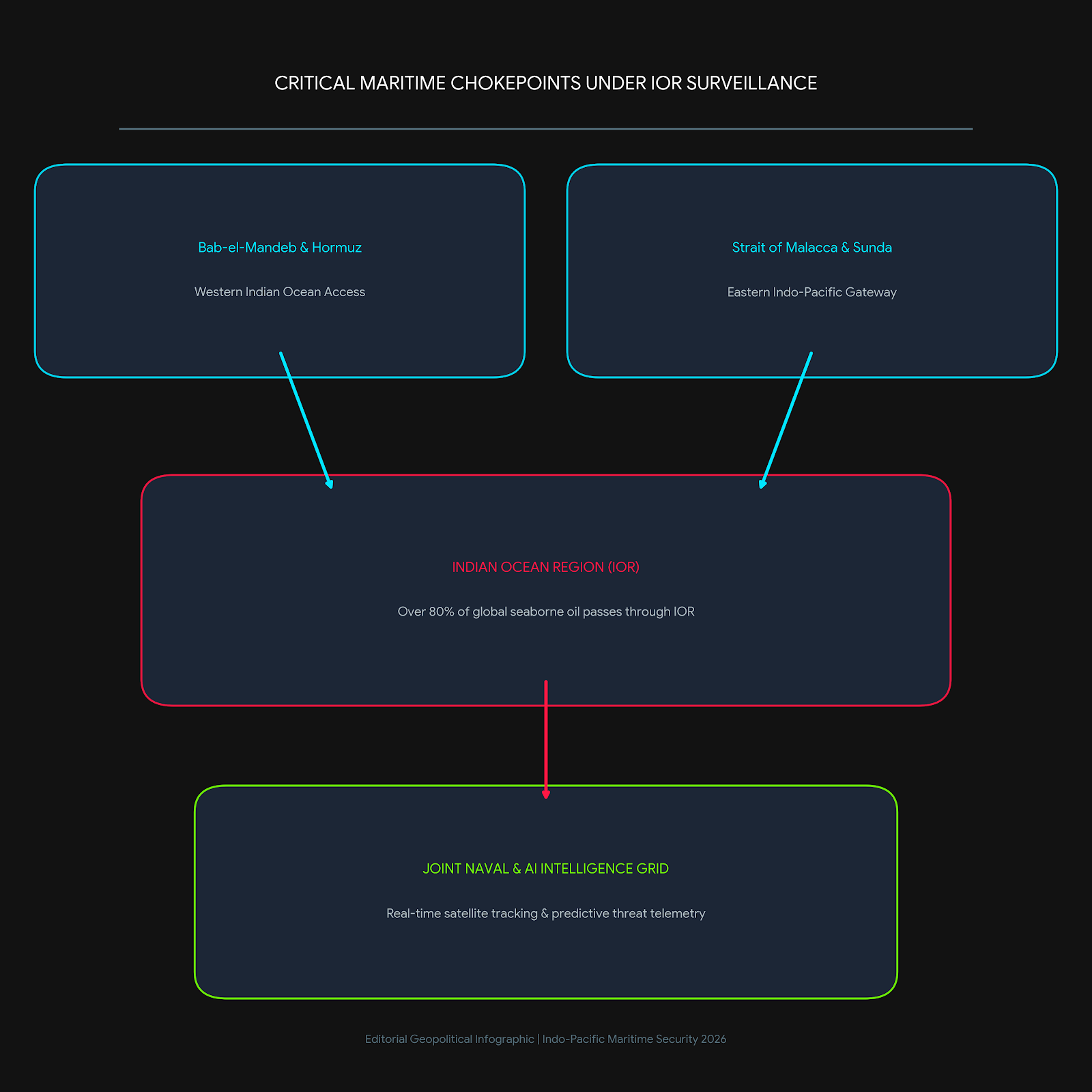
Critical Maritime Checkpoints Under IOR Surveillance
More than 80% of global seaborne oil trade and one-third of global bulk cargo traverse the Indian Ocean. By developing the Andaman and Nicobar Command (ANC)—India’s first tri-service theater command—New Delhi has established a formidable forward-operating bastion near the western entrance of the Malacca Strait. This positioning provides India with unmatched Maritime Domain Awareness (MDA) and the capability to monitor and, if necessary, interdict hostile naval movements passing between the Indian and Pacific Oceans.
Furthermore, India’s SAGAR initiative (Security and Growth for All in the Region) has institutionalized its role as a primary responder. From anti-piracy patrols in the Gulf of Aden to disaster relief missions across East Africa and Island Nations, India acts as the primary safety guarantor for regional littoral states.
2. The Architecture of Multi-Alignment: The Quad and Strategic Autonomy
What makes India unique as a security anchor is its doctrine of Strategic Autonomy. Unlike traditional military partners embedded in rigid, cold-war-era treaty alliances, India maintains an independent foreign policy while constructing flexible, multi-aligned security architectures.
The cornerstone of this framework is the Quadrilateral Security Dialogue (Quad), uniting India, the United States, Japan, and Australia.
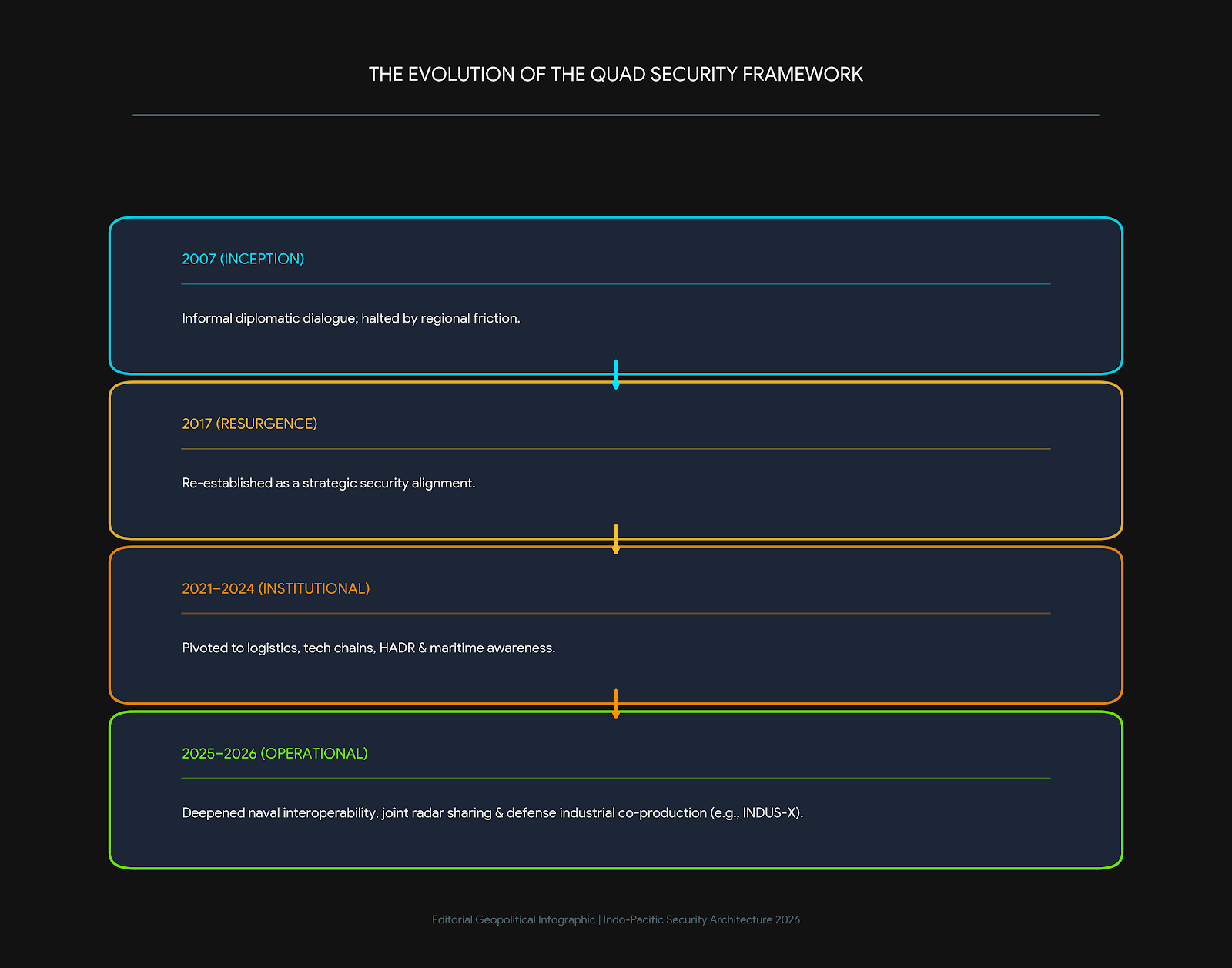
The Evolution of the Quad Security Framework
Within the Quad, India serves as the crucial land and maritime bridge connecting Western Pacific powers to the Indian Ocean. While Western partners originally viewed the Quad through a strict military lens, India helped broaden the coalition’s focus to include supply chain resilience, undersea cable security, critical technologies, and maritime domain awareness via the IPMDA (Indo-Pacific Partnership for Maritime Domain Awareness).
Simultaneously, India’s foundational defense agreements with the U.S.—including LEMOA (logistics exchange), COMCASA (secure communications), and BECA (geospatial intelligence)—allow Indian armed forces to interoperate seamlessly with allied fleets without surrendering national sovereign decision-making.
3. Balancing Hegemony: Countering the “String of Pearls”
The primary geopolitical driver behind India’s elevated security role is the aggressive naval expansion of the People’s Liberation Army Navy (PLAN) into the Indian Ocean.
Through its “String of Pearls” strategy and Belt and Road infrastructure projects, Beijing has sought to establish dual-use naval footholds across the Indian Ocean rim—including facilities in Gwadar (Pakistan), Hambantota (Sri Lanka), Djibouti, and Ream (Cambodia).
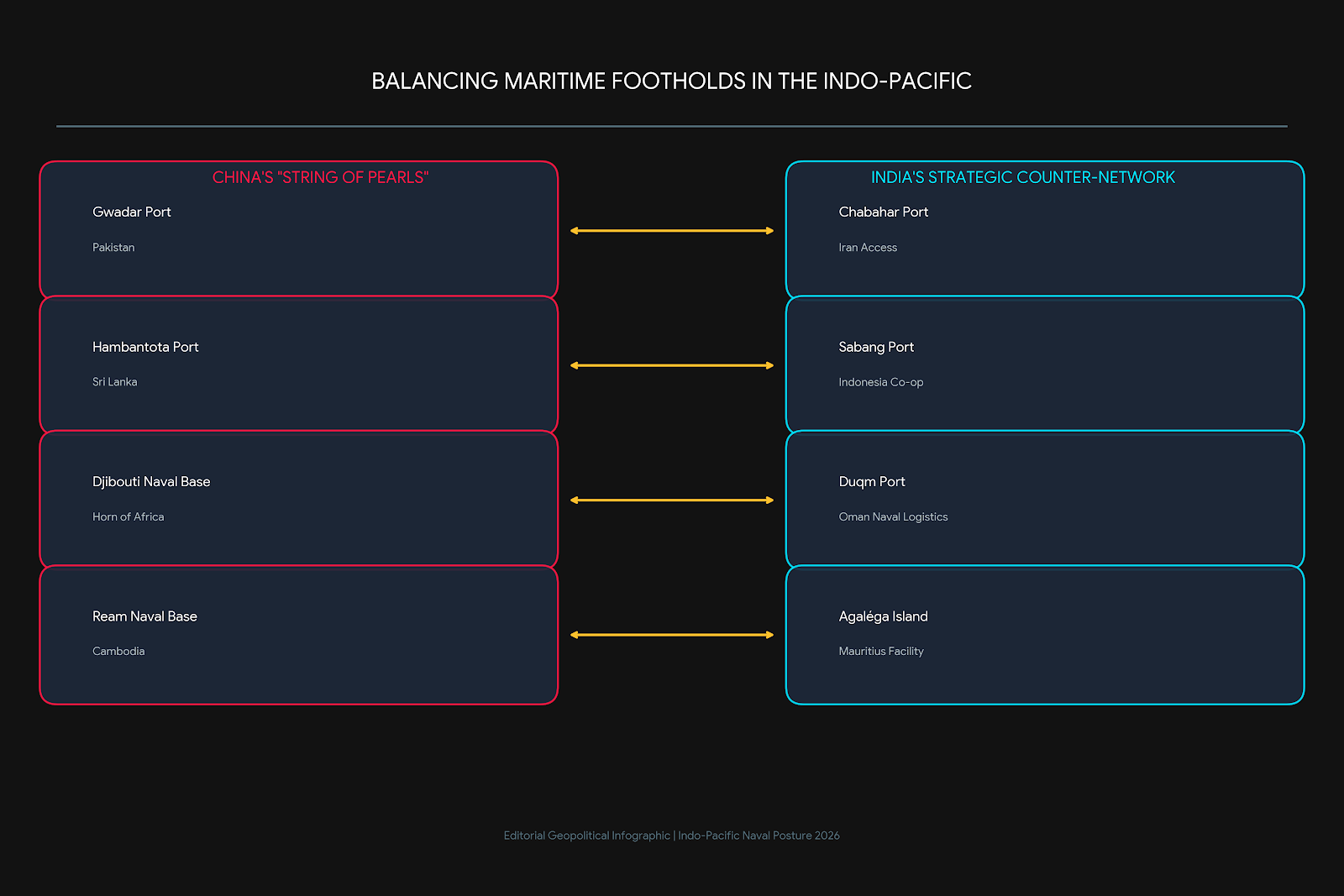
Balancing Maritime Footholds in the Indo-Pacific
In response, India has quietly constructed its own network of maritime strategic access agreements. By securing logistics and berthing rights at Duqm in Oman, Agaléga in Mauritius, and fostering deep naval cooperation with Indonesia at Sabang, India has counter-balanced external encirclement, ensuring that no single power can establish a unilateral sphere of influence over the Indian Ocean.
4. Defense Industrialization: Moving from Importer to Exporter
A security anchor cannot rely indefinitely on imported weaponry. To sustain its long-term strategic posture, India has undertaken a massive structural shift toward domestic defense manufacturing under the Atmanirbhar Bharat (Self-Reliant India) initiative.
Key pillars of this industrial transformation include:
- Naval Shipbuilding: Over 40 warships and submarines currently under construction for the Indian Navy are being built in domestic shipyards, highlighted by the deployment of the indigenously designed and built aircraft carrier INS Vikrant.
- Defense Technology Co-Development: Programs like INDUS-X with the United States facilitate direct joint ventures between defense startups and established contractors, building high-tech capabilities in autonomous undersea vehicles, AI-driven surveillance, and jet engine co-production.
- Defense Exports: India’s defense exports have grown exponentially, supplying precision strike systems like the BrahMos supersonic cruise missile to Southeast Asian partners like the Philippines, directly enhancing the self-defense capabilities of littoral states facing maritime coercion.
Conclusion: The Indispensable Pillar of 21st-Century Equilibrium
The stability of the Indo-Pacific in 2026 rests on a delicate balance of power. A weak or passive India would leave a dangerous security vacuum in the Indian Ocean, inviting zero-sum geopolitical domination over global trade routes. Conversely, an economically robust, militarily capable, and strategically autonomous India serves as the ultimate stabilizer.
By bridging Western partnerships with Global South leadership, protecting critical sea lanes, and building domestic defense resilience, India has solidified its position as the Indo-Pacific Security Anchor. For Washington, Tokyo, Canberra, and ASEAN capitals alike, maintaining a free, open, and rules-based Indo-Pacific is impossible without New Delhi at its core.
* Conceptual illustration generated using AI