U.S. President Donald Trump has launched a blistering attack on the nation of Norway and the Nobel Committee after being passed over for the 2026 Nobel Peace Prize. Speaking at a campaign rally at the Oncenter Convention Center in Syracuse, New York, on Friday, October 9, Trump delivered a highly personal and geopolitical rebuke of the committee’s decision to honor South African jurist Navi Pillay. Branding the decision a “disgraceful and embarrassing” move, the President declared that the snub leaves an “indelible stain” on Norway, the host country of the Peace Prize.
The fiery remarks underscore the President’s long-standing desire for the world’s most prestigious diplomatic honor, while simultaneously highlighting a fundamental clash between his “America First” transactional diplomacy and the multilateral, institution-based worldview traditionally rewarded by the Nobel Committee.
The “Mystery Person” and the Nobel Laureate
The catalyst for Trump’s ire was the Friday morning announcement in Oslo that the 2026 Peace Prize would go to Navi Pillay. To the international legal community, the 85-year-old Pillay is a towering figure: a former United Nations High Commissioner for Human Rights, a former judge at the International Criminal Court, and a veteran of the struggle against apartheid in South Africa. The Nobel committee explicitly recognized her lifetime of contributions to international law and her relentless efforts to prosecute war crimes, crimes against humanity, and genocide.
To Donald Trump, however, she was entirely unknown.
“I never heard of the person. Nobody did,” Trump told his supporters in Syracuse, dismissing Pillay as a “mystery person” and a “liberal person who works at the United Nations”.
The friction between Trump and Pillay’s selection is deeply rooted in recent international investigations. Pillay recently oversaw a high-profile United Nations report that concluded Israel had committed genocide during its military operations in Gaza. Given the Trump administration’s staunch alignment with Israel and its frequent, heavy criticism of international bodies like the UN and the ICC, the committee’s choice was inherently antithetical to the President’s foreign policy doctrine.
The “Eight Wars” and a Transactional View of Peace
Central to Trump’s grievance is his firmly held belief that his diplomatic record is historically unparalleled. For years, the President has publicly and privately lobbied for the Nobel Prize, arguing that his unconventional approach to foreign policy has yielded results that traditional diplomacy never could.
During the Syracuse rally, Trump repeated his assertion that he has personally “settled eight wars,” specifically citing the historical conflict between India and Pakistan as one of his triumphs.
“Any one of these eight wars, you get the Nobel Prize. I did eight. No president’s ever done any,” Trump claimed. He further argued that he had effectively prevented major conflicts from erupting across the Asian continent, claiming credit for averting wars between North and South Korea, Japan and North Korea, and China and Taiwan, though he did not provide specific evidence detailing how his administration single-handedly prevented these hypothetical conflicts.
Trump also wove the recent resolution of the hostage crisis in the Middle East into his pitch for the prize. Emphasizing his direct, unconventional negotiation tactics, he highlighted the return of Israeli hostages from Gaza. “I got back all of the hostages in Israel, including the final 28, both living and dead,” Trump stated. “And I had to work with Hamas to do it. Think of that… Nobody thought it was possible”.
This rhetoric illuminates a core ideological divide. Trump measures peace through the lens of immediate deterrence, raw negotiation, and the application of economic or military pressure. He noted that in all the conflicts he claims to have settled, he “never spoke to the United Nations,” adding that the international body was “of no help to me”. The Nobel Committee, conversely, historically favors structural peacebuilding, disarmament treaties, human rights advocacy, and adherence to international law.
“We Will Not Forget, Norway”
The President’s frustration quickly evolved beyond a critique of the Nobel Committee, translating into a direct diplomatic warning to Norway itself. The Nobel Peace Prize is unique among the Nobel awards; while the others are awarded in Sweden, the Peace Prize is determined by a five-member committee appointed by the Norwegian parliament and awarded in Oslo.
Because of this structure, Trump directed his anger squarely at the Norwegian state. He stated that the failure to award the prize to the United States was “just another sign of how Norway and all these others are ripping off our country”.
The rhetoric escalated into a condemnation of the institution’s legitimacy. “The Nobel Peace Prize has been forever discredited by a handful of radical ideologues who are anti-democracy and really enemies of civilization,” Trump declared to the crowd. He punctuated his grievances with a stark promise regarding the bilateral relationship between Washington and Oslo: “And we will not forget, Norway”.
Such language from a sitting U.S. President directed at a founding NATO ally over an independent prize committee represents a highly unusual breach of diplomatic protocol. It signals a willingness to leverage state-level relationships and alliances over personal accolades and perceived institutional slights.
The Ultimate Validation Denied
For Donald Trump, the Nobel Peace Prize represents the ultimate, elusive validation of his political and diplomatic capabilities. His fixation on the award is often contextualized by political analysts as a direct reaction to his predecessor, Barack Obama, who was awarded the prize in 2009—a decision that Trump has frequently mocked and criticized over the years.
“The United States of America, represented by me as your president, should have received the Nobel Peace Prize, but didn’t,” Trump stated plainly on Friday. “Based on my record of peace — a record like no one ever has had — I’m just saying how crooked the whole Nobel Prize deal is”.
As the 2026 election cycle continues, Trump’s reaction to the Nobel snub will likely become a recurring theme on the campaign trail. It allows him to portray himself as an anti-establishment peacemaker who is actively fighting against a rigged globalist system that refuses to acknowledge his achievements. Whether his supporters view the “indelible stain” as a mark on Norway or a reflection of the President’s own diplomatic combativeness, the friction guarantees that the traditionally quiet, solemn proceedings in Oslo will remain at the epicenter of American political theater.
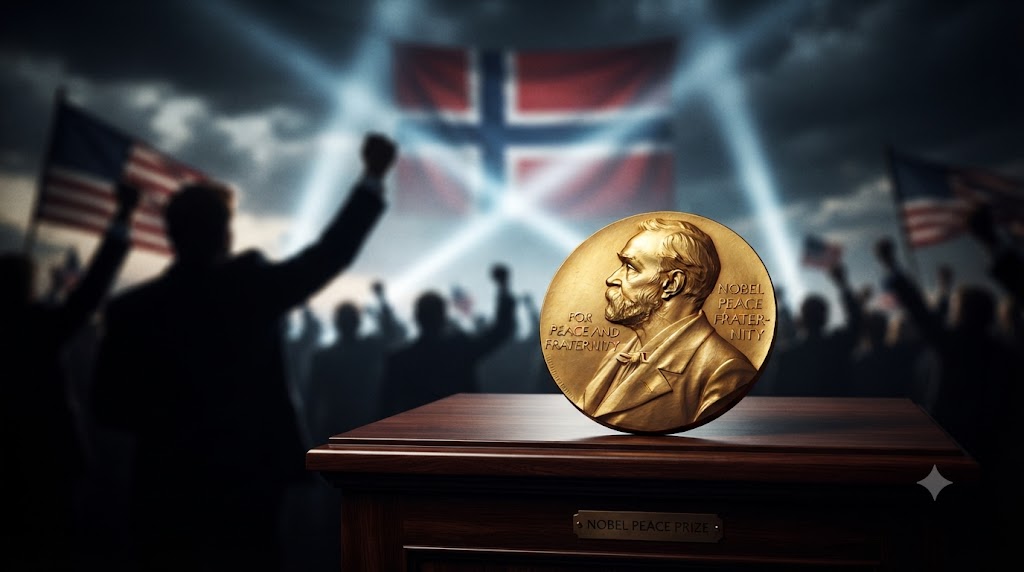
* Conceptual illustration generated using AI