
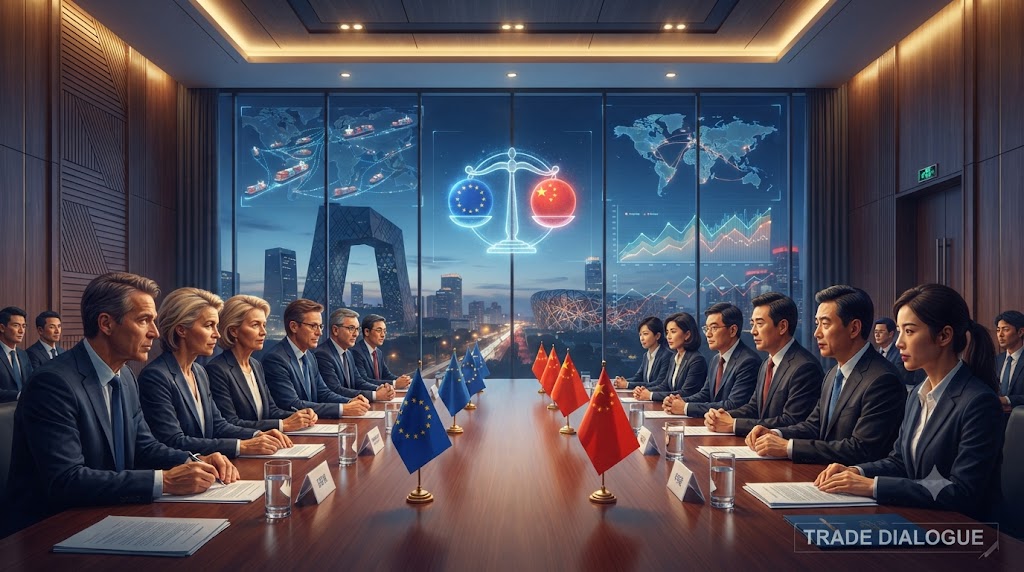
A high-level delegation of European Union trade officials has convened in Beijing for a crucial round of economic and trade dialogues with their Chinese counterparts. The high-stakes meetings arrive at a pivotal juncture for global commerce, marked by escalating bilateral tensions over industrial subsidies, electric vehicle tariffs, market access barriers, and the broader geopolitical ripples of ongoing global conflicts.
As the European Union seeks to “de-risk” its supply chains without decoupling from the world’s second-largest economy, this latest summit represents a delicate balancing act. European leaders are pressing Beijing for concrete structural reforms and a level playing field, while Chinese officials are urging Brussels to avoid protectionist policies that could undermine broader economic stability.
A Strained Economic Landscape
The backdrop for these trade talks is characterized by growing asymmetry. The European Union’s trade deficit with China, while fluctuating slightly in recent years, remains at historically high levels—a point of severe contention for European policymakers who argue that state-led market distortions and overcapacity in key Chinese sectors are flooding the European market while restricting reciprocal access for European businesses.
Key friction points dominating the agenda include:
- Electric Vehicle Tariffs and Subsidies: Following the European Commission’s anti-subsidy investigation into Chinese-built Electric Vehicles (EVs), the EU implemented countervailing duties to protect its domestic automotive sector. Beijing has strongly opposed these measures, viewing them as anti-competitive protectionism, and has initiated its own retaliatory probes into European agricultural and luxury exports, including French cognac and European pork.
- Industrial Overcapacity: European negotiators are raising sharp concerns regarding Chinese manufacturing overcapacity in clean tech, solar panels, legacy semiconductors, and medical devices. European officials argue that state subsidies in China allow domestic firms to produce vast quantities of goods well beyond domestic demand, driving down global prices and undercutting European competitors.
- Market Access and Level Playing Field: European companies operating within China continue to report persistent regulatory barriers, opaque public procurement processes, forced technology transfers, and unpredictable data security legislation that hampers cross-border operations. European delegates are demanding clear commitments toward greater transparency and equal treatment for foreign enterprises.
- Export Controls and Supply Chain Security: In line with the EU’s Economic Security Strategy, the discussions cover restrictions on critical raw materials—such as gallium, germanium, and graphite—where China holds near-monopolistic control. The EU is seeking guarantees of supply chain predictability while defending its own targeted export controls on advanced dual-use technologies.
De-Risking vs. Decoupling: The Strategic Dilemma
For Brussels, the guiding mantra remains “de-risk, not decouple.” European officials have repeatedly stressed that the EU has no desire to sever economic ties with China, which remains one of its most vital trading partners. However, the vulnerabilities exposed by recent global supply chain disruptions and geopolitical shifts have forced European capitals to prioritize resilience and strategic autonomy.
China, conversely, views the EU’s “de-risking” framework with skepticism, suspecting it to be a softer variant of Washington’s containment strategy. During the opening sessions in Beijing, Chinese representatives urged the European delegation to maintain an open market policy, uphold WTO rules, and resist external geopolitical pressure to erect economic barriers.
Beijing continues to frame its economic relationship with Europe as mutually beneficial, emphasizing the potential for expanded collaboration in green transition technologies, digital commerce, and sustainable infrastructure if mutual trust can be restored.
Geopolitical Shadows Over Commerce
While the core agenda centers on trade mechanics, tariffs, and regulatory policy, broader geopolitical realities loom heavily over the negotiation table. European officials have consistently highlighted that economic relations cannot be viewed in total isolation from global security.
The EU delegation has reiterated its concerns regarding Chinese dual-use exports to Russia, urging Beijing to exercise stricter oversight to prevent goods manufactured in or routed through China from supporting military supply chains. For European leaders, China’s stance on European security concerns remains a critical benchmark that directly influences the temperature of bilateral economic cooperation.
The Road Ahead: Pragmatism or Prolonged Friction?
As the talks in Beijing progress, expectations for a dramatic breakthrough remain measured. Both sides recognize the deep structural differences dividing their economic models—the European Union’s market-driven, regulatory-heavy framework versus China’s state-capitalist, policy-steered economy.
However, the continuation of direct, high-level dialogue is widely seen as an essential stabilizing mechanism. Even incremental progress—such as establishing dedicated working groups to address data transfers, establishing clearer channels for resolving trade disputes, or reaching compromise solutions on pending tariff retaliation—could help prevent an escalating trade war that neither economy can afford.
* Conceptual illustration generated using AI