
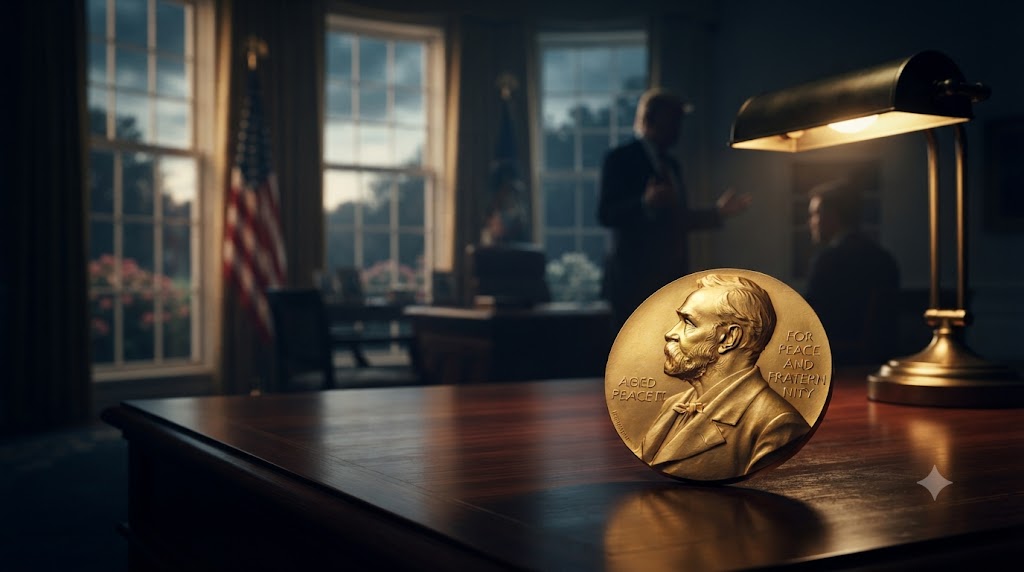
The impending announcement of the 2026 Nobel Peace Prize has reignited a familiar, deeply personal campaign for U.S. President Donald Trump. Speaking from the Oval Office just days before the Norwegian Nobel Committee is scheduled to reveal this year’s laureate on Friday, October 9, Trump forcefully renewed his pitch for the world’s most prestigious diplomatic honor. Positioning himself as an unparalleled global peacemaker, Trump asserted that he intrinsically deserves the award, arguing that failing to recognize his foreign policy achievements would reflect poorly on the committee itself.
As the geopolitical landscape remains fraught with tension, the President’s public lobbying offers a revealing look into how his administration views its own legacy, defining international stability through a uniquely transactional lens.
The “Eight Wars” Claim and the Politics of Peacemaking
Central to the President’s latest Nobel pitch is a sweeping, though heavily scrutinized, quantitative claim regarding his diplomatic record. “I’ve done stuff that nobody else has ever done. I’m not bragging, I’m just telling you the facts. No president has probably ever settled any wars. I settled eight wars,” Trump told reporters.
Trump framed his argument not as a plea for recognition, but as an undeniable accounting of his second-term legacy. He stated that it would be a “great discredit” to the Nobel Committee if they chose to honor someone else. “And I’m not saying that out of scorn, I’m saying that when you settle eight wars, and nobody’s never,” he added, emphasizing the unprecedented nature of his claim. Furthermore, he suggested his interventions have saved “hundreds of millions of lives” globally.
The exact list of the eight wars Trump claims to have halted remains undefined by the White House, leaving foreign policy analysts to parse through his recent diplomatic engagements. While supporters laud his unconventional, high-pressure approach to international relations, critics and independent observers have pushed back against the narrative of absolute global pacification. Major, systemic conflicts involving nations like Ukraine and Iran remain deeply complex and unresolved.
Furthermore, parties to some of the conflicts Trump claims to have successfully mediated actively dispute the extent of the U.S. President’s diplomatic role. In certain regions where Trump takes credit for brokering peace—including the Democratic Republic of Congo and the border between Cambodia and Thailand—hostilities have recently flared up again, casting doubt on the permanence or reality of the touted settlements.
The Iran Paradigm: Defining Victory
The disconnect between the Oval Office’s rhetoric and the reality on the ground is perhaps most evident in the Middle East. While Trump’s administration continues to struggle to secure a lasting, definitive ceasefire with Iran, the President recently asserted that the conflict is essentially won due to the neutralization of Tehran’s military and nuclear capabilities.
By framing strategic deterrence or temporary pauses in escalation as “settled wars,” the administration is attempting to redefine the parameters of traditional diplomacy. For Trump, the promise of lower oil prices and heavily degraded adversary capabilities constitutes a conclusive victory. However, the Norwegian Nobel Committee has historically favored enduring, structural peace treaties, disarmament agreements, and grassroots humanitarian efforts over the volatile enforcement of military deterrence.
Trump himself seemed to acknowledge this historical friction during his remarks, noting the committee has “a reputation for maybe not giving it to people like me”.
The Obama Grievance and the Pursuit of Validation
To fully understand Trump’s fixation on the Nobel Peace Prize, one must look at his long-standing grievances regarding his predecessors—most notably, Barack Obama. Obama was awarded the prize in 2009, mere months into his first term, a decision that sparked widespread debate even among his supporters.
Trump used his recent Oval Office address to once again highlight this disparity. “Obama got it, and he didn’t do anything,” Trump stated. “He still doesn’t know what he got it for. He got it when he got elected, right at the beginning, and he had no idea why he got it”.
This sense of being overlooked by the global diplomatic establishment has driven much of Trump’s public campaigning for the award. While he maintains that he did not broker international deals specifically for the prize, stating “I didn’t do it for that, I did it because I saved a lot of lives,” the frequency with which he discusses the Nobel indicates its immense symbolic value to him.
He has, however, found validation from various international and domestic figures. Representative Darrell Issa, a Republican from California, recently stated he was nominating Trump for his efforts to secure peace in the Middle East. Additionally, Trump claimed that leaders from Cambodia, Israel, and Pakistan have nominated him, though the Nobel Committee’s strict secrecy rules prevent the verification of such claims. Perhaps most notably, Venezuelan opposition leader Maria Corina Machado, who won the 2025 Nobel Peace Prize, actually gave her physical medal to Trump in January of this year as she sought U.S. backing for her democratic efforts in Caracas.
A Clash of Diplomatic Philosophies
As the world waits for the committee’s announcement in Oslo on October 9, the discourse surrounding Trump’s candidacy highlights a fundamental divide in how global peace is defined. Is peace the aggressive suppression of adversaries through economic sanctions and military posturing, or is it the painstaking, collaborative building of international consensus?
Trump insists that his transactional, America-First doctrine has achieved results that traditional, multilateral diplomacy never could. Yet, as with many of his sweeping declarations, the assertion that he has unilaterally “settled eight wars” remains fiercely disputed by geopolitical realities and unresolved crises.
Whether he receives the call from Oslo or not, Donald Trump has already crowned himself the ultimate peacemaker. For a president who views international relations through a highly personalized lens, the Nobel Peace Prize remains the final, elusive piece of validation he believes the world owes him.
* Conceptual illustration generated using AI