
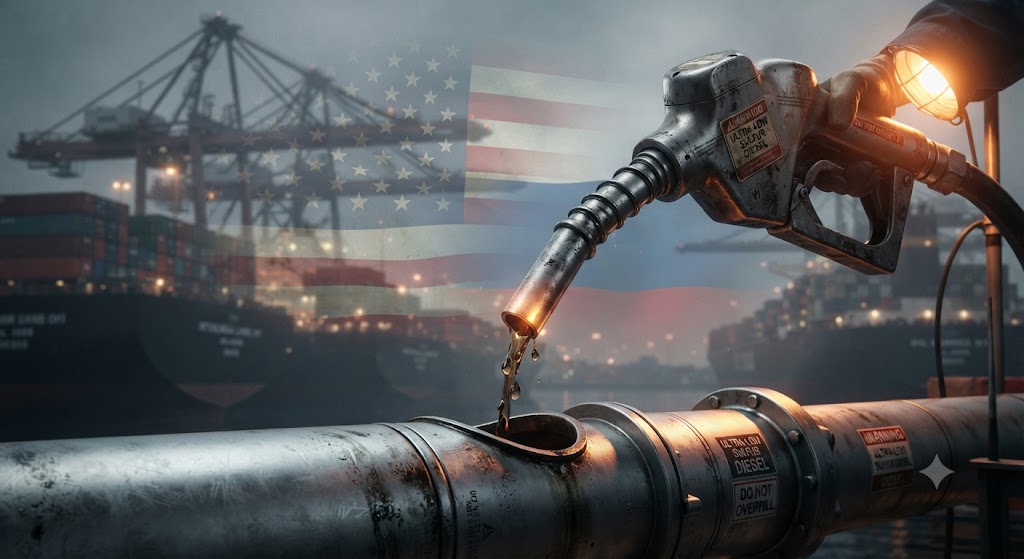
In a stunning reversal of international economic policy, the United States has temporarily lifted sanctions on the sale and import of Russian-origin diesel fuel on global markets. The sweeping policy shift, formally announced by the U.S. Department of the Treasury on Friday, October 9, 2026, permits the global transaction of Russian diesel through April 7, 2027.
The lifting of these sanctions—originally imposed to isolate Moscow over its war in Ukraine—was brokered directly between U.S. President Donald Trump and Russian President Vladimir Putin. The deal represents a profound collision between domestic electoral pressures, soaring global inflation, and the harsh realities of an escalating conflict in the Middle East. As global energy markets react to the sudden influx of millions of tons of Russian fuel, the diplomatic fallout is already beginning to reshape transatlantic alliances.
The Mechanics of the Deal
The agreement struck between Washington and Moscow outlines an aggressive timeline for the injection of Russian diesel into global and American markets. According to President Trump, Russia has committed to immediately supplying more than 300,000 metric tons of diesel. This initial wave will be followed by an additional 500,000 metric tons in November, and another one million metric tons shortly thereafter.
Depending on the operational condition of Russia’s refineries, Trump indicated on Truth Social that Moscow could deliver an additional 3 million tons of diesel in the coming months. Russian Deputy Prime Minister Alexander Novak quickly confirmed the arrangement, stating that Russia is ready to supply the additional diesel as early as October, with exports expected to rise significantly through November and December as key refineries resume full operations following seasonal repairs.
The immediate economic impact of the announcement was palpable. Upon news of the agreement, U.S. diesel futures plunged by nearly 5%, trading down to $4.64 a gallon. For a global economy suffocating under the weight of high logistical and transportation costs, the sudden drop in diesel prices offers a highly anticipated, albeit politically complex, relief valve.
The Catalyst: War in the Middle East and Domestic Politics
To understand the sheer magnitude of this policy shift, one must examine the severe macroeconomic constraints currently facing the Trump administration. The global energy crisis of late 2026 has been drastically exacerbated by the ongoing war involving the U.S., Israel, and Iran. The broader regional conflict, coupled with recent attacks by Houthi militias on vital refineries in Saudi Arabia, has fundamentally tightened global fuel supplies, creating an unsustainable price surge at the pump.
In the United States, gasoline and diesel prices have spiked sharply at a time when voters consistently cite the cost of living as their top concern ahead of the crucial November midterm elections. Diesel fuel is the lifeblood of the American supply chain, powering the freight trucks, agricultural machinery, and trains that keep consumer goods moving. High diesel prices directly translate to higher costs for food and retail products.
President Trump has made his domestic priorities clear regarding the deal. “Lower prices for Americans, especially our Great Farmers, Ranchers, and Truckers, is my Greatest Priority,” Trump stated. By opening the floodgates to Russian fuel, the administration is making a calculated bet: alleviating the acute financial pain felt by American consumers and industries ahead of the midterms outweighs the geopolitical optics of easing economic pressure on Moscow.
The Backlash from Kyiv and Washington
While the deal may lower overhead for American trucking and agriculture, it has triggered intense diplomatic backlash from Ukraine and its allies. The decision undermines the robust sanctions regime that the U.S. and Europe spent years building to limit the revenue Russia uses to fund its war machine.
Ukrainian President Volodymyr Zelensky issued a scathing critique of the arrangement, warning that the influx of cash will directly finance Russian military operations. “This only fuels Putin and enables him to wage more war,” Zelensky stated. “And at the very moment when we are talking about peace, America is allowing Russia to export diesel”.
Zelensky further condemned the policy shift on the social media platform X, remarking, “Gifts to Putin will not bring peace or any benefit to the civilised world. Russia will ‘repay’ the diesel with further terror and perfidy”.
The controversy is not limited to Eastern Europe; it has also sparked bipartisan pushback within the halls of the U.S. Congress. A number of U.S. lawmakers have openly criticized the deal, arguing that providing Russia with a lucrative financial lifeline compromises the strategic objective of halting Moscow’s territorial ambitions in Ukraine. Critics argue that the temporary, domestic political benefits of lower fuel prices come at the unacceptable cost of global security and the erosion of the international sanctions framework.
Russia’s Domestic Export Landscape
Interestingly, the U.S. sanctions waiver coincides with a shift in Russia’s own domestic energy policies. Prior to this deal, sanctions and domestic export bans had heavily restricted the movement of Russian petroleum products worldwide. Russia had previously imposed a strict ban on diesel and marine fuel exports—slated to remain in effect through the end of October—in response to a domestic fuel crisis.
This internal crisis was largely precipitated by a highly effective campaign of Ukrainian drone strikes targeting Russian oil refineries throughout the summer of 2026. These strikes severely hampered Moscow’s refining capacity, forcing the Kremlin to hoard its fuel for domestic and military use. Now, as those refineries come back online and domestic stockpiles stabilize, the U.S. sanctions waiver provides Moscow with a perfectly timed, highly lucrative off-ramp to dump its surplus diesel onto a desperate global market.
Energy Realpolitik
The lifting of sanctions on Russian diesel underscores a stark reality of modern geopolitics: energy security frequently overrides ideological commitments. The intertwined crises of 2026—a grinding war in Eastern Europe, a rapidly expanding conflict in the Middle East, and intense domestic electoral pressures in the United States—have created an environment where pure realpolitik dictates policy.
By issuing a Treasury license valid through April 2027, the U.S. has effectively decoupled the global diesel trade from its broader geopolitical standoff with Moscow. As millions of tons of Russian fuel begin flowing into global ports, the world is witnessing the undeniable power of energy economics to force unprecedented diplomatic compromises. Whether this deal serves as a pragmatic necessity to avert a global recession or a strategic blunder that permanently emboldens Moscow is a question that will be answered long after the November midterms are decided.
* Conceptual illustration generated using AI