
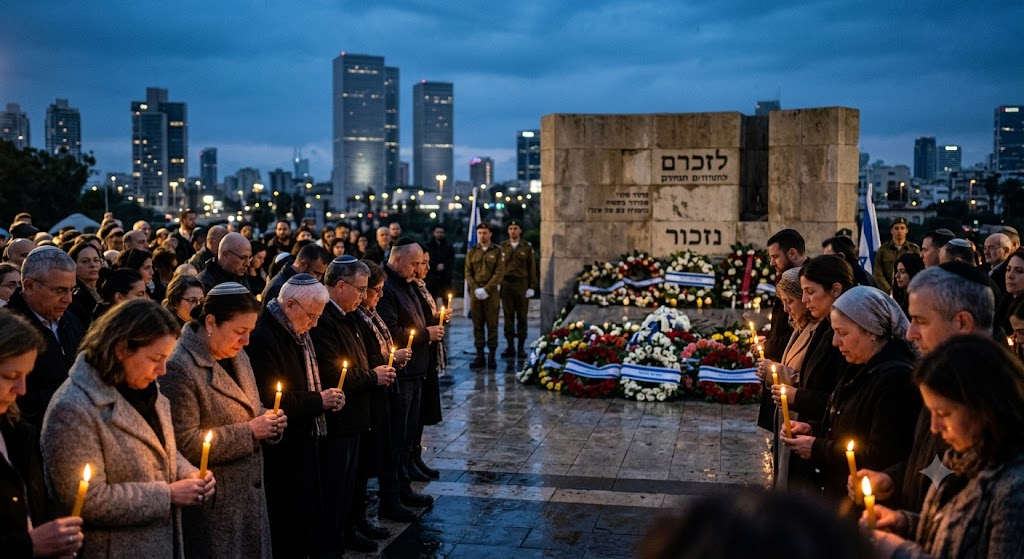
At precisely 6:29 a.m. on Wednesday, October 7, 2026, a nationwide moment of silence descended across Israel. Exactly three years after Hamas militants breached the border, triggering a military assault that destroyed much of the Gaza Strip, the country paused to honor the victims of the deadliest day in its history. During the initial 2023 attack, militants killed 1,200 people and took 251 hostages into Gaza, permanently altering the geopolitical landscape of the Middle East. Today, commemorations unfold across a nation that remains deeply scarred. As detailed by Ynetnews, events are planned at some 400 locations nationwide, encompassing memorial convoys, protest installations, and survivor testimonies. Yet, as the nation mourns, it does so against the backdrop of a radically changed Gaza, a tenuous year-old ceasefire, and a deeply polarized domestic political arena.
The Dawn of Remembrance: 6:29 a.m.
The focal point of Wednesday’s early morning mourning is a solemn vigil held at the site of the Nova music festival near the Gaza border. Here, families, friends, and survivors are returning to the exact grounds where 348 young people were killed by militants during the initial assault. The haunting images from that day—burned cars, bloodied facilities, civilians being dragged away, and families mourning their loved ones—remain frozen in the collective memory of the nation, as highlighted by [suspicious link removed].
Later in the evening, at 9:15 p.m., the focus will shift to a central memorial ceremony in Tel Aviv. Hosted by Eli Sharabi, the event aims to serve as a unifying and hopeful gathering giving voice to different groups across Israeli society. Organizers have arranged for performances by prominent Israeli artists, including Shlomo Artzi, Ivri Lider, Miri Mesika, Valerie Hamaty, and Harel Skaat, creating a communal space for shared grief. Concurrently, commemorative events will also be held at Hostage Square in Tel Aviv, a site that has served as the emotional epicenter for public advocacy and solidarity over the past three years.
The First Anniversary Without Hostages
This third anniversary carries a profound, albeit painful, distinction: it is the first commemoration for Israelis without any hostages still held in Gaza. For over two years, the fate of the 251 individuals abducted on October 7 dictated Israel’s domestic mood and foreign policy. Following protracted and agonizing negotiations, all hostages—both those living and the remains of the deceased—were exchanged with Hamas for Palestinians held in Israeli jails.
The grueling chapter of the hostage crisis formally closed in January 2026, when the remains of the final Israeli hostage were recovered and returned home. While the resolution brings a definitive closure to families who spent years campaigning tirelessly in Hostage Square, the psychological scars of the prolonged captivity, and the immense human cost of their return, continue to reverberate through the national consciousness.
A Fractured Gaza and a Tenuous Ceasefire
The Hamas attack of October 7, 2023, triggered a devastating military retaliation that decimated vast swaths of the Gaza Strip. Today, the realities on the ground in Gaza remain dire, despite a ceasefire implemented in October 2025 that was intended to halt the war for good. According to health authorities in Gaza—whose figures are regarded as reliable by the United Nations—Israel’s subsequent bombardment and ground operations have killed more than 74,000 people.
The geopolitical footprint of the enclave has been drastically and physically redrawn over the past three years. The 2025 ceasefire agreement initially left Israel in control of approximately 53% of Gaza, a territorial hold that Israeli forces have since expanded to nearly two-thirds of the strip. Hamas maintains control over the remaining third. Within this heavily fractured and restricted landscape, the vast majority of Gaza’s 2 million residents continue to live in makeshift tents and bombed-out buildings, grappling with catastrophic humanitarian conditions.
Furthermore, the term “ceasefire” masks a reality of ongoing, low-intensity conflict and fragile security. Since the truce was enacted in October 2025, health authorities report that over 1,400 Palestinians have been killed in Gaza. During the same timeframe, the Israeli military has reported the deaths of five soldiers killed by militants or in combat. These deadly skirmishes highlight the extreme fragility of the current peace arrangement and the persistent volatility that defines the newly drawn borders.
The Domestic Political Crisis and Diplomatic Maneuvering
As Israel navigates its grief, the nation remains mired in a prolonged political stalemate. The unity that often follows national tragedy has given way to fierce partisan divisions. Prime Minister Benjamin Netanyahu faces a deeply polarized electorate that continues to hold the government accountable for the security failures of October 7. Current election polls indicate that if a vote were held today, neither Netanyahu nor his main political competitors would be able to muster enough seats in parliament to form a viable governing coalition.
Internationally, diplomatic efforts to stabilize the region are ongoing. According to a report by The Hindu, a Trump envoy recently discussed a Gaza plan with Prime Minister Netanyahu following a rare meeting with Hamas officials. Such diplomatic back-channels underscore the ongoing, complex negotiations required to maintain the fragile October 2025 ceasefire and manage the partitioned reality of the Gaza Strip.
Three years later, the State of Israel has fundamentally changed. The return of the final hostages in January 2026 closed one agonizing chapter, but the massive death toll of 74,000 in Gaza, the sprawling territorial occupation, and a deadlocked government in Jerusalem ensure that the legacy of October 7, 2023, will dictate the region’s geopolitical and social trajectory for generations to come. The moment of silence at 6:29 a.m. is not just a remembrance of the past, but a stark acknowledgment of a deeply uncertain future.
* Conceptual illustration generated using AI