
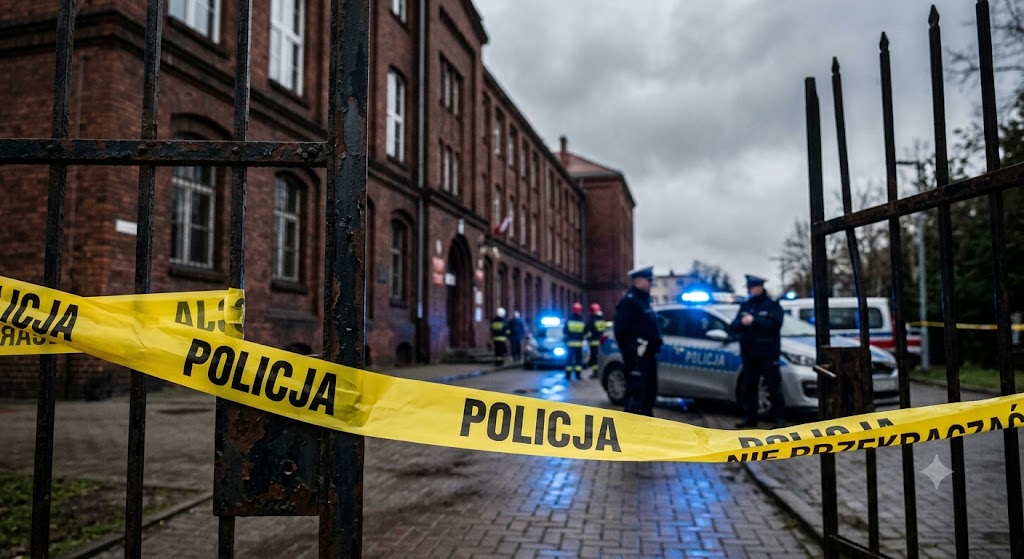
The foundational promise of any educational institution is safety—a secure environment where students can learn and educators can teach without the looming threat of violence. On Wednesday, October 7, 2026, that fundamental sanctuary was violently breached at a high school in Poland. In a shocking incident that has left the local community reeling and the nation searching for answers, a 19-year-old student orchestrated a targeted knife attack within the corridors of a vocational school in Ostrołęka, a city located north of the capital, Warsaw. The rampage left at least seven people wounded, with some official reports indicating up to eight victims, plunging the quiet city into a state of emergency and collective trauma.
The Anatomy of the Attack
The terrifying sequence of events unfolded during regular school hours, abruptly transforming a standard academic day into a scene of chaos and medical triage. According to preliminary reports from Polish law enforcement, the 19-year-old suspect, who was actively enrolled as a student at the vocational school, entered the premises armed with a knife—described by officials as a “dangerous tool”.
Rather than isolating a single target, the assailant indiscriminately attacked both his peers and the school’s faculty. Ostrołęka prosecutor Elzbieta Lukasiewicz confirmed the grim demographic of the victims, stating that both students and teachers were among those injured in the sudden melee. “It appears that the boy went into the school and attacked the students and teachers with a dangerous tool,” Lukasiewicz detailed to the news channel TVN24.
The scale of the casualties quickly overwhelmed the school’s immediate medical capabilities. While initial police dispatches cited seven wounded individuals, the regional fire department provided a slightly higher tally to the PAP news agency, reporting that the injured included three adults and five teenagers. Emergency medical services rushed to the scene to stabilize the victims, at least two of whom were reported to be seriously hurt in the assault.
The Manhunt and Apprehension
In the immediate aftermath of the stabbings, as panic gripped the student body and faculty scrambled to secure classrooms, the 19-year-old attacker managed to flee the school grounds. His escape triggered an intensive, rapid-response manhunt across Ostrołęka by local and regional police forces.
The search concluded a few hours later. Around noon on Wednesday, police tracked the suspect down and successfully detained him near the city’s beach area. Police spokesman Marcin Sawicki confirmed the arrest to the Polish Press Agency, adding a crucial detail to the unfolding narrative: the teenager had also sustained injuries during the course of the morning’s events. Following his apprehension, authorities released a blurred photograph of the youth as he was taken into police custody. He is currently being held as investigators work to determine the exact sequence of the rampage and untangle the underlying motives that drove a student to enact such violence against his own school community.
A City on Edge: Lockdowns and Leadership Response
The ripple effects of the violence were felt instantaneously across Ostrołęka. Recognizing the immediate threat of a fleeing, armed suspect, municipal authorities and school administrators initiated sweeping security protocols. The vocational school where the attack took place was immediately shuttered, transforming from an active educational facility into a highly restricted crime scene.
Furthermore, as a strict precautionary measure, authorities moved to secure other educational institutions throughout the city while the suspect remained at large. For hours, parents endured agonizing uncertainty, waiting for official confirmation regarding the safety of their children.
Attempting to quell the rising panic, Ostrołęka Mayor Paweł Niewiadomski issued a public statement once the suspect was in custody. “The situation has been brought under control,” Niewiadomski assured the public. Acknowledging the extreme stress placed on the community, he added, “I am asking students, parents, and staff to remain calm and follow the instructions of the school administration and emergency services”.
The Broader Implications: A Shattered Sense of Security
While mass casualty events and school violence have tragically become a recurring focal point in North American media, such incidents remain exceedingly rare in Poland and across much of Eastern Europe. The Ostrołęka stabbing will undoubtedly serve as a massive psychological shock to the Polish educational system.
When a student turns a weapon on their own teachers and classmates, it forces a localized, painful reckoning. In the days and weeks to come, the focus of the Polish public and lawmakers will inevitably pivot from the immediate criminal investigation to broader, systemic questions. How did warning signs go unnoticed? What mental health resources were available to the 19-year-old student prior to his breaking point? And crucially, how must Polish schools adapt their physical security protocols to prevent a recurrence of Wednesday’s horror?
As the victims recover in local hospitals and the suspect awaits formal judicial proceedings, the community of Ostrołęka is left to navigate the difficult, long-term process of healing. The physical wounds inflicted by the “dangerous tool” will eventually close, but the psychological scars left on the students and educators who witnessed their sanctuary turn into a crime scene will require extensive, compassionate, and sustained intervention.