
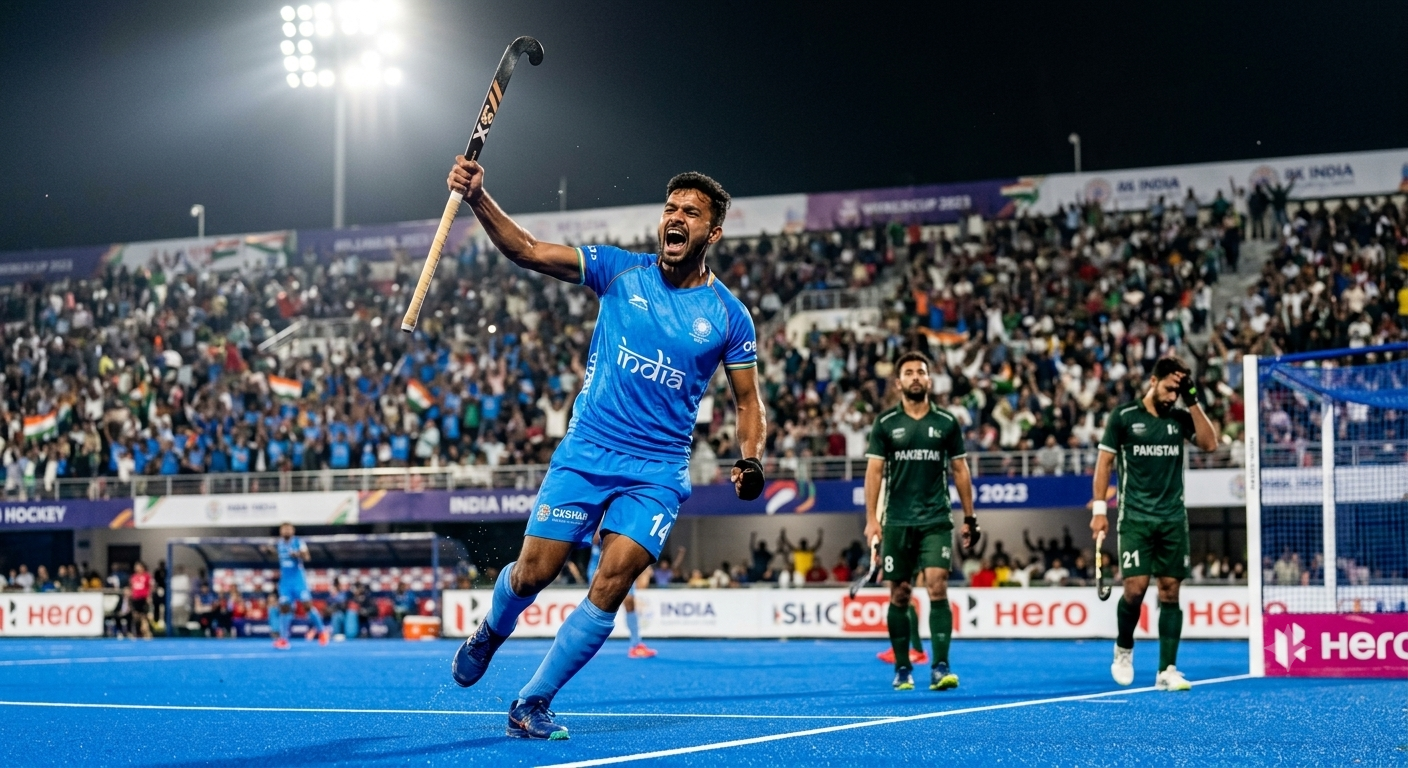
There is no stage in world hockey that quite matches the sheer intensity, historical weight, and palpable tension of an India versus Pakistan encounter. When that clash happens to be a high-stakes semi-final at the Asian Games, the drama is elevated to an entirely different stratosphere. On Thursday, October 1, 2026, fans at the Aichi-Nagoya Asian Games witnessed a modern classic that will be etched into the annals of this storied rivalry. In a pulsating, edge-of-the-seat thriller that saw momentum swing wildly from one half of the turf to the other, the defending champions, India, narrowly edged past a resilient Pakistan side 4-3. The victory was secured in the most dramatic fashion possible, with forward Abhishek finding the back of the net in the 60th and final minute to shatter Pakistani hopes and send India through to the gold-medal match.
The Unstoppable Force Meets Resilient Challengers
Heading into the semi-final, the Indian men’s hockey team looked utterly invincible. Under the tactical guidance of head coach Craig Fulton, the Men in Blue had steamrolled through their pool-stage assignments. With staggering victories over Indonesia (13-1), Sri Lanka (16-1), South Korea (8-2), and Japan (2-0), India had amassed an intimidating 49 goals while conceding a mere four. Fulton had explicitly labeled this semi-final as a “game of consequence,” and his squad looked determined to assert their dominance from the opening whistle.
Pakistan, on the other hand, arrived at the semi-finals battle-tested. Having secured their spot by finishing second in Pool B—a journey that included wins against Thailand, Uzbekistan, China, and Oman, alongside a narrow 4-5 defeat to Malaysia—they carried the underdog tag but possessed lethal weapons, notably drag-flicker Sufiyan Khan, who led the tournament with 11 goals.
A Flawless First Quarter for the Defending Champions
The opening fifteen minutes of the match played out exactly as the Indian think-tank would have scripted. India immediately seized control of the midfield, suffocating Pakistan’s transition play and establishing a relentless high press. The pressure quickly yielded dividends as India earned a flurry of penalty corners.
Cometh the hour, cometh the captain. Harmanpreet Singh, widely regarded as one of the most lethal penalty corner specialists in the modern era, showcased his absolute mastery. Unfazed by the charging Pakistani rushers, Harmanpreet slotted home two blistering goals in the first quarter, including a thunderous strike in the 13th minute. By the end of the first quarter, India had established a comfortable 2-0 cushion, looking every bit the defending champions they are.
The 3-0 Cushion and the Illusion of Safety
India continued to dictate the tempo as the match progressed into the second and third quarters. The tactical superiority of the Indian midfield kept Pakistan starved of meaningful possession. The match appeared to be completely put to bed when Sukhjeet Singh struck to make it 3-0. Capitalizing on a brilliant, piercing pass from Shilanand Lakra in the mid-region, Sukhjeet reacted with lightning-fast reflexes, catching the Pakistani defense and their goalkeeper completely flat-footed.
At 3-0 down, many teams would have folded under the immense pressure of a continental semi-final. However, this is India vs. Pakistan—a fixture where logic often takes a backseat to sheer willpower and national pride.
The Green Shirts Mount a Stunning Fightback
Instead of capitulating, Pakistan triggered one of the most breathtaking comebacks of the tournament. The three-goal deficit seemingly unburdened their attackers, who began to play with a frantic, aggressive desperation that caught the Indian defense off guard.
The turning point came when India paid a heavy price for a rare lapse in defensive structure. Pakistan orchestrated a slick circle entry, weaving quick passes that dismantled the Indian backline, allowing Waheed Rana to score from close range, leaving Indian goalkeeper Mohith Shashikumar helpless. This initial breakthrough breathed new life into the Pakistani dugout.
Ammad Butt further reduced the deficit in the 38th minute, punishing an Indian defense that suddenly looked confused and hesitant in clearing their lines. The unthinkable then materialized in the 49th minute when Hannan Shahid capitalized on yet another defensive error to level the score at 3-3. In the span of a single half, India’s impenetrable armor had been shattered, and the ghosts of past chokes threatened to derail their gold-medal aspirations.
Abhishek’s Last-Gasp Heroics
With the score deadlocked at 3-3 in the closing minutes, the specter of a dreaded penalty shootout loomed large. Both sides traded frantic counter-attacks. In the 57th minute, India managed a promising circle entry but failed to convert it into a penalty corner or a shot on goal, immediately inviting a dangerous Pakistani counter that was thankfully neutralized.
Just as the stadium prepared for the final hooter and a shootout, Abhishek produced a moment of absolute magic. In the 60th minute, with seconds ticking away, the Indian forward found himself in the circle and unleashed a stunning field goal that completely bypassed the Pakistani defense. The ball crashing into the backboard sparked delirious celebrations in the Indian camp and absolute heartbreak for Pakistan.
Looking Ahead to the Gold-Medal Clash
With this dramatic 4-3 victory, India has successfully kept their title defense alive and booked their place in the coveted Asian Games gold-medal match. They will now await the winner of the second semi-final between Malaysia and South Korea, while Pakistan will be forced to regroup and fight for the bronze medal.
Beyond the immediate tournament implications, this victory extends India’s remarkable decade-long psychological stranglehold over their arch-rivals. The Men in Blue have not lost a match to Pakistan since the final of the 2016 South Asian Games. While Fulton and his coaching staff will undoubtedly spend the next few days analyzing the defensive frailties that allowed a 3-0 lead to slip, for today, the Indian hockey fraternity can exhale. They survived the ultimate scare, driven by the enduring truth of tournament hockey: it’s not over until the final whistle.
* Conceptual illustration generated using AI