
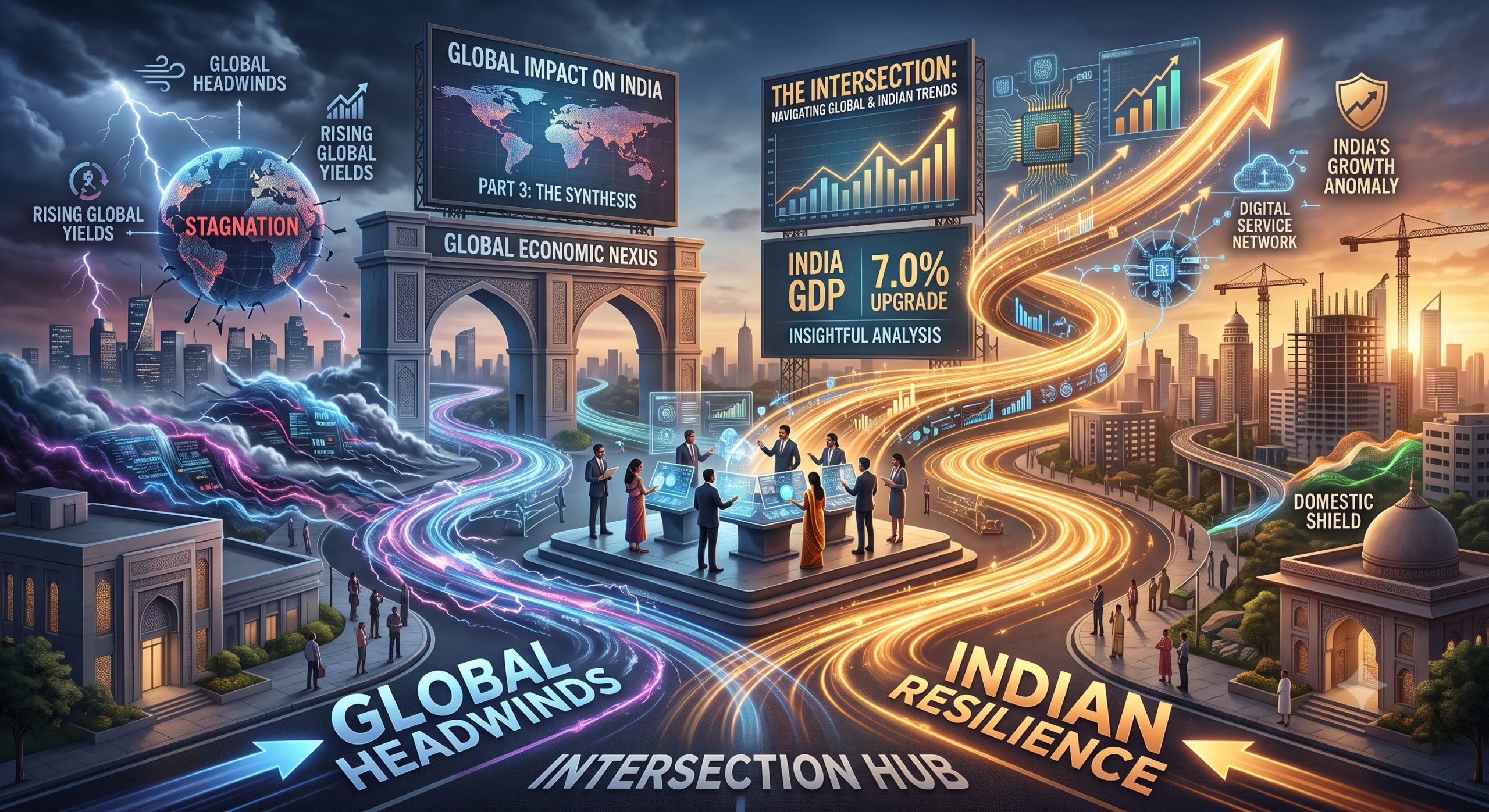
The global economy is currently operating on two entirely different frequencies. On one side, as explored earlier in this series, the traditional pillars of international trade are stalling under the weight of multi-year high interest rates and persistent inflation. On the other, India is accelerating, fueled by a massive domestic capital expenditure push and an aggressive expansion into high-tech manufacturing. But these two realities do not exist in a vacuum. To truly gauge the trajectory of the market moving into the final quarter of 2026, we must analyze the intersection: how macro global headwinds are colliding with—and in some cases, actively accelerating—India’s domestic growth engine.
The most critical point of intersection is the ongoing restructuring of global supply chains, specifically within the technology and semiconductor sectors. The global environment is currently characterized by exceptionally expensive capital; hawkish stances from central banks mean multinational corporations are facing the highest borrowing costs in decades. Ordinarily, this would freeze international expansion. However, geopolitical friction and the imperative to de-risk away from concentrated supply hubs are forcing tech giants to relocate production regardless of the macro cost of capital.
This is exactly where India’s domestic strategy converts a global headwind into a localized tailwind. By rolling out aggressive Production Linked Incentive (PLI) schemes and the ISM 2.0 initiative—which has already brought five semiconductor units into production—India is effectively offsetting the global cost of capital for foreign investors. The state is subsidizing the initial risk, making the country one of the few viable destinations for massive industrial relocation in a high-interest-rate environment. The global rush to build resilient, fragmented supply chains is feeding directly into India’s 9.1% manufacturing surge.
Simultaneously, the structural shift in global trade heavily favors India’s legacy macroeconomic strengths. With digitally deliverable services now accounting for roughly 71% of all global intermediate inputs, the nature of trade has fundamentally changed. As Western economies face stagnation in the movement of physical goods, corporations are doubling down on digital transformation and AI integration to drive corporate efficiency. India, with its deep reservoir of IT and digital infrastructure expertise, is structurally built to absorb this demand. The global digital services boom acts as a massive, insulated revenue generator, funneling foreign exchange into the country. This capital influx, in turn, helps finance the government’s domestic infrastructure blitz without severely straining the national deficit.
Yet, this intersection is not entirely frictionless. The very global fragmentation that is pushing tech manufacturing to India’s shores is also creating severe trade complexities for traditional goods. India’s response has been a highly pragmatic, multi-aligned trade strategy. While Western demand for traditional merchandise softens, India has aggressively pivoted its export focus. Merchandise trade with core BRICS economies surged 34% between April and August 2026, heavily compensating for the sluggishness in traditional Western markets. By leveraging new trade pacts and leaning into the expanding BRICS economic bloc, India is ensuring that its newly expanded factory capacity has guaranteed buyers, even as the broader global goods market contracts.
Navigating the remainder of the year requires understanding this delicate balance. India is actively leveraging global geopolitical fragmentation to build its manufacturing base, while simultaneously riding the global digital services boom to fund its domestic transition. The ultimate success of this economic anomaly will depend on how skillfully policymakers can continue to play these massive global shifts to their domestic advantage, insulating the local consumer while capturing shifting global capital.