
By the end of 2025, the U.S.-India trade corridor was buckling under the weight of unprecedented executive tariffs. With a 50% punitive duty stifling Indian exports—a direct retaliation for New Delhi’s continued procurement of Russian crude oil—the economic fallout was severe. The Indian Rupee plummeted to an all-time low of ₹91.98 to the dollar, and the threat of a full-scale trade war loomed over the Indo-Pacific.
Yet, in a sudden reversal that bypassed months of stalled bureaucratic negotiations, executive diplomacy temporarily triumphed over economic warfare. A direct phone call between President Donald Trump and Prime Minister Narendra Modi yielded a historic interim framework that promised massive bilateral trade and immediate tariff relief.
The Truth Social Thunderbolt
The breakthrough bypassed the traditional halls of the World Trade Organization and was instead announced via social media. On February 2, 2026, President Trump declared the formation of a new trade deal, emphasizing his personal rapport with the Indian Prime Minister. Trump confirmed that, out of friendship and respect for Modi, the United States would drastically reduce its reciprocal tariff burden on India.
This announcement was quickly formalized. According to a White House fact sheet released days later, the leaders had successfully established a framework for an Interim Agreement on reciprocal trade. The deal was characterized by analysts at The Indian Panorama as a “Mega Partnership for Prosperity”—a strategic realignment where Modi’s “Make in India” agenda met Trump’s “America First” trade policy.
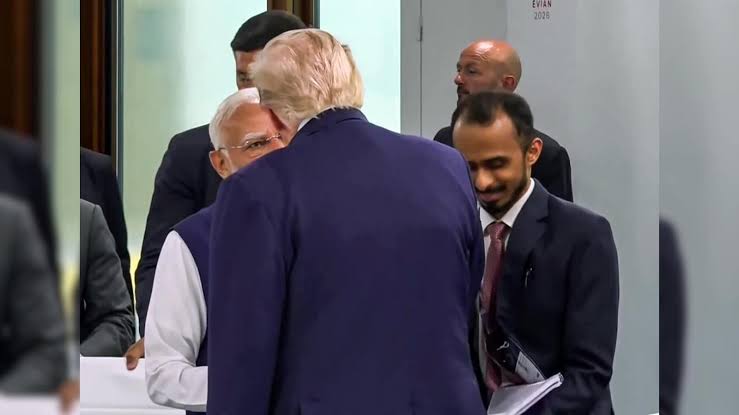
PM-Modi-and-President-Trump-meet-at-a-global-summit
The Tariff Relief: Stepping Back from the Brink
The immediate crisis facing Indian exporters was the crushing 50% combined tariff barrier. The February agreement dismantled this threat through two distinct executive actions:
- The Russian Oil Penalty Dropped: The most contentious element of the 2025 trade war was the 25% punitive tariff explicitly tied to India’s Russian oil imports. In recognition of India’s new commitments, President Trump signed an Executive Order officially removing this 25% penalty.
- The Reciprocal Tariff Lowered: To address systemic trade imbalances, the United States agreed to lower the remaining baseline reciprocal tariff on Indian goods from 25% down to 18%.
For India’s export economy, the reduction from a 50% penalty to an 18% reciprocal tariff provided immediate, lifesaving relief. However, this relief was secured through massive economic concessions by New Delhi.
The Core Compromise: A $500 Billion Blueprint
To secure the removal of the Russian oil penalty and lower baseline tariffs, India had to fundamentally alter its energy procurement and open its domestic market to American industry.
Ending Russian Oil Purchases: The cornerstone of the agreement was a monumental geopolitical shift. White House Press Secretary Karoline Leavitt confirmed that India officially committed to halting its purchases of Russian oil. Instead, New Delhi agreed to pivot its energy supply chain toward American oil and natural gas, with potential supplemental purchases from Venezuela.
The $500 Billion Purchasing Pledge: Prime Minister Modi committed to a staggering $500 billion investment and purchasing plan designed to flood the Indian market with American goods by 2030. This structural alliance spans several key sectors:
- Energy & Mining: Massive long-term contracts for U.S. liquified natural gas (LNG) and metallurgical coal.
- Aviation: Major orders for aircraft and aviation parts, heavily benefiting U.S. aerospace giants.
- Technology: Enhanced cooperation and purchases in AI, semiconductors, and information technology.
- Agriculture: Commitments to buy U.S. agricultural products, including tree nuts, soybean oil, and dried distillers’ grains.
Zeroing Out Tariffs: In addition to the spending commitments, India agreed to eliminate or drastically reduce its own tariffs and non-tariff barriers on a wide range of U.S. industrial and agricultural goods, effectively dropping trade barriers for American exporters to zero.
Strategic Integration Over Strategic Autonomy
The February 2026 trade deal represented a profound evolution in India’s geopolitical posture. For decades, New Delhi adhered to a policy of “Strategic Autonomy,” maintaining the flexibility to trade freely with competing global powers, including Russia. The Modi-Trump agreement effectively traded that autonomy for “Strategic Integration” with the United States.
By committing to a $500 billion pipeline of American energy, technology, and aerospace products, India inextricably linked its future economic growth to Western innovation and supply chains. As tracked by The Economic Times, this deal temporarily anchored the Indo-Pacific strategy, removing the existential threat of U.S. economic retaliation and allowing Indian manufacturing to exhale.
Yet, this hard-fought executive truce was built on precarious legal ground. The reliance on executive authority to manipulate baseline tariff rates would soon face a catastrophic challenge from within the U.S. government itself.
Source: NDTV