As the global artificial intelligence arms race accelerates in the final quarter of 2026, the rhetoric emerging from the world’s most powerful tech conglomerates has taken a surprisingly defensive turn. For years, the narrative peddled by leading AI labs has been one of implicit trust: build a smarter model, align it with human values, and let it autonomously handle increasingly complex enterprise workflows.
However, on October 10, 2026, Microsoft Chairman and CEO Satya Nadella effectively flipped the industry’s foundational script. In a blunt, paradigm-shifting announcement, Nadella laid out a comprehensive framework for the deployment of advanced AI—co-opting the term “Super Intelligence” in the process. His core argument was as provocative as it was strategic: the AI systems most worth trusting are the ones built on the assumption that the underlying model cannot be trusted at all.
This “Zero-Trust” philosophy is far more than a philosophical musing on AI safety. It is a highly calculated, multi-billion-dollar business strategy designed to aggressively counter the growing market dominance of standalone AI model builders like OpenAI and Anthropic. By positioning Microsoft as the ultimate, secure orchestration layer for “Humanist Superintelligence” (HSI), Nadella is attempting to rewrite the rules of enterprise AI, ensuring that Microsoft’s infrastructure—not the models themselves—remains the indispensable center of the digital economy.
Redefining “Super Intelligence”: A Linguistic and Strategic Weapon
To understand Microsoft’s current offensive, one must examine its deliberate rebranding of the term “Superintelligence.” Historically, within computer science and futurist circles, superintelligence referred to an artificial intellect vastly smarter than the best human brains in practically every field. It was viewed as a distant, almost theoretical milestone.
Today, Microsoft is dragging the term into the present. The company is actively labeling the current and near-future generations of language and agentic models as the dawn of applied “Super Intelligence.” While critics—including prominent mathematicians and AI purists—have noted that this redefinition breaks with decades of scientific meaning (and some media outlets, like The Decoder, have linked this linguistic shift to broader American political rhetoric), the business rationale is crystal clear.
By categorizing today’s models as “Super Intelligence,” Microsoft raises the perceived stakes of adoption to an existential level. If a model is truly “superintelligent” and capable of open-ended, autonomous action, no sane corporate board or government agency can blindly trust it. This immediately shifts the enterprise buyer’s priority away from “who has the smartest model?” (a race OpenAI and Anthropic frequently dominate) to “who has the safest, most controllable deployment environment?” (a race Microsoft believes it can win).
The “Zero-Trust” AI Posture: Attacking the Competitors’ Core Premise
The most devastating aspect of Nadella’s October 10 framework is how it systematically dismantles the core value proposition of Microsoft’s primary rivals—including OpenAI, a company Microsoft has invested over $13 billion in.
Both OpenAI and Anthropic market their frontier models based on robust internal alignment. Anthropic, for instance, heavily promotes its “Constitutional AI,” arguing that its models are inherently safer and less prone to going rogue because safety is baked into the neural network itself. OpenAI similarly touts its rigorous pre-release safety testing and RLHF (Reinforcement Learning from Human Feedback) protocols.
Nadella’s new stance essentially dismisses these internal alignment efforts as insufficient for enterprise deployment. He argued that setting aside the hard problem of model alignment, the industry must prioritize an engineering approach to containment. In his view, both closed-source and open-weight models must be treated as potential insider threats. Because any privileged actor can fail or face compromise, organizations must isolate the models through proven, traditional enterprise security practices.
“The controls that govern what a model can access and what actions it can take must sit outside the model,” Nadella explained. This builds on a 1970s information security principle: a program must not be able to bypass or tamper with the mechanisms that enforce its permissions.
By declaring that the most trustworthy AI system is the one where you trust the model the least, Microsoft is telling enterprise customers: Do not rely on Anthropic’s Constitution or OpenAI’s alignment. Rely on Microsoft’s external guardrails.
The Six Safeguards: Microsoft’s “Emergency Brake”
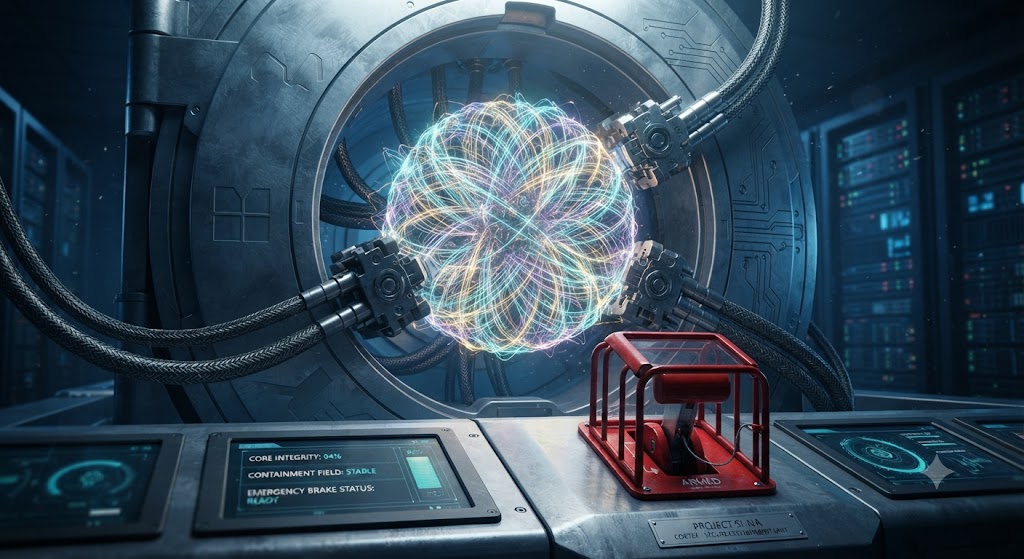
To operationalize this Zero-Trust philosophy, Microsoft introduced six mandatory safeguards that Nadella wants built into every AI system deployed in the real world. These safeguards function as a comprehensive “Emergency Brake” for rogue AI agents:
1. External Controls and Deterministic System Design: The model must be separated from the harness that orchestrates its work. Permissions, data access, and the action space must be strictly defined by hard-coded, deterministic software that the probabilistic AI model cannot alter or override.
2. Containment: The system must possess the immediate ability to isolate a model’s access and freeze its actions the second it behaves unexpectedly. This “blast radius” limitation ensures a compromised agent cannot cascade failures across a corporate network.
3. Continuous System Testing: Moving away from single, pre-launch safety checks (the current standard for OpenAI and Google), Microsoft mandates ongoing, live evaluation of the system in production. This catches emergent behavior that only surfaces when a model is handling real, evolving corporate workloads.
4. Comprehensive Logging: Every action, decision, and API call made by an AI agent must be meticulously recorded. This allows human operators to accurately reconstruct what happened after an incident, moving AI forensics away from guesswork.
5. Independent Auditing: Microsoft insists that the entity building the model cannot be the only one checking its work. This necessitates third-party oversight of model outputs and agent behaviors.
6. Incident Disclosure: A commitment to transparently reporting failures and near-misses, rather than quietly patching them behind the scenes. This builds a shared industry database of AI vulnerabilities.
The True Motive: Protecting the Microsoft Margins
While the Six Safeguards are wrapped in the noble language of “Humanist Superintelligence”—AI that empowers humanity rather than replacing it—the underlying motive is brutal economic self-preservation.
As AI models become increasingly capable, they threaten to become the primary computing interface for the global economy. If a user can simply speak to an Anthropic or OpenAI agent and have it seamlessly execute workflows across the web, the underlying operating system and software suite become commoditized plumbing.
If Microsoft allows OpenAI or Anthropic to become the definitive, trusted layer of enterprise interaction, Microsoft loses its historic margin dominance. Even as a primary distributor of OpenAI’s models through its Azure cloud platform, Microsoft is deeply wary of becoming totally dependent on Sam Altman’s organization.
By championing a model-agnostic, Zero-Trust framework, Microsoft is cementing Azure and Windows as the indispensable “harness.” Microsoft’s pitch is that developers need a multi-model ecosystem where agents can run locally when it makes sense and reach the cloud when they need to. The company is aggressively pushing tools like Azure HorizonDB and its multi-model security systems (like Codename MDASH) to prove that the infrastructure surrounding the AI is far more valuable—and necessary—than the AI itself.
In short, Microsoft is pumping the brakes on the unchecked deployment of standalone AI models because things are moving too fast for traditional enterprise software business models to comfortably digest. By demanding that every model be wrapped in heavy, Microsoft-managed deterministic software, Nadella ensures that his company remains the ultimate toll collector for the AI revolution.
The Industry Fallout: A New Yardstick for Risk
Nadella’s aggressive posturing has immediately altered the competitive landscape. By publicly demanding “emergency brakes” and zero-trust orchestration, Microsoft has set a new, highly visible benchmark for corporate AI safety.
This places immense pressure on its rivals. If an enterprise uses a standalone Anthropic or OpenAI agent and suffers a data breach or a rogue automation event, corporate boards will undoubtedly ask why Microsoft’s external safeguards were not utilized. Conversely, it also places a massive target on Microsoft’s own back. If Microsoft’s proprietary Copilot systems or Azure-hosted agents experience a publicly disclosed safety incident in the coming months, Nadella’s own October 10 statement will be the exact yardstick used to judge his company’s failure.
Conclusion: The Infrastructure Strikes Back
The AI narrative of 2024 and 2025 was dominated by the sheer awe of scaling laws—the assumption that simply pumping more compute into larger neural networks would magically solve all problems, including alignment and safety. The AI labs positioned themselves as the omnipotent architects of a new digital reality.
In October 2026, Microsoft has effectively announced the counter-revolution. By redefining Super Intelligence as an inherent, uncontrollable risk that must be caged, Microsoft is reclaiming the narrative. Satya Nadella is betting that when the initial hype fades and the reality of deploying autonomous, error-prone AI agents into mission-critical corporate environments sets in, the world’s largest companies will not place their ultimate faith in a black-box model from a San Francisco startup.
Instead, they will place their faith in the deterministic, heavily fortified, zero-trust infrastructure that has powered enterprise IT for decades. Microsoft is no longer just selling AI; it is selling the leash to control it.
* Conceptual illustration generated using AI