
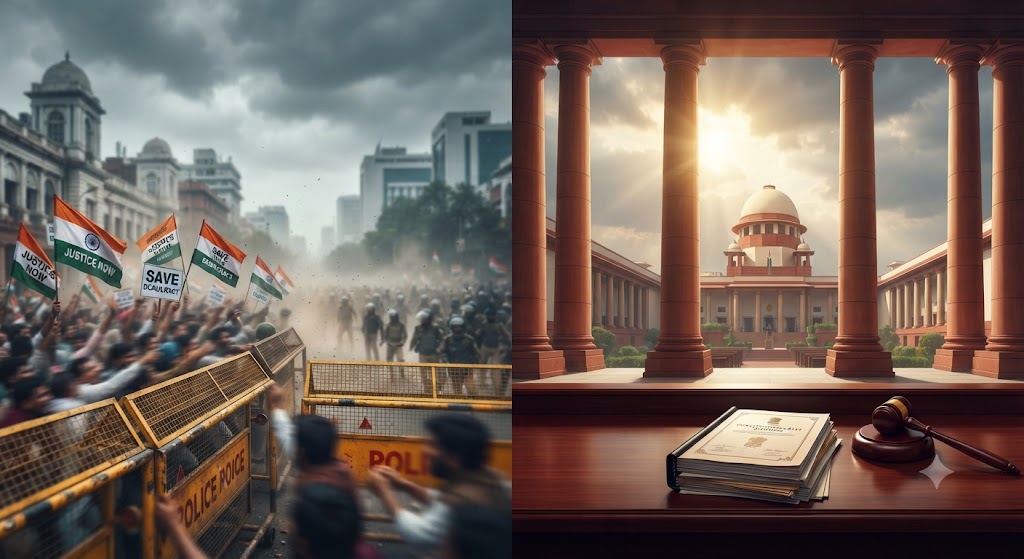
The barricades erected across New Delhi in October 2026 serve as physical markers of a deeply polarized Indian political landscape. As thousands of demonstrators, led by the INDIA bloc and civil society groups like the Cockroach Janata Party (CJP), marched toward the Supreme Court under the banner of the “March for Democracy”, the discourse surrounding the protests fractured into two irreconcilable narratives.
For the ruling Bharatiya Janata Party (BJP) and its supporters, the mobilization is a calculated, cynical exercise. The ruling establishment’s thesis is stark: having repeatedly failed to secure the Prime Minister’s office through the traditional mechanisms of the ballot box, Rahul Gandhi and the opposition have effectively abandoned the accepted democratic structure of winning elections. Instead, they are accused of attempting to manufacture a political crisis, weaponizing street-level chaos and inciting public anxiety to destabilize a legitimately elected government.
Conversely, the opposition frames the exact same events as a desperate, necessary defense of constitutional democracy. They argue that the electoral system itself has been fundamentally compromised, forcing them onto the streets to demand institutional accountability. To understand the current political paralysis in the capital, one must dissect these competing claims of “manufactured anarchy” and “institutional capture.”
The Charge: Bypassing the Ballot for the Street Veto
The core accusation leveled against Rahul Gandhi by the ruling establishment is that he has adopted a strategy of perpetual disruption. According to this perspective, the Congress party, unable to construct a winning electoral coalition capable of unseating the BJP at the national level, is attempting to delegitimize the institutions that oversee those elections.
The BJP points to the massive disruption of daily life in the National Capital Region as evidence of this strategy. During the height of the protests against Chief Election Commissioner (CEC) Gyanesh Kumar, authorities were forced to shut down dozens of metro stations, suspend internet services in key sectors, and place roughly 7,000 individuals under preventive detention. From the government’s vantage point, these measures were not authoritarian crackdowns, but necessary law-and-order responses to an opposition deliberately trying to paralyze the state.
Critics of the opposition argue that Gandhi is attempting to utilize a “street veto”—a political tactic where a minority faction uses the sheer volume and disruption of street protests to overrule or bypass the legislative and electoral mandate of the majority. By allegedly fomenting unrest and backing aggressive agitations by groups like the CJP, the ruling party views Gandhi’s actions not as democratic participation, but as a dangerous provocation designed to create the optics of an “undeclared emergency.”
This narrative suggests that by constantly casting doubt on Electronic Voting Machines (EVMs) and the Election Commission, the opposition is refusing to accept the core tenet of democracy: the loser’s consent. By shifting the blame for electoral defeats onto the mechanics of the election itself, Gandhi is accused of actively eroding public faith in the democratic structure to serve his own prime ministerial ambitions.
The Opposition’s Defense: The “Vote Chori” Allegations
To analyze Gandhi’s strategy entirely through the lens of manufactured anarchy ignores the specific, institutional grievances driving the current mobilization. The October 2026 protests are not amorphous anti-government rallies; they are highly targeted campaigns focused on the Election Commission of India (ECI) and CEC Gyanesh Kumar.
The opposition’s central rallying cry is “vote chori” (vote theft). The dispute centers on the Special Intensive Revision (SIR) of electoral rolls. The INDIA bloc alleges that this exercise has been manipulated, resulting in the wrongful deletion of massive numbers of eligible voters—with some petitions alleging up to 13 crore (130 million) names were removed nationwide without proper restoration mechanisms.
From Gandhi’s perspective, questioning the Election Commission is not an attack on the democratic structure, but a prerequisite for its survival. During a press conference at the Congress headquarters on October 12, Gandhi explicitly demanded that CEC Kumar resign and “turn approver,” claiming the electoral system requires a complete overhaul to protect the Constitution. The opposition argues that when the referee of the democratic process is perceived to be acting under the pressure of the executive, taking to the streets becomes a constitutional duty rather than an act of anarchy.
The “Tandav” Metaphor and the Dual Strategy
The rhetorical battle reached a new intensity when Rahul Gandhi addressed the nature of the protests. On October 12, Gandhi compared the opposition’s agitation to Lord Shiva’s cosmic dance of destruction and creation. “This is tandav, Lord Shiva’s dance. There is no planning here,” Gandhi stated to reporters. “There is no need for a plan. A dance is going on… And anyone can join Shivji ki baraat”.
For the ruling party, equating a political protest that disrupts the capital to a chaotic, unplanned “tandav” is a tacit admission of the very anarchy they have been warning against. It feeds the narrative that the opposition is recklessly provoking the masses without a coherent legislative strategy.
However, Gandhi’s actions suggest a more calibrated, dual-track approach than his “unplanned” rhetoric implies. While encouraging citizens to march to Connaught Place and the Supreme Court, the opposition is simultaneously utilizing the highest democratic structures available to them.
The “March for Democracy” was timed to coincide with the filing of a comprehensive writ petition in the Supreme Court by Rahul Gandhi, Mallikarjun Kharge, and a broad coalition of opposition leaders. The petition formally requests the judicial examination of ECI records regarding the SIR exercise and seeks an independent panel to probe the decision-making process.
This legal maneuvering heavily complicates the accusation that Gandhi has completely “put down his weapon” of democratic engagement. By submitting to the jurisdiction of the Supreme Court and citing written communications with the Chief Justice of India, the opposition is actively engaging with the constitutional framework, running a sophisticated legal challenge in tandem with their street-level optics.
The Erosion of Institutional Trust
The current standoff on Bhagwan Das Road and at Jantar Mantar highlights a severe crisis in Indian political trust. A healthy democracy requires a basic consensus on the rules of the game. The ruling party must believe that the opposition is a loyal adversary operating within constitutional bounds, and the opposition must believe that the electoral machinery is fundamentally neutral.
In October 2026, both of these pillars of trust appear deeply fractured. The BJP views the Congress leadership as a destabilizing force willing to burn down the institutional house because they cannot currently govern it. Conversely, the Congress views the BJP as a hegemonic force that has already captured the institutional house, necessitating extraordinary public mobilization to break the lock.
When political disagreements escalate into mutual accusations of treason, vote theft, and dictatorship, the middle ground of legislative debate evaporates. If the state views all mass protests as “manufactured anarchy,” it risks overly militarizing its response to genuine public grievances. If the opposition views every electoral setback as proof of a rigged system, it risks alienating voters who seek policy solutions rather than perpetual institutional warfare.
As the Supreme Court prepares to hear the petitions regarding the Election Commission and the subsequent mass detentions, the judicial bench finds itself serving as the final arbiter in a profoundly political dispute. Whether the events of October 2026 are ultimately recorded by history as an orchestrated attempt to manufacture chaos, or as a vital defense of electoral integrity, will depend largely on the transparency of the institutions currently under fire.
* Conceptual illustration generated using AI