
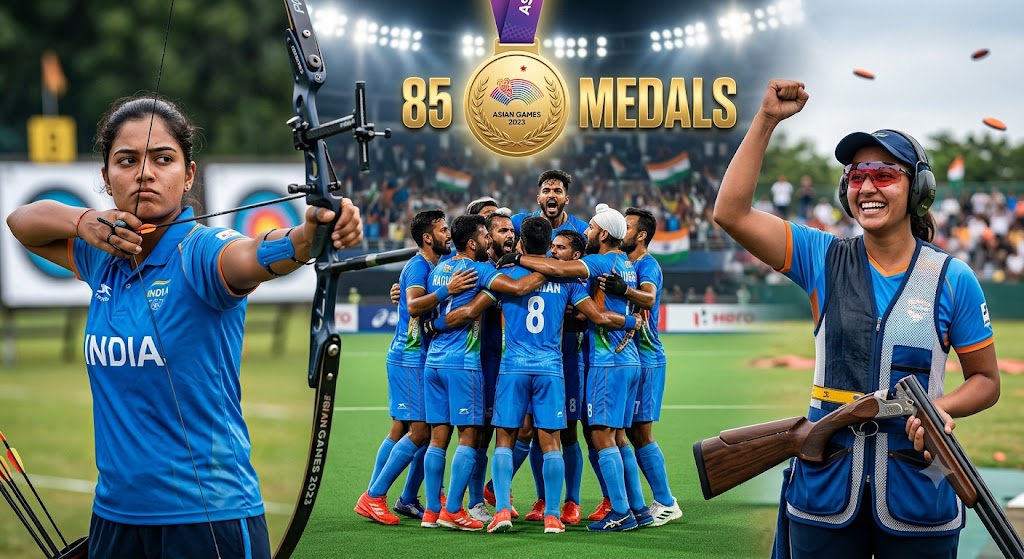
As the Olympic flame was extinguished at the closing ceremony in Aichi-Nagoya on Sunday, October 4, led by flag-bearing double-gold medalist trap shooter Neeru Dhanda, the Indian sporting ecosystem could collectively exhale. The 2026 Asian Games have officially concluded, and India has firmly cemented its status as a continental heavyweight. Matching their final position from Hangzhou, the Indian contingent secured a highly coveted fourth-place finish on the medal table. With a final tally of 85 medals—comprising 21 gold, 27 silver, and 37 bronze—the campaign goes down as India’s second-best finish in the history of the Games. Crucially, India managed to fend off a fierce late charge from Uzbekistan, who also finished with 21 golds but fell short of India’s superior silver medal count.
The Late Golden Avalanche
The story of India’s 2026 campaign is fundamentally one of endurance and a spectacular late-stage acceleration. Entering the final 48 hours of competition, India was locked in a tight, anxiety-inducing battle for top-five supremacy. What unfolded over October 2 and 3 was nothing short of a golden avalanche. The momentum was turbocharged across diverse venues—from the archery ranges and golf greens to the hockey turf and the cricket pitch. This late surge was not merely about padding the medal tally; it represented a psychological breakthrough for Indian athletes performing under the crushing pressure of high-stakes medal bouts.
Archery’s Olympic Recurve Breakthrough
Nowhere was this breakthrough more evident than in Archery, which emerged as India’s premier goldmine, yielding five golds and nine overall medals. While India’s dominance in compound archery has become an expected standard—sweeping all three compound team titles—the true tectonic shift occurred in the Olympic recurve discipline.
Historically, South Korea has maintained an iron-fisted, 28-year stranglehold on women’s recurve events. That monopoly was violently shattered by Kumkum Anil Mohod, who delivered a masterclass in precision to become the first Indian woman to win an individual recurve gold. Paired with a stunning gold from the women’s recurve team of Ankita Bhakat, Kirti Sharma, and Mohod, India medaled in all five recurve events. By dismantling Korean dominance, Indian archers have officially put the world on notice ahead of the Los Angeles 2028 Olympics.
Shotguns and Golf Clubs: Rewriting History
Simultaneously, the shooting ranges witnessed a shotgun revolution led by Neeru Dhanda. Ending a 48-year wait for India, Dhanda became the first Indian woman to win an Asian Games shotgun gold, seizing the trap title with a new Asian record. She subsequently paired with Kynan Chenai to secure the mixed team trap gold, rounding out a 15-medal haul for the shooting contingent.
Meanwhile, on the manicured greens, history was rewritten by Pranavi Urs. Demonstrating immense nerve under pressure, Urs captured the country’s first-ever individual Asian Games golf gold, ending a 24-year drought for an Indian title in the sport. She then anchored the women’s team—alongside veterans Aditi Ashok and Diksha Dagar—to secure a historic team silver.
Unprecedented Supremacy in Team Sports
While individual brilliance defined the shooting and archery ranges, India’s absolute supremacy in team sports underscored a robust, deep-rooted sporting infrastructure. For the first time in modern memory, India executed a clean sweep of the most culturally significant team events in the subcontinent.
Both the Men’s and Women’s Kabaddi teams reasserted their continental dominance, clinching their respective golds. On the cricket pitch, the Men’s team delivered a thrilling 19-run victory over arch-rivals Pakistan in the final, matching the gold secured earlier by the Women’s team.
However, the most strategic victories came on the hockey turf. Both the Indian men’s and women’s field hockey teams secured gold medals, a dual triumph that hasn’t been achieved since 1982. The men’s team dismantled Malaysia 5-1 in the final, while the women’s squad triumphed in their tournament. Beyond continental pride, these dual hockey golds carry immense geopolitical sporting weight: both teams have now secured direct, automatic qualification for the LA 2028 Olympics, bypassing the treacherous global qualifying tournaments entirely.
The Combat Arena and Track & Field Milestones
In the combat arenas, Indian athletes delivered raw physical dominance. The boxing ring yielded three gold medals, with Lovlina Borgohain cementing her legacy as only the second Indian woman (after Mary Kom) to win an Asiad boxing gold, alongside victories from Parveen Hooda and Ankush Panghal. On the wrestling mat, Aman Sehrawat and Sujeet Kalkal powered through their respective freestyle categories to stand atop the podium.
The narrative surrounding Athletics remains a complex mix of high volume and near-misses. Track and Field supplied a massive 24 medals—the highest volume of any sport for India. However, only one of those 24 medals was gold, courtesy of a dramatic finish by the women’s 4x400m relay team (Kiran Pahal, Poovamma Machettira, Prachi Choudhary, and Vithya Ramraj) on the final day. Despite the lack of golds, the quality of the performances signaled immense underlying progress. Vithya Ramraj shattered PT Usha’s legendary 42-year-old national record in the women’s 400m hurdles, while long-distance runner Gulveer Singh secured a grueling triple-medal haul (silver in 10000m and 1500m, bronze in 5000m).
The Road to Los Angeles 2028
As the 495-member Indian contingent returns from Japan, the overarching takeaway from Aichi-Nagoya is the successful diversification of India’s sporting portfolio. While traditional strongholds like shooting and wrestling continued to deliver, the emergence of gold-medal capabilities in golf, Olympic recurve archery, and women’s team sports points to a maturing, holistic sports ecosystem.
Finishing fourth in Asia is no longer an anomaly; it is the new baseline. With 85 medals secured and a slew of LA 2028 Olympic quotas locked in, the 2026 Asian Games will not be remembered merely as a successful fortnight. It will be recorded as the definitive launching pad for India’s ambitions to transition from a continental powerhouse to a genuine global Olympic contender.