

In May 2026, an unusual mascot made an unprecedented entry into the annals of contemporary political communication. What began as an Internet-native, satirical outlet mocking systemic youth unemployment, exam paper leaks, and corporate grind culture rapidly morphed into a viral political phenomenon known as the Cockroach Janta Party (CJP). Harnessing the acute anxieties of an estimated 20 million “chronically online” Gen Z followers, CJP bypassed traditional cadre-building methods to stage massive street demonstrations in the nation’s capital.
By mid-July 2026, the movement had reached its absolute zenith. On July 20, thousands of young protesters paralyzed central Delhi, occupying Jantar Mantar and demanding immediate institutional reforms in public recruitment and electoral oversight. Global headlines marvelled at the speed with which meme culture had been weaponized into genuine political leverage.
However, as we navigate late October 2026, the trajectory of CJP presents a starkly different picture. The fiery momentum that defined the summer months has given way to a pronounced downward trend. Between preventive police lockdowns, strict court-mandated undertakings, mounting backlash from urban business communities, and internal strategic drift, CJP’s street-level mobilization and public authority have cooled dramatically.
Here is an investigative analysis of CJP’s downward trend from its July peak to the present day, deconstructing the structural, legal, and political forces that contained India’s most viral youth movement.
The July Peak vs. October Reality: A Statistical and Spatial Shift
To understand the trajectory of CJP’s decline, one must contrast the operational environment of July 2026 with that of October 2026.
During the July 20–25 protest window, CJP demonstrated an ability to disrupt the capital’s daily functions. The sheer density of student turnouts forced the Delhi Metro Rail Corporation (DMRC) to close 18 major stations, leading to a single-day 16.8% drop in passenger boardings. Social media engagement across CJP’s primary channels recorded millions of impressions daily, outperforming established political entities in viral reach.
By October, however, the movement’s physical footprint was systematically contained. When CJP attempted to reignite street pressure in early October, the state response was immediate and preemptive. On October 10, the DMRC was directed to close entry and exit gates at 45 metro stations simultaneously—skipping key transit hubs in central Delhi and triggering a staggering 39.1% collapse in weekend passenger journeys.
More crucially, the legal arena delivered a decisive blow to CJP’s operational methodology. On October 21, senior CJP leadership—including co-conveners Saurav Das and Ashutosh Ranka—were forced to submit formal written undertakings to the courts promising that the group would not issue further calls for demonstrations at Jantar Mantar without prior administrative permissions. The transition from spontaneous, viral street occupation to legally bound restraint marks a permanent structural pivot downward.
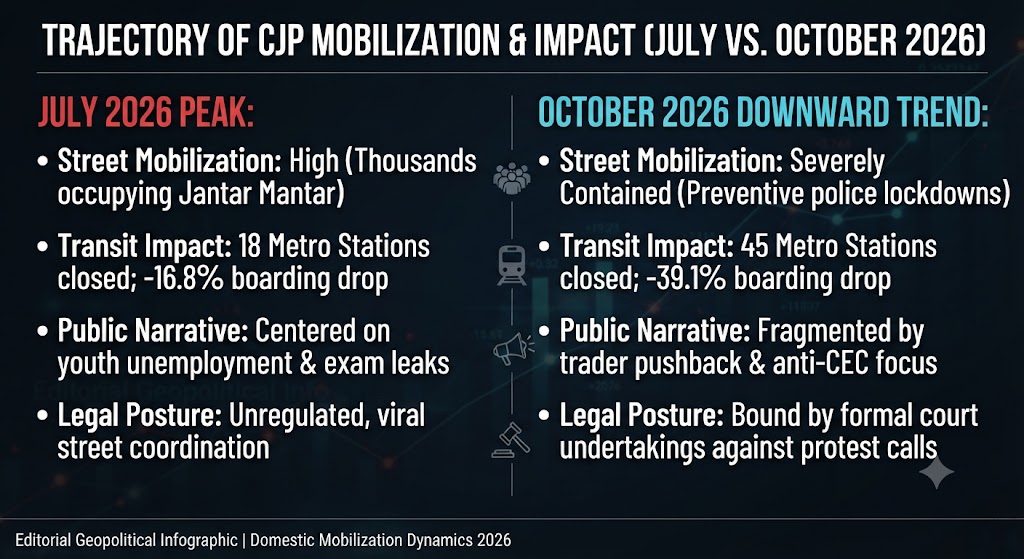
Trajectory of CJP Mobilization & Impact (July vs. October 2026)
Four Key Drivers Behind CJP’s Downward Trend
The cooling off of CJP is not the result of a single tactical mistake, but rather the cumulative effect of four compounding friction points:
1. State Security Engineering and Legal Containment
Following the chaotic clashes of July 20, Delhi Police shifted from reactive crowd management to preemptive security engineering. Law enforcement authorities initiated probes into a suspected “premeditated” angle behind CJP’s logistics, citing the July disruptions to justify sweeping, multi-layered barricading and site closures across central Delhi in October.
By securing court undertakings that restrict public call-outs, the state effectively dismantled CJP’s primary strategic weapon: its ability to summon thousands of young people to a single urban node within hours via social media broadcasts.
2. Economic Backlash from Urban Traders and Commuters
While CJP enjoyed widespread initial sympathy among Gen Z students, its repeated shutdowns of commercial hubs alienated urban working-class and business populations.
The New Delhi Traders Association (NDTA) and regional merchant bodies expressed growing fury as major commercial districts like Connaught Place were forced to shut down during protest calls. Traders estimated cumulative business losses ranging between ₹200 crore to ₹2,000 crore during multi-day shutdowns. Small shop owners, auto drivers, and daily commuters who suffered severe travel delays due to metro station closures began viewing the protests not as a heroic youth crusade, but as an economic disruption to their daily livelihoods.
3. Strategic Drift and Narrative Expansion
At its inception, CJP’s message was hyper-focused on tangible, non-partisan economic grievances: chronic graduate unemployment, delayed government recruitment results, and paper leaks in national competitive examinations. This tight focus resonated across diverse demographic lines.
However, between August and October, CJP expanded its agenda into highly polarized political territories—joining campaigns against Chief Election Commissioner Gyanesh Kumar over electoral-roll audits and adopting broader “regime change” rhetoric alongside veteran political activists. This narrative expansion diluted CJP’s original satire-driven identity. Moderate, independent Gen Z followers who joined to demand jobs and exam integrity felt disconnected from complex electoral disputes, causing a drop in organic online engagement and campus participation.
4. The Satire Trap: Limits of Meme-Driven Organization
Satire is an exceptional tool for rapid, low-cost political mobilization, but it is a fragile foundation for long-term institutional power. The “chronically online” mascot appeal that generated millions of Instagram followers in May and June proved difficult to translate into a disciplined, sustainable organization.
As state scrutiny intensified, the gap between “clicking a like button” and “facing police detentions” widened dramatically. Without a formal organizational cadre, policy think-tank backing, or structured state negotiation channels, CJP struggled to convert its viral outrage into concrete legislative or administrative concessions, leaving followers fatigued by continuous calls to action that yielded diminishing real-world returns.
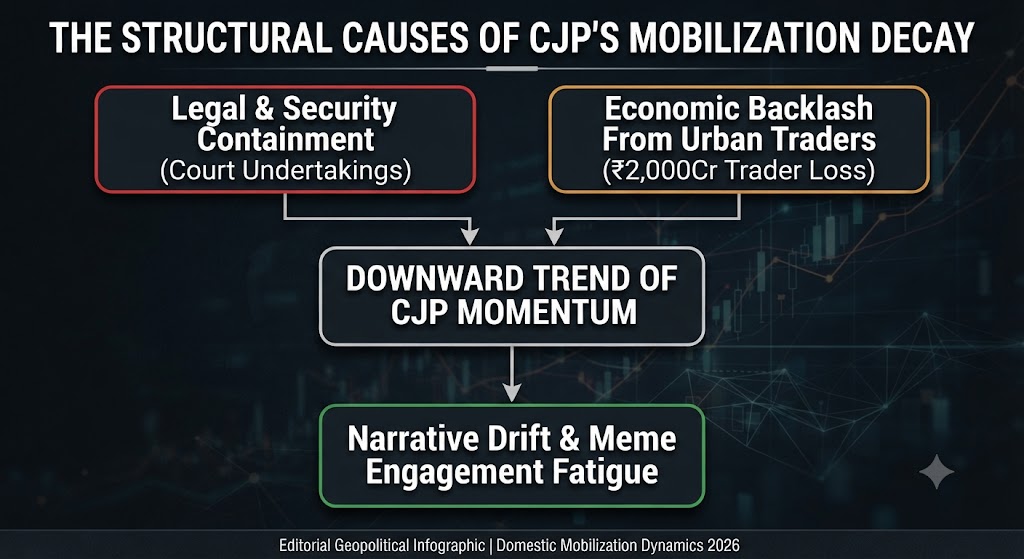
The Structural Causes of CJPs Mobilization Decay
The Broader Lesson: Youth Movements in the Algorithm Era
The downward trend of CJP between July and October 2026 offers profound insights into the mechanics of modern, social-media-driven political movements.
In the modern digital economy, algorithms allow non-traditional political actors to achieve viral scale at speeds that were unthinkable a decade ago. CJP amassed a larger online following than traditional political parties in a matter of weeks. Yet, rapid algorithmic growth often creates a dangerous illusion of permanent power.
When digital movements attempt to step out of the screen and occupy physical infrastructure, they run directly into the physical realities of state power, legal accountability, public transit logistics, and urban economics. Without a clear strategy to navigate these physical constraints, viral momentum decays quickly under administrative pressure.
Conclusion
The cooling of the Cockroach Janta Party from its explosive July peak to its constrained October reality does not mean that the underlying grievances of India’s Gen Z have disappeared. The core pressures that birthed CJP—high youth unemployment, fierce competition for public sector jobs, and digital disillusionment—remain deeply embedded in the socioeconomic landscape.
However, the era of uncoordinated, satire-fueled viral street occupations in the capital appears to have reached its legal and operational limits. As CJP’s leadership adjusts to court-mandated restrictions and recalibrates its strategy, the movement faces a pivotal choice: evolve from a meme-driven protest wave into a structured, policy-focused advocacy group, or watch its remaining influence fade into the background noise of the digital archive.
* Conceptual illustration generated using AI