
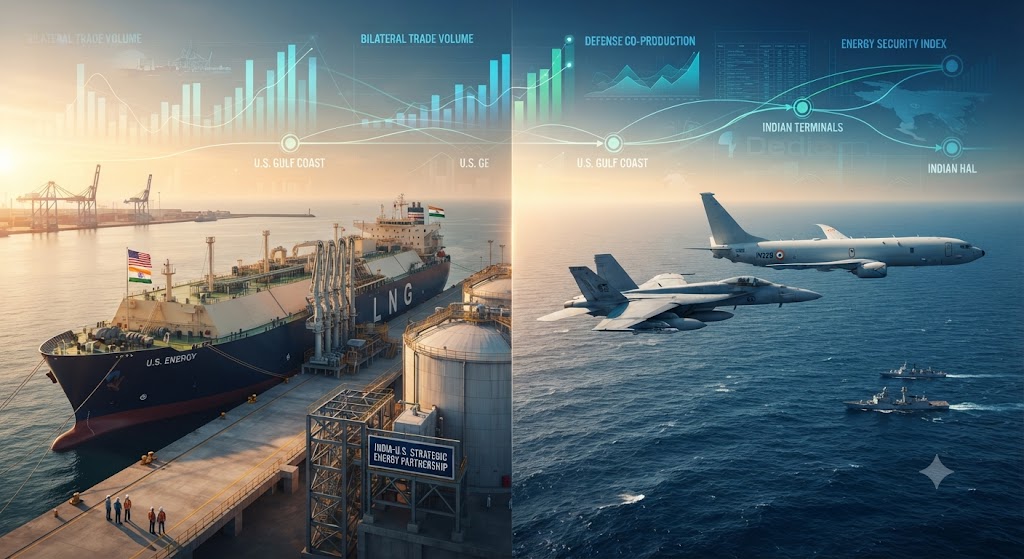
In the high-stakes arena of global diplomacy, trade policy is rarely just about tariffs and import quotas; it is a structural mechanism for reshaping geopolitical alliances. As bilateral trade talks between Washington and New Delhi reach a decisive phase in late October 2026, the underlying strategic architecture of the relationship has become unmistakably clear.
Faced with aggressive U.S. reciprocal tariff threats, scrutiny over Russian crude imports, and a lingering $40-plus billion trade deficit in India’s favor, the United States and India are engineering a major realignment. Rather than engaging in a destructive tariff war, Washington is actively nudging—and New Delhi is pragmatically pivoting—toward a monumental expansion of Indian purchases in two vital, high-value American sectors: Energy and Defense.
By substituting legacy import streams with American Liquefied Natural Gas (LNG), U.S. crude, and advanced co-produced defense hardware, India is executing a sophisticated strategic calculation. This pivot promises to narrow the trade deficit, alleviate tariff friction with Washington, and modernize India’s military-industrial base—all while preserving New Delhi’s non-negotiable foreign policy core: Strategic Autonomy.
Here is an in-depth, investigative breakdown of the energy and arms realignment reshaping U.S.-India relations.
1. The Energy Axis: LNG, Crude, and Strategic Substitution
Energy has rapidly emerged as the fastest-growing pillar of U.S.-India bilateral trade. As the world’s third-largest oil consumer, importing over 4.5 million barrels of crude per day to fuel its fast-growing economy, India’s energy security requirements are vast and continuous.
Over the past three years, India leveraged discounted Russian sea-borne crude to insulate its domestic consumers from global price shocks. However, as secondary tariff pressures from Washington intensify and Western sanctions tighten on shadow tanker fleets, Indian refiners—both state-owned enterprises like IOCL and HPCL and private giants like Reliance Industries—are recalibrating their sourcing portfolios.
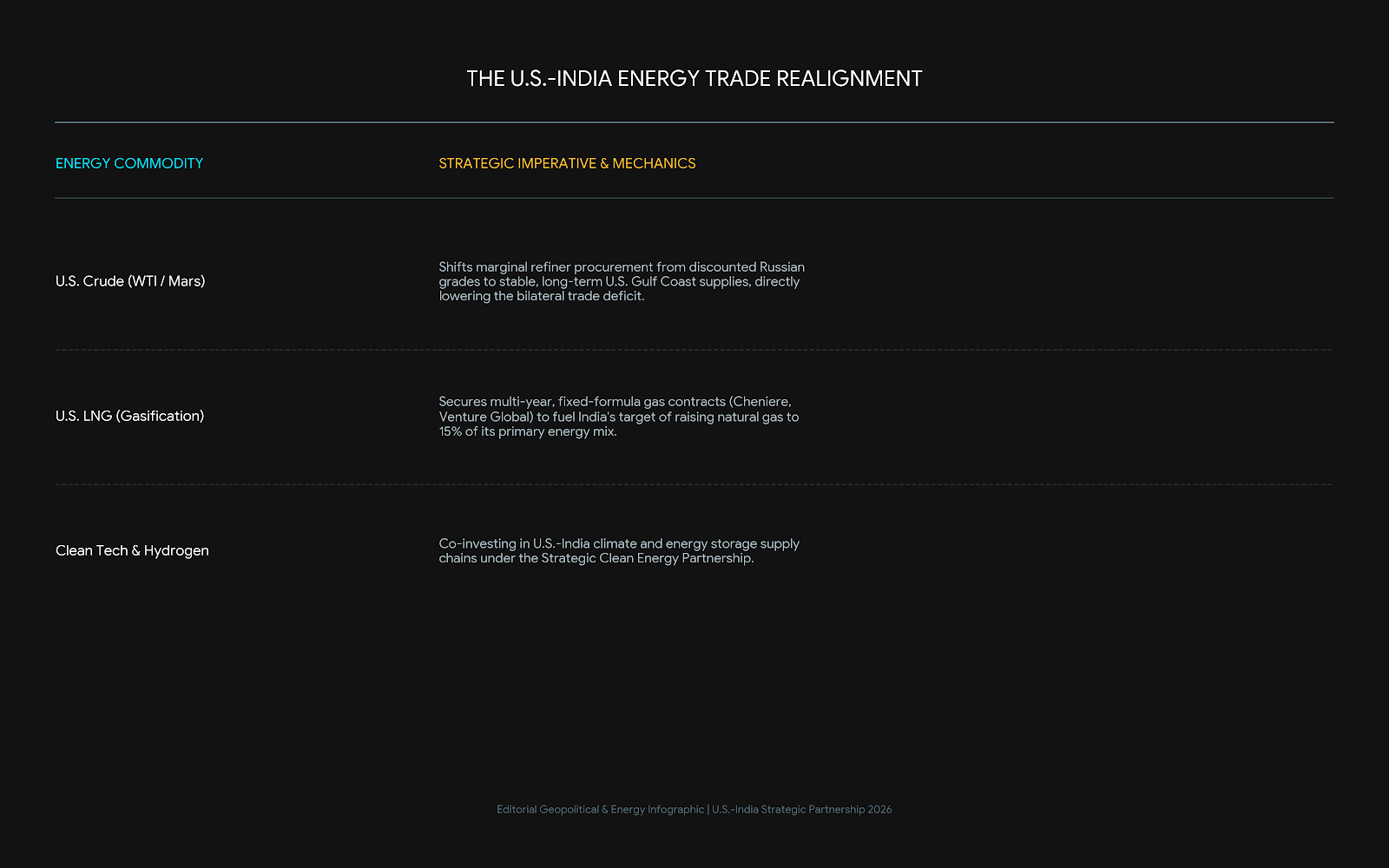
The US – INDIA Energy Trade Realignment
A. The LNG Push for Industrial Transition
India’s national mandate to raise the share of natural gas in its primary energy mix from ~6.5% to 15% requires a massive expansion of imported Liquefied Natural Gas. U.S. energy exporters, capitalized by record production along the Gulf Coast, offer long-term supply stability linked to Henry Hub pricing rather than volatile Brent crude indices. Multi-billion-dollar long-term LNG off-take agreements serve a dual purpose: they power India’s industrial fertilizer plants and urban gas distribution grids while providing Washington with massive export numbers to offset its trade imbalance with New Delhi.
B. Commercial Flexibility in Crude Procurement
While India maintains that it will purchase crude oil from any nation not subject to international legal bans, Indian refiners have steadily increased their intake of U.S. West Texas Intermediate (WTI) and light sweet grades when price spreads narrow. Increasing commercial purchases of U.S. energy gives Indian negotiators a formidable defense against U.S. legislative actions like the Lindsey Graham Sanctioning Act, demonstrating that New Delhi is actively recycling its export earnings directly back into the American energy sector.
2. The Defense Axis: Moving Beyond Sourcing to Co-Production
If energy provides the commercial volume to balance the trade deficit, defense procurement provides the strategic glue binding Washington and New Delhi together.
For decades, India was structurally tied to Moscow for military hardware, with up to 65% of its legacy inventory originating from Soviet or Russian design bureaus. However, the prolonged conflict in Ukraine severely impaired Russia’s defense supply chains, delaying spare parts delivery and modern tech upgrades for the Indian Armed Forces.
Recognizing this vulnerability, India has accelerated its defense modernization shift toward Western platforms. Crucially, New Delhi has rejected traditional “buyer-seller” arrangements, demanding high-technology transfers and local manufacturing—a demand the U.S. has increasingly agreed to meet to secure India as its primary Indo-Pacific security partner.
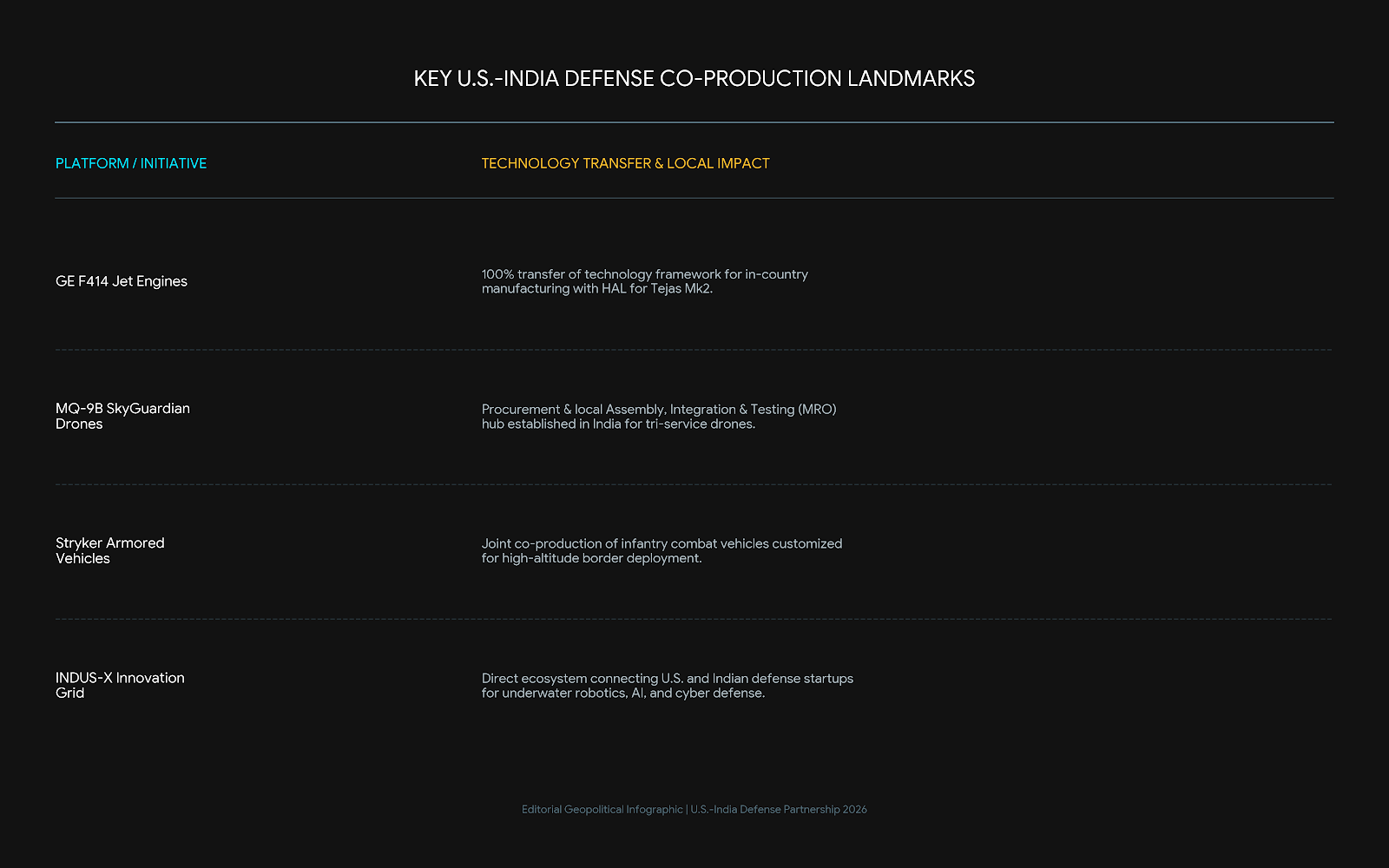
Key US-INDIA Defense Co-Production Landmarks
A. The GE-F414 Engine Breakthrough
The flagship example of this defense pivot is the agreement between General Electric and Hindustan Aeronautics Limited (HAL) to co-produce the GE F414 jet engine in India. Featuring unprecedented levels of core technology transfer, this deal powers India’s indigenous Light Combat Aircraft (Tejas Mk2) and future Advanced Medium Combat Aircraft (AMCA), permanently shifting India’s tactical aviation trajectory away from Russian engines.
B. Maritime Domain Awareness and Strike Precision
The Indian Navy’s procurement of MQ-9B SeaGuardian / SkyGuardian long-endurance drones and expansion of its P-8I Poseidon maritime patrol fleet has transformed intelligence sharing across the Indian Ocean Region. Integrated via secure communications agreements like COMCASA, these platforms allow Indian commanders to maintain real-time surveillance over critical maritime chokepoints alongside U.S. and Quad partner forces.
3. The Trade-Off: How Mega-Purchases Neutralize Tariff Pressure
The political logic driving Donald Trump’s recent praise for Prime Minister Modi becomes clear when viewed through the lens of economic trade-offs.
In tariff negotiations, the primary U.S. grievance is the $40+ billion trade imbalance generated by Indian software services, pharmaceuticals, textiles, and auto components entering the American market.
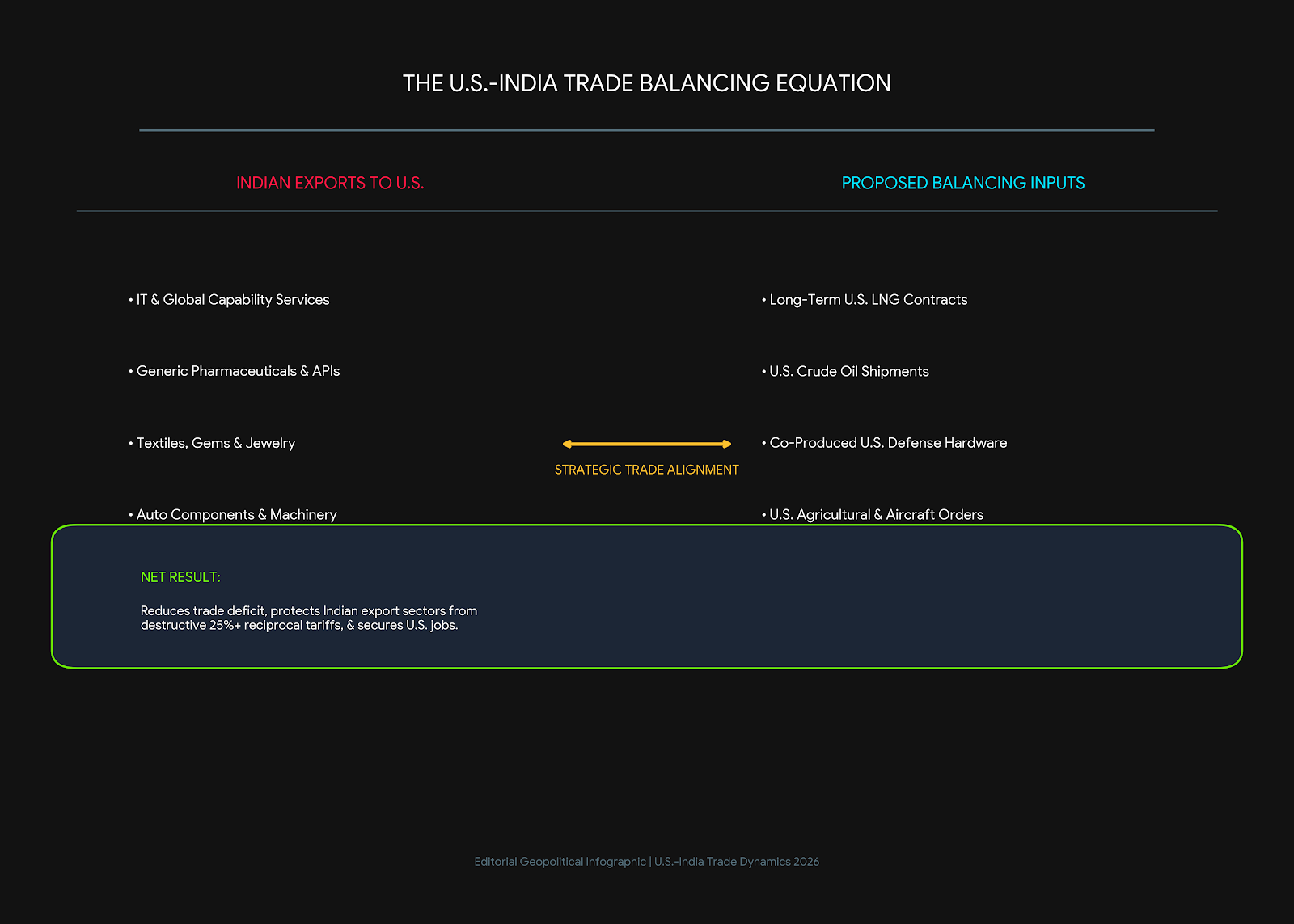
The US-INDIA Trade Balancing Equation
By committing to multi-billion-dollar energy contracts and high-value defense acquisitions over the next decade, India offers Washington a structural mechanism to offset the deficit without forcing New Delhi to destroy tariff protections on sensitive domestic sectors like agriculture and dairy.
For the White House, securing massive export commitments for American energy producers and defense contractors serves as a major domestic political victory. For New Delhi, it shields high-employment export industries (pharma, IT, textiles) from retaliatory duties.
4. The Limits of the Pivot: Preserving Strategic Autonomy
Despite the expanding purchases of U.S. energy and defense systems, it would be an error to interpret this movement as India joining a traditional U.S.-led treaty alliance.
Indian foreign policy remains firmly rooted in multi-alignment:
- Avoiding Single-Source Traps: Indian strategists remember past U.S. arms embargoes and technology restrictions. New Delhi will never replace a 60% dependence on Russia with a 60% dependence on the United States. Instead, it is diversifying across the U.S., France (Rafale jets, Scorpène submarines), Israel, and domestic suppliers.
- Protecting Domestic Red Lines: India’s refusal to open its domestic agricultural and dairy markets to U.S. industrial farming demonstrates that economic pivoting has strict boundaries designed to protect hundreds of millions of low-income farmers.
- Sovereign Decision-Making: India continues to maintain active diplomatic and economic engagements within BRICS, the Shanghai Cooperation Organisation (SCO), and the Global South, proving that commercial transactions with Washington do not translate into strategic vassalage.
Conclusion: Realpolitik in Action
The pivoting of Indian procurement toward U.S. energy and defense in late 2026 is a masterclass in modern transactional realpolitik.
By strategically aligning its vast commercial buying power with Washington’s primary economic and security priorities, India has turned a potential trade war into a structural partnership. Washington gets export volumes, high-tech manufacturing synergies, and an indispensable security anchor in the Indo-Pacific; New Delhi gets advanced technology transfers, energy security, and protection for its vital export industries.
In the complex multipolar world of 2026, alliances are no longer written in rigid ideological treaties—they are negotiated in energy contracts, co-production lines, and shared strategic balance sheets.
* Conceptual illustration generated using AI