
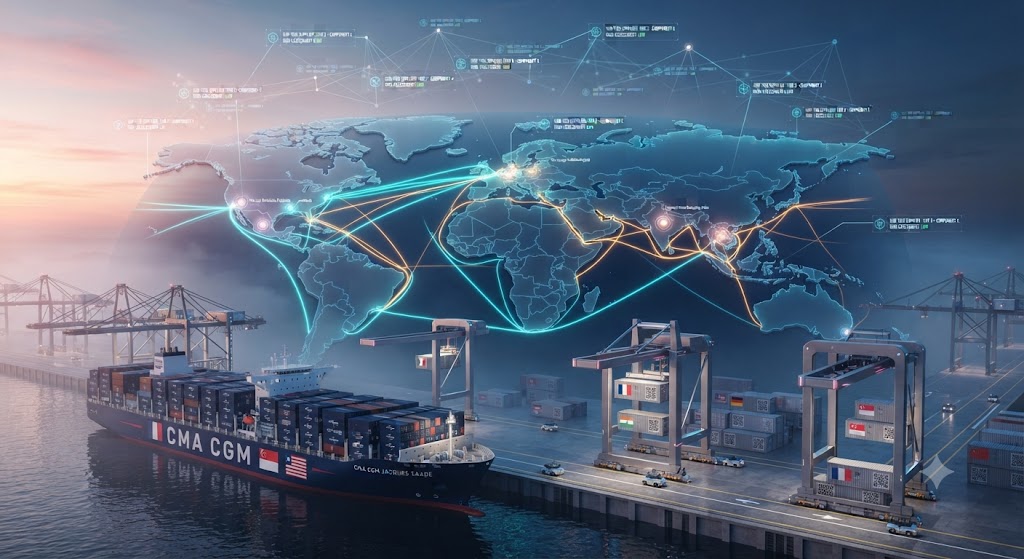
For the better part of three decades, global supply chain strategy was governed by a single, unyielding doctrine: cost minimization. Multinationals built lean, hyper-efficient, “Just-in-Time” manufacturing ecosystems that concentrated production in low-cost manufacturing hubs—chiefly mainland China.
However, a relentless series of geopolitical shocks—ranging from trade wars and pandemic bottlenecks to heightened cross-strait tensions and unilateral tariff regimes—forced a fundamental rethink. Western corporations and policymakers abandoned pure offshoring in favor of “friendshoring”: the strategic relocation of critical manufacturing and sourcing networks to nations deemed political allies or low-risk partners.
As we navigate late 2026, the initial euphoric wave of friendshoring has collided with operational reality. While production lines for smartphones, electric vehicles, medical devices, and semiconductors have visibly shifted to destinations like Vietnam, India, Mexico, and Poland, executive boardrooms are discovering a uncomfortable truth.
Friendshoring has not eliminated global supply chain vulnerability; it has merely obscured it. Behind the illusion of “decoupled” final assembly lies a complex, multi-tiered network of hidden sub-tier dependencies, infrastructure bottlenecks, and new geopolitical friction points. Here is an in-depth analysis of the structural dependencies inherent in friendshoring and how global enterprises are adapting.
The Anatomy of the Friendshoring Map in 2026
To understand where supply chains are migrating, one must examine the specialized industrial corridors that have emerged over the last four years. Driven by policies like the U.S. CHIPS Act, the Inflation Reduction Act, and the European Union’s Critical Raw Materials Act, capital has flowed heavily into specific regional hubs:
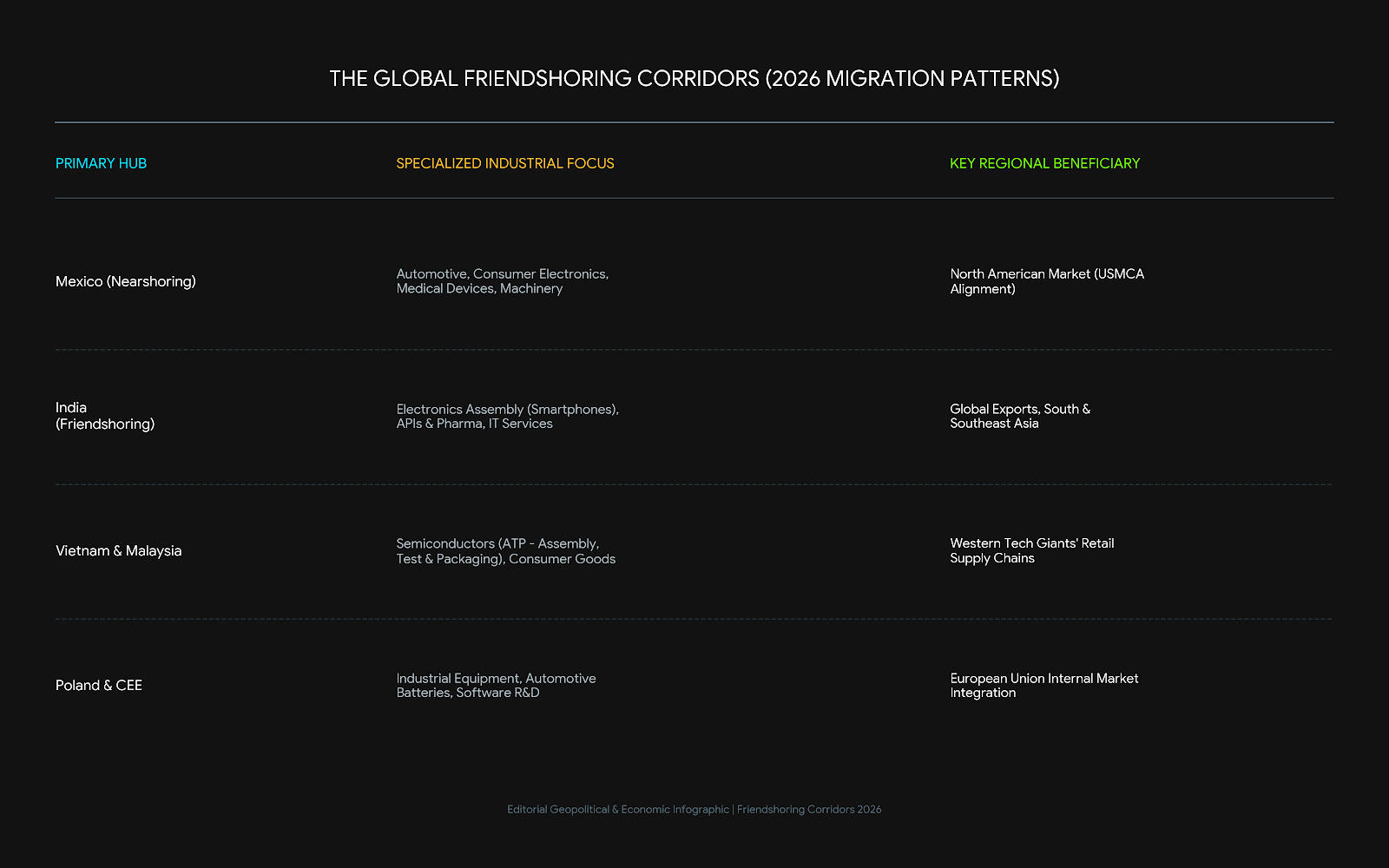
The Global Friendshoring Corridors (2026 Migration Patterns)
On the surface, this migration appears to be a massive success. Final-stage import metrics show a distinct decline in direct shipments of finished goods from traditional manufacturing strongholds to Western markets. However, a deeper audit of the sub-tier supply chain reveals that many “friendshored” products are far less decoupled than headline numbers suggest.
The “Transshipment Trap”: Hidden Sub-Tier Dependencies
The most significant operational risk facing friendshored supply chains is the sub-tier dependency paradox. While a multinational enterprise may establish a state-of-the-art final assembly facility in Northern Vietnam or Central Mexico, the underlying Tier-2 and Tier-3 inputs—raw materials, specialized chemicals, active pharmaceutical ingredients (APIs), sub-assemblies, and specialized tooling—frequently remain anchored in original sourcing markets.
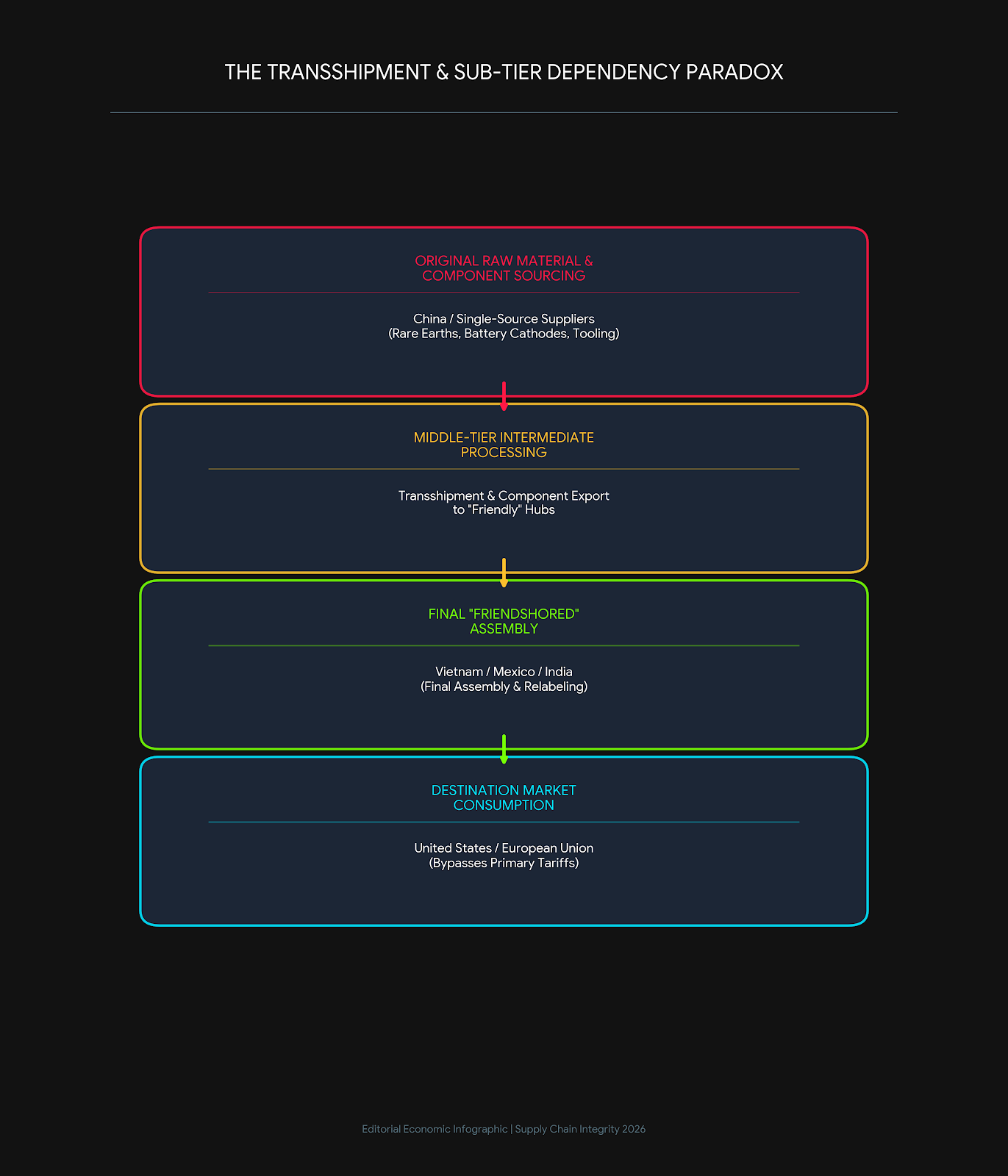
The Transshipment and Sub-Tier Dependency Paradox
1. The Capital Pass-Through Mechanism
In response to Western trade restrictions, foreign manufacturing conglomerates have aggressively invested in “friendshored” nations. In Mexico, Vietnam, and Thailand, industrial parks are increasingly funded, built, and operated by foreign capital. Component parts are manufactured offshore, shipped to these intermediate hubs for final assembly or minor processing, and then exported to Western markets under preferential trade terms (such as the USMCA).
Trade analysts refer to this as the “transshipment trap.” While the final origin label reads “Made in Mexico” or “Made in Vietnam,” up to 60% to 70% of the embedded value-add still originates from primary non-Western supply networks.
2. Critical Material Monopolies
Even when final component fabrication takes place inside an allied nation, critical upstream material inputs remain heavily concentrated. For example:
- EV Battery Supply Chains: An electric vehicle battery may be assembled in Poland or Mexico, but the refined lithium, cobalt, and synthetic graphite cathode materials are overwhelmingly processed by a small handful of global refiners.
- Pharmaceutical APIs: Generic medicine formulation may take place in India or Europe, but the foundational key starting materials (KSMs) and active pharmaceutical ingredients remain dependent on chemical precursors sourced from primary global suppliers.
Infrastructure Friction and Local Constraints in “Friendly” Hubs
Beyond sub-tier dependencies, multinationals attempting to rapidly scale production in friendshored destinations are encountering severe localized capacity constraints. “Friendly” nations are not friction-free environments; they face distinct structural limitations:
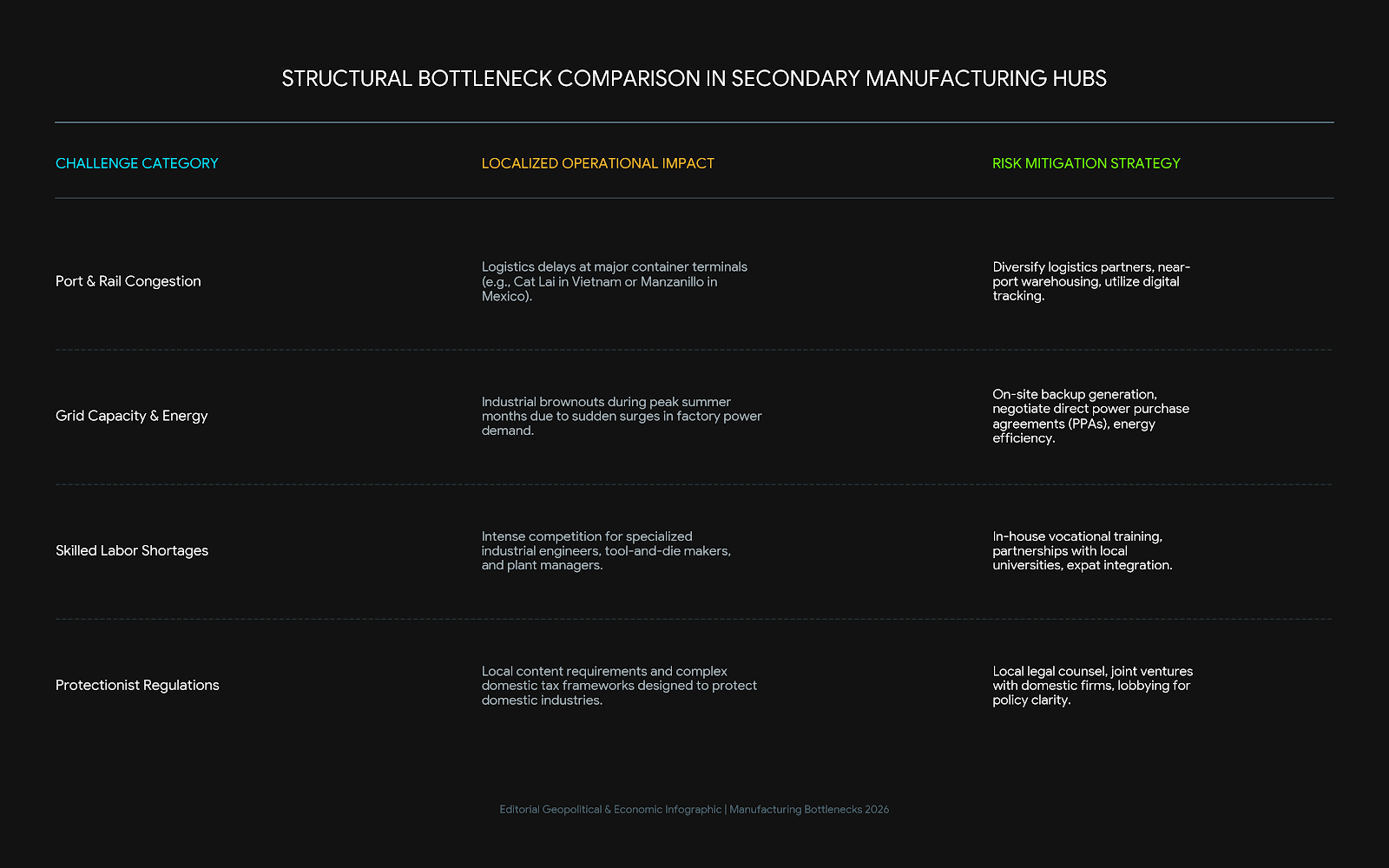
Structural Bottlenecks Comparison in Secondary Manufacturing Hubs
When hundreds of global enterprises attempt to shift capital into the same secondary manufacturing hubs simultaneously, infrastructure strains quickly. Power grids in Southeast Asia have faced summer rationing under the weight of new industrial load, while border crossings between Mexico and the U.S. routinely experience multi-mile commercial truck backlogs.
Furthermore, “friend” nations operate in their own national self-interest. Governments in developing manufacturing hubs are increasingly introducing local content mandates, export tariffs on unprocessed minerals, and strict labor laws to ensure that friendshoring delivers long-term domestic economic value rather than serving merely as a low-cost assembly pass-through.
Strategic Realism: The Shift to Multi-Nodal Resilience
Recognizing that friendshoring is not a magic bullet, leading corporate supply chain strategists in late 2026 are shifting from ideological “decoupling” to pragmatic multi-nodal resilience.
Rather than replacing one single-source hub with another, resilient enterprises are adopting three core operational practices:
- Multi-Tier Digital Mapping: Leveraging enterprise AI and graph databases to map supply networks down to Tier-3 and Tier-4 raw material suppliers. True risk management requires knowing where the raw chemical or mineral originates, not just where the final invoice was stamped.
- Modular Component Standardization: Redesigning products using standardized, interchangeable components that can be sourced from multiple geographic regions simultaneously, preventing a single regional lockdown or tariff spike from halting entire production lines.
- Dual-Sourcing (“China + 2” / “Regionalization”): Maintaining secondary production lines within primary manufacturing ecosystems while building redundant, regionalized capacity near key consumer markets (e.g., combining North American nearshoring with Southeast Asian friendshoring).
Conclusion
Friendshoring represents a necessary and permanent evolution in global trade architecture, reflecting a world where geopolitical risk must be factored into every corporate balance sheet alongside labor and freight costs. However, viewing friendshoring as a total cure for supply chain vulnerability is a dangerous strategic oversight.
Building true supply chain security in 2026 requires looking beyond superficial final-origin labels and superficial political alliances. The corporations that thrive in this complex multi-polar era will be those that master deep sub-tier transparency, invest in genuine regional industrial capacity, and accept that in an interconnected global economy, resilience is built not by cutting ties, but by managing dependencies with relentless intelligence.
* Conceptual illustration generated using AI