
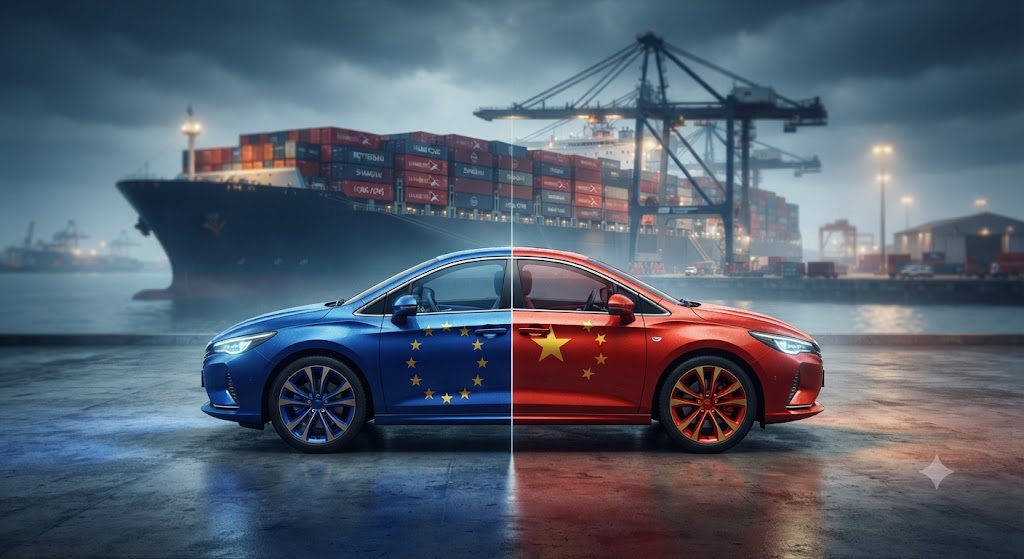
Following two days of intense, high-stakes negotiations in Beijing, the European Union and China have reached a preliminary trade agreement that promises to fundamentally reshape the global automotive landscape. Announced on Friday, October 9, 2026, the breakthrough deal aims to cut Chinese exports of hybrid electric vehicles (HEVs) and plug-in hybrid electric vehicles (PHEVs) to the European market by more than half.
Brokered by European Trade Commissioner Maroš Šefčovič and Chinese Commerce Minister Wang Wentao, the “common understanding” arrives just in time to avert a catastrophic, full-scale trade war between two of the world’s largest economic blocs. Beyond automobiles, the sweeping interim agreement includes critical Chinese concessions to lower tariffs on European goods and simplify export licenses for rare-earth materials, directly addressing the EU’s deep anxieties over supply chain security.
Plugging the Hybrid Loophole
The specific targeting of HEVs and PHEVs in this agreement is not a coincidence; it is a direct response to the shifting tactics of Chinese automakers. Earlier in the decade, as Brussels began aggressively imposing countervailing duties and tariffs on heavily subsidized pure battery electric vehicles (BEVs) originating from China, automotive giants like BYD and Geely rapidly pivoted. To bypass the BEV tariffs and maintain their aggressive expansion into the European continent, these manufacturers flooded the market with highly competitive, aggressively priced plug-in hybrids and conventional hybrids.
The numbers highlight a staggering market penetration. According to industry data, Chinese-manufactured hybrid vehicles accounted for 6.35% of all new-car registrations in the European Union during the first seven months of 2026—a near-doubling from the 3.38% market share they held during the same period in 2025. In specific European markets where charging infrastructure lags, such as Ireland, conventional and plug-in hybrids now account for nearly four in ten new-car registrations, making the influx of Chinese vehicles an existential threat to legacy domestic manufacturers.
By explicitly agreeing to “moderate” and halve the export volume of these vehicles, European Commissioner Šefčovič noted that the bloc is effectively “preventing several millions of car exports from China to the European Union”. For legacy European automakers—many of whom are currently struggling with high labor costs, expensive energy, and a sluggish transition to full electrification—this quota acts as a vital, multi-year pressure release valve.
The €360 Billion Deficit and the Leverage of Crisis
To understand why Beijing agreed to voluntarily slash its most lucrative export category, one must examine the broader macroeconomic context weighing heavily on the Chinese delegation.
The European Union has grown increasingly militant regarding its trade deficit with China, which ballooned to a staggering €360 billion ($403 billion) last year. European policymakers have consistently argued that China’s state-sponsored industrial overcapacity is artificially suppressing global prices and crippling local European industry. Prior to this week’s summit in Beijing, Brussels was preparing to unleash a devastating new round of punitive measures that would have severely restricted Chinese access to the single market.
Simultaneously, China is grappling with a profound internal economic crisis. A prolonged real estate slump, weak domestic consumer demand, and high youth unemployment have forced Beijing to rely overwhelmingly on its manufacturing export engine to prop up national GDP growth. As Bernd Lange, the chief of the European Parliament’s trade committee, noted prior to the talks, China’s domestic economic fragility actually handed Brussels unprecedented “bargaining power”.
Faced with the reality that the United States has already effectively locked Chinese vehicles out of its market via 100% tariffs, Beijing could ill afford to lose Europe as well. Commerce Minister Wang Wentao and his negotiating team ultimately concluded that securing a guaranteed, albeit halved, slice of the European market with predictable regulatory conditions was strategically preferable to facing a complete, tariff-driven embargo.
The Rare Earths Trade-Off
While the headline focus remains on the millions of halted hybrid vehicles, the most consequential long-term victory for the European Union may lie deeper in the supply chain.
As part of the interim deal, China committed to improving market access for European companies and lowering tariffs on products that will benefit “almost every” EU member nation. Crucially, Beijing also agreed to simplify its restrictive procedures for issuing export licenses for rare-earth elements and permanent magnets.
China currently exercises a near-monopoly over the mining and refinement of rare earth minerals—the essential building blocks required to manufacture everything from wind turbine generators and smartphone batteries to advanced military guidance systems and, ironically, the electric motors used by European automakers. Over the past several years, Beijing has increasingly weaponized this dominance, utilizing export quotas and complex licensing requirements to retaliate against Western trade policies.
By securing a commitment to stabilize the rare earths supply chain, European negotiators have successfully de-risked one of the bloc’s most glaring strategic vulnerabilities. This concession provides European green-tech manufacturers with the operational predictability required to scale up their own energy transition efforts without the constant threat of a sudden, politically motivated raw material embargo.
A Fragile Peace Awaiting Ratification
Despite the optimistic rhetoric flowing from Beijing, the trade war has been paused, not permanently canceled. Maroš Šefčovič aptly characterized the preliminary agreement as a “crucial first step” toward genuine rebalancing, indicating that the two sides will reconvene by January 2027 to assess compliance and hammer out the finer, legally binding technicalities.
Furthermore, the initial deal remains subject to intense bureaucratic scrutiny. The agreement must still be formally ratified by the leaders of all 27 nations within the European Union. This ratification process will undoubtedly face fierce debate in Brussels and Strasbourg. While nations with heavy automotive manufacturing footprints like France and Italy will likely champion the protectionist relief, other member states heavily reliant on cheap Chinese imports to meet their climate goals may view the quota as an inflationary burden on their own consumers.
The events of October 2026 demonstrate that the era of unbridled, frictionless globalization has definitively ended. In its place, the European Union and China are pioneering a new paradigm of highly managed, calibrated economic integration—one where access to the world’s most lucrative consumer markets is fiercely negotiated, quota by quota, and mineral by mineral.
* Conceptual illustration generated using AI