
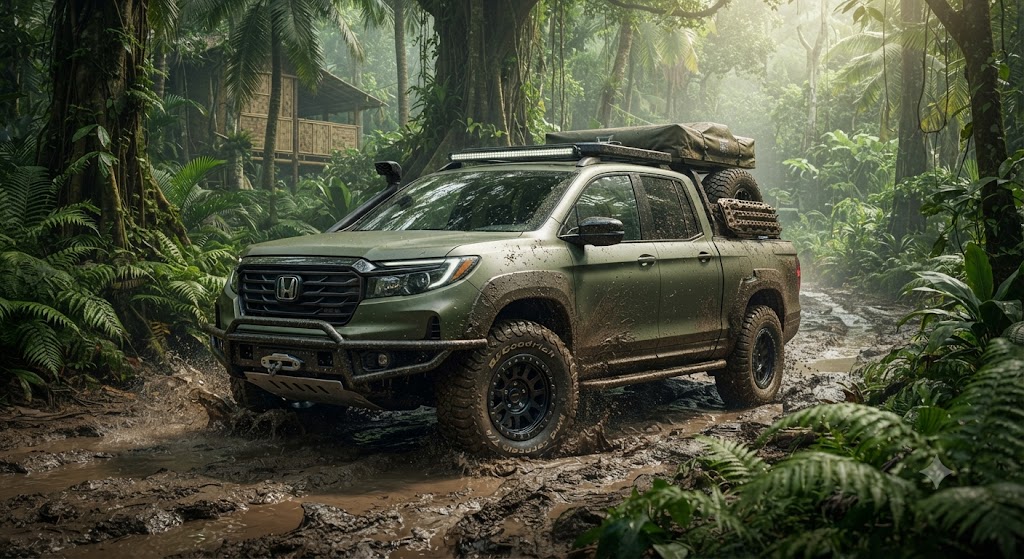
A surprising revelation has emerged from the Japanese automotive press, signaling a major strategic shift for one of the world’s most renowned automakers. According to a recent report by the prominent Japanese newspaper Yomiuri Shimbun, Honda is preparing to dive into the lucrative and highly competitive ladder-frame pickup truck segment. However, instead of engineering a new platform from the ground up, Honda will reportedly rely on a trusted rival-turned-partner: Mitsubishi Motors.
The report indicates that Honda plans to introduce a rebadged version of the formidable Mitsubishi Triton pickup. Targeted for a Southeast Asian rollout in 2028, this move will finally equip Honda with a traditional, rugged workhorse capable of handling demanding off-road conditions and heavy payloads—a critical necessity in markets where their current unibody offerings fall short.
The Triton Connection: Why Mitsubishi?
Developing a ladder-frame chassis from scratch requires an astronomical capital investment and years of rigorous testing. For a company like Honda, which has built its reputation on front-wheel-drive architectures and sophisticated unibody crossovers, pivoting to a body-on-frame truck independently would be a risky and costly endeavor.
This is where Mitsubishi becomes the perfect strategic partner. The Mitsubishi Triton (also known in some markets as the L200) is a legendary nameplate in the midsize pickup segment. Recently redesigned, the Triton features a robust ladder-frame construction—essentially a chassis built on a ladder-shaped skeleton. This architecture provides superior durability, payload capacity, and off-road capability compared to passenger-car-based platforms.
Globally, the Triton is a massive success, with sales reaching approximately 130,000 units in fiscal 2025, making it Mitsubishi’s best-selling model across its entire lineup. It is highly regarded for its proven four-wheel-drive systems, two-speed transfer cases, and torquey turbodiesel engines. By tapping into this existing, highly successful platform, Honda can bypass the lengthy development cycle and immediately offer a credible, full-fledged off-roader to its customer base.
Bridging the Gap: The Southeast Asian Battlefield
To understand why Honda is making this move now, one must look at the dynamics of the Southeast Asian automotive market. In countries like Thailand, Indonesia, and the Philippines, pickup trucks are not just lifestyle vehicles; they are essential tools for agriculture, commerce, and daily life in regions with challenging terrain.
Currently, Honda’s only pickup truck is the Ridgeline. While the Ridgeline is highly praised in the North American market for its car-like ride quality and clever storage solutions, it is fundamentally a unibody vehicle based on the Pilot SUV platform. It lacks the ruggedness, ground clearance, and traditional four-wheel-drive hardware demanded by Southeast Asian, Australian, and New Zealand buyers. Furthermore, the Ridgeline is built in the United States and is only available in left-hand drive, making it entirely unsuitable for these critical overseas markets.
Adding urgency to Honda’s strategy is the rapid influx of Chinese automakers into Southeast Asia. Brands like BYD, GWM (Great Wall Motor), and Geely are aggressively expanding their footprint in the region with heavily subsidized, feature-rich vehicles. Honda is urgently seeking to bolster its sales and protect its market share in these emerging markets. Introducing a genuine, rugged pickup truck under the trusted Honda badge gives the company a powerful new weapon to retain fleet buyers and traditional truck enthusiasts who might otherwise defect to Chinese or established Japanese competitors like Toyota and Isuzu.
The Strategic Alliance: Honda, Nissan, and Mitsubishi
The decision to share the Triton platform is part of a much broader, evolving alliance between three of Japan’s automotive giants. Earlier this year, Honda and Nissan engaged in high-level discussions regarding potential partnerships to combat the rising tide of competition and the shifting EV landscape. While their initial merger talks were abandoned, the companies agreed to explore extensive product-sharing and technological cooperation.
Mitsubishi, which is already part of a deeply integrated alliance with Nissan, naturally entered the fold. This three-way collaboration is designed to maximize economies of scale and optimize factory utilization.
For Mitsubishi, supplying trucks to Honda is a massive financial boon. The Triton is manufactured in Thailand, a global hub for midsize pickup production. Building a rebadged version for Honda will significantly increase utilization rates at Mitsubishi’s Thai facilities, driving down the per-unit cost of the Triton program for both companies.
The cooperation isn’t expected to end with just swapping badges on the tailgate. The Yomiuri Shimbun report notes that Honda and Mitsubishi are weighing the joint development of interior components, such as instrument displays and speedometers, to further reduce costs and differentiate the Honda-branded truck from its Mitsubishi sibling. Furthermore, the companies are considering expanding this OEM supply arrangement to include other vehicle models in the future.
A History of Pragmatic Rebadging
While Honda is fiercely proud of its engineering heritage, the company is not opposed to pragmatic badge-engineering when market conditions demand it. This proposed Triton tie-up echoes several fascinating chapters in Honda’s history.
In the 1990s, as the SUV craze swept across North America, Honda found itself without a rugged utility vehicle in its lineup. To quickly plug this gap, Honda partnered with Isuzu (then affiliated with GM). The result was the Honda Passport (a rebadged Isuzu Rodeo) and the Acura SLX (a rebadged Isuzu Trooper). These vehicles served as successful stopgaps until Honda could develop its own Pilot and MDX models.
Perhaps the most unusual example occurred in Japan, where Honda briefly sold the first-generation Land Rover Discovery as the “Honda Crossroad”. More recently, Honda partnered with General Motors to utilize the Ultium EV platform, resulting in the Honda Prologue and Acura ZDX electric SUVs. The strategy with the Triton follows this established playbook: leverage a partner’s proven platform to rapidly enter a crucial segment while minimizing financial risk.
What to Expect in 2028 and Beyond
If the reports hold true, the Honda-badged Triton will officially debut in 2028, starting with the Association of Southeast Asian Nations (ASEAN) markets. While the initial focus is on Southeast Asia, the vehicle could potentially be exported to other regions where midsize, ladder-frame trucks are popular.
However, American truck enthusiasts should not hold their breath. The “Chicken Tax”—a 25% tariff on imported light trucks—makes it economically unfeasible to import a Thai-built pickup into the United States. If Honda decides to introduce a ladder-frame truck in North America, rumors suggest it might involve a separate arrangement with Nissan to utilize their underused Canton, Mississippi plant, potentially sharing architecture with the next-generation Nissan Frontier.
For now, the focus is squarely on the Eastern hemisphere. The prospect of a Honda-badged, ladder-frame pickup featuring Mitsubishi’s legendary four-wheel-drive prowess is a thrilling development. It proves that in an era of rapid electrification and shifting global alliances, legacy automakers are willing to cross traditional boundaries to deliver exactly what the market demands.
* Conceptual illustration generated using AI