

There is an old, anxiety-inducing parlor trick where a performer balances a massive, over-inflated balloon squarely on the point of a highly sharpened needle. For a few agonizing seconds, the surface tension of the rubber holds. The audience holds its breath, knowing that the slightest shift in air pressure, the tiniest vibration on the table, or a millimeter of miscalculation will result in a violent, catastrophic pop.
As we navigate the final quarter of 2026, this trick is no longer an illusion; it is the exact macroeconomic reality of the United States. The American economy is resting an unprecedented, hyper-inflated $40 trillion debt balloon directly on the razor-sharp needle of global interest rates and bond market volatility.
For years, fiscal hawks have warned about the escalating national debt, often to the collective eye-rolls of politicians who argued that the U.S. dollar’s status as the global reserve currency offered limitless borrowing power. But the math has finally caught up with the hubris. On August 18, 2026, the United States federal government officially crossed the $40 trillion debt threshold for the very first time in its history.
This is not just another staggering number in a ledger; it is an economic tipping point. The speed of this accumulation, the brutal mathematics of compound interest, and the geopolitical crises demanding even more deficit spending have created a scenario where the U.S. economy is sitting on a needle. Here is a comprehensive analysis of how the United States accrued this $40 trillion burden, what the “needle” actually represents, and why the everyday American citizen is the one who will ultimately feel the puncture.
The Exponential Acceleration: Defying Projections
To understand the gravity of the current crisis, one must first grasp the sheer velocity of the borrowing. The national debt is not just growing; it is accelerating exponentially.
According to data compiled by the Joint Economic Committee of the U.S. Congress, the national debt is currently expanding at a mind-bending rate of roughly $90,000 every single second. To put the acceleration into perspective, the Congressional Budget Office (CBO) had previously projected that the U.S. would not breach the $40 trillion mark until fiscal year 2028. We arrived at this grim destination nearly two full years ahead of schedule.
The most recent trillion dollars added to the national credit card took only about five months to accumulate. As of early October 2026, the total gross national debt had reached $40.25 trillion, representing a massive $2.39 trillion increase from exactly one year prior.
To visualize how rapidly the United States has mortgaged its future, observe the historical accumulation below.
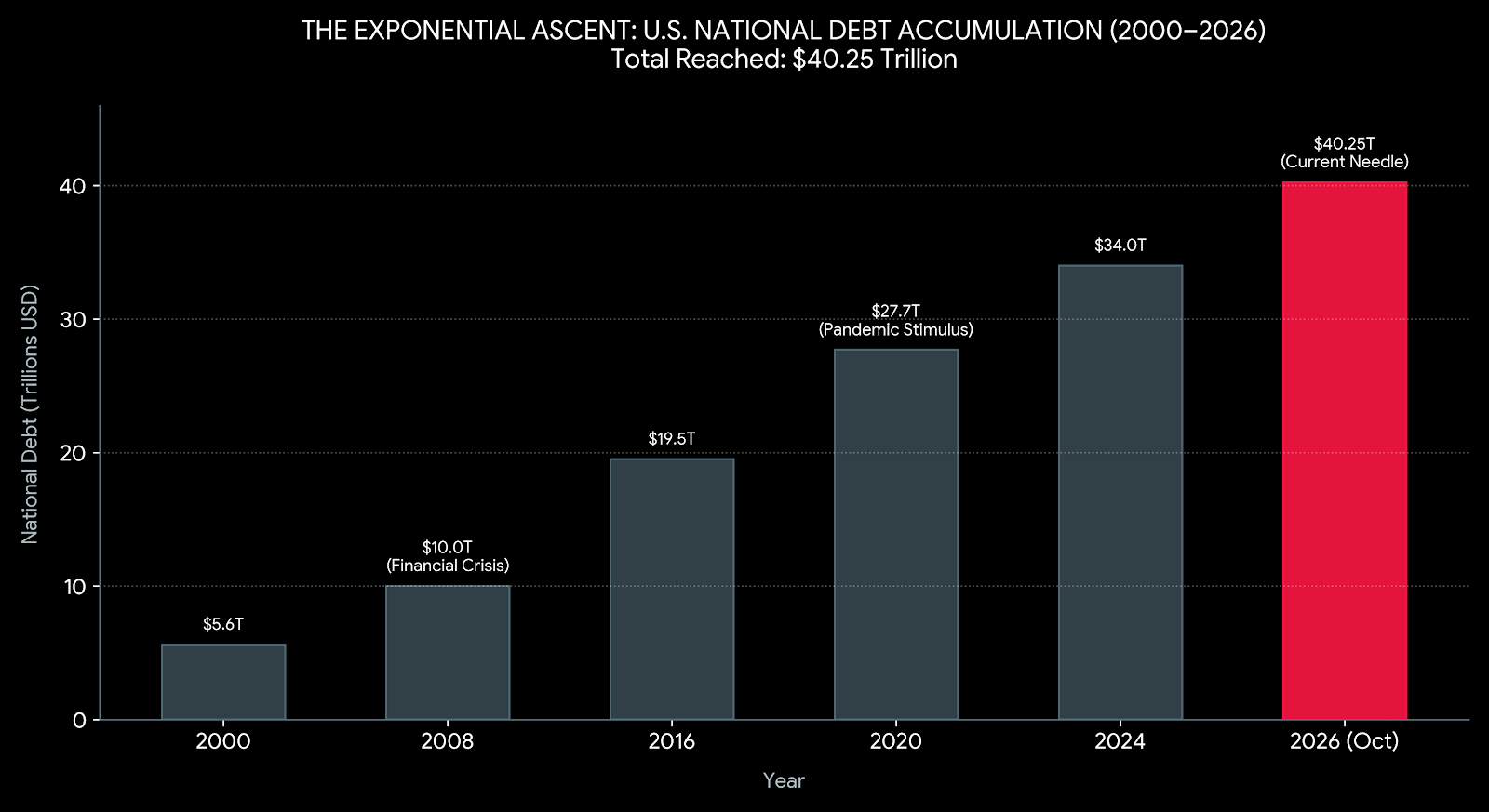
The trajectory of the U.S. National Debt from 2000 to October 2026
The Anatomy of the Balloon: How We Reached $40 Trillion
How does a nation double its debt in a single decade? The $40 trillion balloon is a composite of decades of structural deficits, compounded by a series of massive, once-in-a-generation economic shocks.
Historically, the U.S. debt-to-GDP ratio has spiked during armed conflicts, pandemics, and severe economic recessions, only to decline during periods of peace and prosperity. However, in the 21st century, the U.S. government abandoned the “decline” phase of that historical cycle.
The foundation of this debt surge began with the 2008 financial crisis, which necessitated massive federal bailouts and stimulus packages. This was followed by sweeping tax cuts that significantly reduced federal revenue streams without corresponding cuts in public spending. Then arrived the COVID-19 pandemic, which triggered an unprecedented tsunami of relief spending that permanently altered the baseline of federal expenditures.
Most recently, the acceleration from $34 trillion to $40 trillion has been fueled by the intersection of domestic policy and global warfare. According to the Conference Board, government debt accumulation surged incredibly fast after Congress raised the debt limit by $5 trillion in July 2025. Furthermore, the ongoing dual hot wars in the Middle East and Eastern Europe have forced the Pentagon to burn through billions of dollars in sophisticated munitions, creating an unyielding drain on the federal treasury. Tariff refunds and lingering pandemic aftershocks have also been cited as primary drivers of this late-2026 debt surge.
The Needle: Interest Rates and the Risk of Puncture
If the $40 trillion debt is the balloon, what is the needle? The needle is the cost of servicing this massive obligation.
For the better part of the last two decades, the U.S. government enjoyed a historically anomalous period of near-zero interest rates. Borrowing money was essentially free, masking the true danger of the mounting principal. Today, that era is definitively dead. As the Federal Reserve battled the inflation spikes of the post-pandemic world, interest rates rose to their highest levels in decades.
Currently, the average interest rate on total marketable U.S. debt sits at roughly 3.5%. While that percentage may seem modest to a consumer looking at mortgage rates, when applied to a $40.25 trillion principal, the math becomes apocalyptic. The U.S. government is now spending more on interest payments than it does on critical national programs.
This is the very definition of sitting on a needle. If inflation flares up again—perhaps due to the ongoing energy shocks from the blockade of the Strait of Hormuz—the Federal Reserve may be forced to hold or even raise interest rates. If the yield on government bonds increases further, the federal government’s interest costs will skyrocket.
As the Congressional Budget Office warned, this dynamic poses severe economic risks: a growing portion of national savings is being sucked into purchasing government debt rather than being invested in productive capital, technology, or factories. This “crowding out” effect throttles long-term economic growth and discourages work and innovation.
The Burden on the American Household
The sheer scale of $40 trillion is practically incomprehensible to the human brain, which is why politicians frequently succeed in treating it as an abstract mathematical concept. However, the consequences of this debt are brutally tangible for the average citizen.
When we divide this staggering sum, the gross national debt equates to exactly $298,606 for every single household in the United States.
The American public is paying for this debt in three distinct, painful ways:
1. The Stealth Tax of Inflation: As the national debt-to-GDP ratio currently stands at an alarming 123%, global investors begin to question the fiscal discipline of the United States. To attract buyers for its endless supply of Treasury bonds, the government must offer higher yields, or the Federal Reserve must indirectly monetize the debt. This dynamic inherently decreases the value of the U.S. dollar, which directly contributes to the crushing inflation everyday Americans are currently experiencing at the grocery store and the gas pump.
2. Reduced Public Services: Every dollar the federal government spends servicing the interest on its debt is a dollar that cannot be spent on infrastructure, healthcare, education, or veterans’ benefits. The CBO explicitly notes that rising interest costs will inevitably force severe reductions in essential government programs. The U.S. is slowly transitioning into an entity that primarily exists to pay its past creditors, rather than investing in its future citizens.
3. The Threat of a Fiscal Crisis: The most terrifying risk factor identified by the CBO is the potential for a “sudden fiscal crisis”. This occurs when global investors simply decide that the balloon has expanded too far. If international creditors and domestic funds lose faith in the U.S. government’s ability to manage its 123% debt-to-GDP ratio, they will demand exorbitant interest rates to continue lending. This would trigger a catastrophic default spiral, crashing the value of the dollar and freezing global credit markets.
Conclusion: Backing Away from the Edge
The United States has spent the first quarter of the 21st century living wildly beyond its means, utilizing its status as a global financial hegemon to shield itself from the mathematical laws of economics. The milestone of August 18, 2026, must serve as the final alarm bell.
Sitting on a needle is not a sustainable long-term economic posture. The current strategy of funding structural domestic deficits and multi-trillion-dollar foreign wars entirely through the issuance of new debt is pushing the nation toward a mathematical cliff. Washington’s inability to control its spending has created a $40 trillion vulnerability that enemies abroad and markets at home can plainly see.
To safely step off the needle, the U.S. must undertake politically agonizing reforms. It requires a radical restructuring of entitlement programs, a severe optimization of the defense budget, and a comprehensive overhaul of the tax code to actually align federal revenue with federal outlays. It is a painful prescription, but the alternative—waiting for the $40 trillion balloon to pop—will inflict a level of economic devastation that the United States may never fully recover from.
Impact on the Stock Market | Impact on Individual Retirement Accounts (401ks and IRAs) | The $40 Trillion Shockwave: How the National Debt and High Interest Rates are Quietly Draining Your 401(k) and the Stock Market
* Conceptual illustration generated using AI