
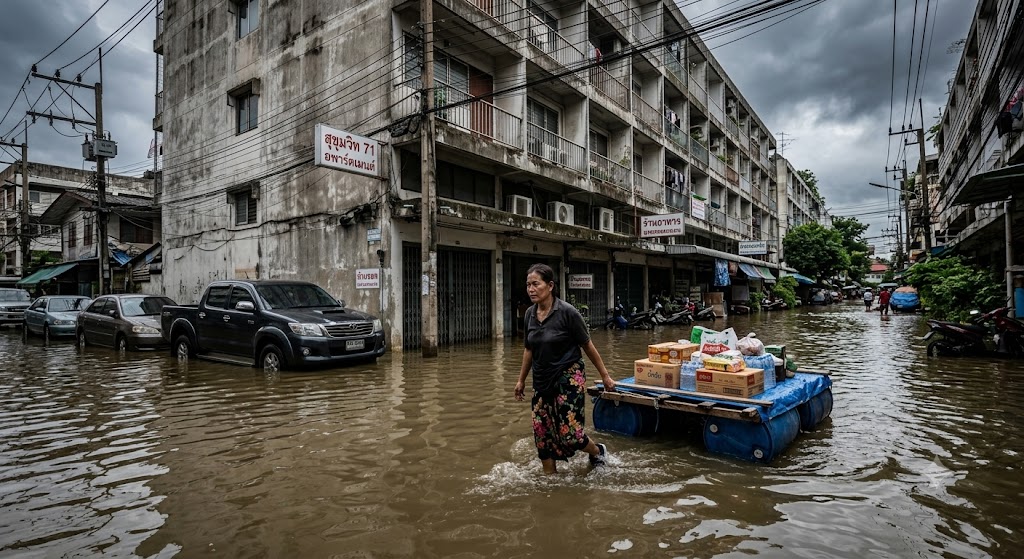
Late September and early October of 2026 will likely be remembered as the moment Bangkok’s historically strained relationship with water finally snapped. The Thai capital, often romanticized as the “Venice of the East,” is currently grappling with a severe, slow-moving catastrophe. Following relentless, torrential downpours, authorities took the extraordinary step of declaring all 50 districts of the city a disaster zone. It is officially the worst flooding to strike Bangkok in 15 years, paralyzing the metropolis and transforming its notoriously congested thoroughfares into stagnant, debris-filled lakes.
With the nationwide death toll rising to 40 people—several due to drowning and accidental electrocution—and property damages surging past the $320 million (฿11 billion) mark, the crisis extends far beyond a typical rainy-season inconvenience. As the floodwaters slowly begin to recede, leaving behind a foul-smelling residue of mud and ruin, Bangkok is being forced to confront a deeply uncomfortable truth: its rapid, concrete-heavy urbanization has stripped the city of its natural defenses.
The Meteorological Perfect Storm
The anatomy of this deluge reveals a staggering volume of water. Between September 16 and 28, central Thailand was battered by an active low-pressure system and tropical depression moving up the Gulf of Thailand. Instead of passing through, the system stalled over the region for days.
The resulting rainfall was biblical. In just three days, Bangkok received approximately 320 millimeters (12.6 inches) of rain. To put that into perspective, that is nearly the total volume of rain the low-lying capital typically receives in the entire month of September, or roughly half a year’s worth of average rainfall in London.
This astronomical deluge from the sky was brutally compounded by factors on the ground. River overflow and significantly higher discharge rates from the Chao Phraya Dam sent torrents of water rushing toward the capital’s eastern districts. Canals swiftly burst their banks, flooding adjacent roadways and trapping millions of residents. In total, the disaster has affected over 3.3 million people across 30 Thai provinces, with Bangkok and its southern neighbor, Samut Prakan, bearing the absolute brunt of the devastation.
Dystopian Scenes in the Concrete Jungle
For the 329,000 households directly affected within Bangkok, daily life has devolved into a surreal, dystopian struggle. Neighborhoods in the eastern part of the capital, such as Lat Krabang and Khlong Sam Wa, have been particularly hard hit.
The 1970s Khlong Chan flat compound in northeast Bangkok has emerged as the defining visual symbol of the disaster. Photos circulating across the country show the residential blocks rising ominously out of brownish, murky water, with the rooftops of parked cars barely visible above the surface. Suleemas Kurangkul, a 73-year-old resident of the compound whose ground-floor stairs remain submerged, described the terrifying speed of the inundation. Unlike the city’s usual evening storms, the rain was constant, “like all day, all night,” she noted, trapping residents before they could safely evacuate. By the time mobile warnings were issued, street-level water was already waist-high.
Human ingenuity and desperation have collided in the flooded streets. Residents have been spotted using blow-up paddling pools and, in one remarkable instance, a floating refrigerator, as makeshift boats to navigate to their homes. The chaos even prompted the arrest of one man who decided to ride a jet ski down a main city road.
As the rain briefly paused later in the week, the immediate threat of drowning gave way to a new, lingering hazard: the stench of the stagnant lakes. “The smell is getting stronger,” Kurangkul reported, pointing to the massive amounts of garbage and debris floating through the residential blocks. Health organizations have also raised urgent indoor air quality alerts, warning that the extreme dampness will inevitably trigger hazardous black mold growth across thousands of waterlogged homes in the coming weeks.
The Paving of the Khlongs
How did a city built on a vast floodplain of the Chao Phraya River become so vulnerable? The answer lies in decades of unchecked urban development.
Historically, Bangkok relied on an intricate, sprawling network of muddy canals—known as khlongs—to naturally drain monsoon waters out to the sea. However, the city’s aggressive economic expansion saw much of this vital canal network filled in and paved over with concrete to make way for roads, shopping malls, and high-rise condominiums.
Today, the megacity relies almost entirely on an artificial, highly strained network of mechanical pumps and dikes. When a severe weather event dumps 300mm of rain in 48 hours, this artificial system simply cannot cope. The concrete prevents the water from absorbing into the earth, turning the city’s vast road network into a series of massive, stagnant retention ponds.
Economic and Logistical Paralysis
The economic ripple effects of the flooding are already proving to be severe. The disaster has triggered massive disruptions across Thailand’s vital manufacturing and tourism sectors.
In the automotive industry, Toyota was forced to shut down operations at four different manufacturing plants on September 30, as flooded roads completely severed their supply chains and prevented the delivery of essential parts.
The aviation sector has fared no better. Suvarnabhumi Airport, located in heavily flooded Samut Prakan, descended into logistical chaos. With flooded roads preventing approximately half of Thai Airways’ workforce from reporting to their shifts, the national carrier was forced to cut 30% of its planned departures from Bangkok. Thousands of flights were canceled, and an estimated 5,600 pieces of luggage were left stranded in the terminal. The operational meltdown was so severe that the board of directors of Thai Airways formally removed the airline’s chief from his post on October 2.
A Grim Glimpse of the Future
Prime Minister Anutin Charnvirakul has established a governmental war room to monitor the crisis, warning that the Bangkok metropolitan area remains at acute risk from massive volumes of floodwater still flowing southward from the northern provinces. With the Thai weather agency forecasting more heavy rain next week, the crisis is far from over.
However, beyond the immediate emergency response, the 2026 floods serve as a chilling preview of the climate reality facing Southeast Asia. Rising sea levels and increasingly erratic, severe monsoon patterns are on a collision course with Bangkok’s sinking, concrete-heavy geography.
For the residents bailing water out of their living rooms, the existential threat is no longer abstract. Chaleerat Chamrasporn, a 55-year-old resident navigating the flooded streets, captured the grim mood perfectly: “It’s a lesson. The kids are into doomsday-themed content, so now they can see what the ‘end of the world’ is actually like, or rather, that this is just the beginning”.
* Conceptual illustration generated using AI